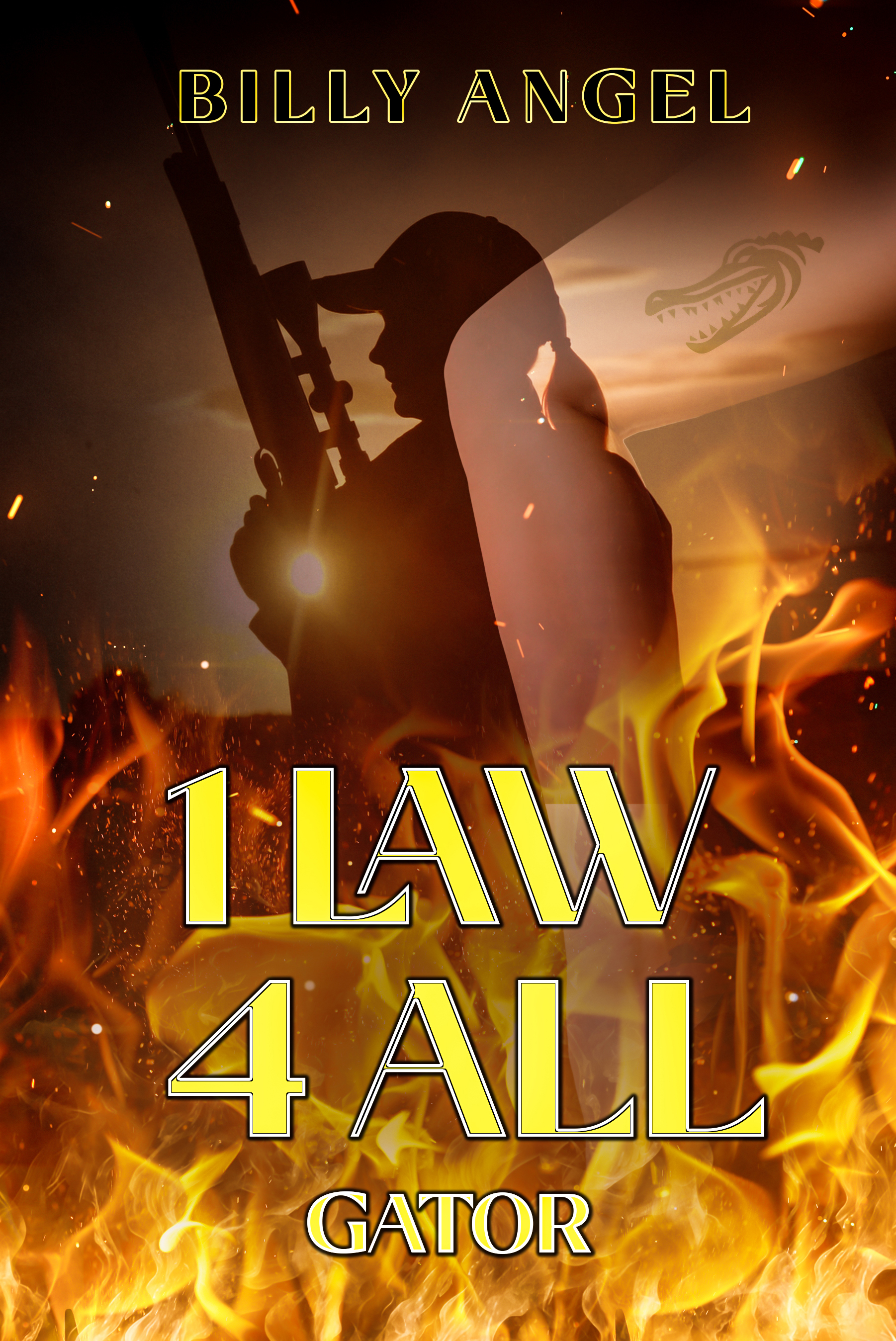
Logline
A Tampa civil-rights attorney must dismantle a century-old globalist election-fraud conspiracy before Florida's votes are stolen — while Italian and Russian mob forces race to control his kidnapped fiancée and the one man who can deliver the tampered machines.
Short synopsis
When election-fraud investigators walk into Tampa attorney Juan Oneca's office warning of nano-particle-rigged voting machines, a Russian hitman follows minutes later — and Juan's fiancée Dominica vanishes from a beach walk the same morning. Kidnapped to coerce her Gambino-connected father into facilitating the machine tampering, Dominica and her cousin are held in a Georgia safe house while Juan's Fair and Free Foundation races across five cities to trace the conspiracy to its source: four aging globalist billionaires known only as The Club, who have spent a century engineering elections and are now targeting Florida.
Extended synopsis
Tampa attorney Juan Oneca has one week until his wedding when Lucy and Sean from the Fair and Free Foundation arrive with evidence of Project Florida — a scheme to affix nano-particle stickers to voting machine monitors during interstate transport, enabling remote WiFi manipulation of tallies statewide. The operation is already in motion, quietly authorized through a legislative rider buried in the Clean Plastics Bill by two corrupt U.S. Representatives, the hardware manufactured in China, the financial pipeline running through a European bancorp called Janewatschild Holdings. Minutes after the meeting, a Russian shooter ambushes the group outside Juan's office. His quick-drawing paralegal Nancy drives the attacker off. Then Dominica disappears.
Dominica Bianca is taken off a morning beach walk by operatives working for Brighton Beach mob captain Hoza Mogilevich, himself serving Moscow crime boss Vladimir 'Tarzan' Solonik, who is contracted by The Club — four ultrawealthy globalists identified only as Mr. North, Mr. South, Mr. East, and Mr. West, playing bridge on a Caribbean island estate. The kidnapping is leverage: Dominica's father Nickolas, a Gambino-connected union boss, controls the delivery drivers hauling the voting machines. The Club needs those drivers blind. Dominica's cousin Annie tracks her north via a GPS chip hidden beneath a matching gator tattoo — and is captured before she crosses into Georgia.
The Foundation mobilizes nationally. In Las Vegas, operative Jimmy Kohl neutralizes a Russian surveillance team. In San Francisco, Mac Streeter survives a black SUV forcing him toward a cliff. In Washington, Carol Finley and Kitiona Tuafa, working with a political blogger and a congressional aide, follow campaign contribution records back through corrupt legislators to Janewatschild Holdings, mapping the full financial architecture of The Club's American operation. Meanwhile, Fair and Free field teams document nine separate truck break-ins on video — operatives posing as hitchhikers boarding Nickolas's union rigs and applying the tampered stickers — building the evidentiary foundation for legal and political action.
The hostage situation fractures violently when the three Russian soldiers holding Dominica and Annie in a St. Simons Island safe house go rogue, demanding a ten-million-dollar ransom that contradicts Hoza's original arrangement with Nickolas. To prove the threat is real, the gang's Sur 13 enforcer carves a piece of tattooed skin from Annie's thigh and ships it to Nickolas. The act transforms a political conspiracy into a personal war. Nickolas and his brother Frank activate Gambino and Calabrian contacts for a hard extraction, while the competing demands from Moscow, The Club, and the freelancing kidnappers create a volatile, three-way pressure cooker in coastal Georgia.
The finale runs on two simultaneous tracks. Juan's Foundation, armed with video evidence of the truck tampering and a fully traced financial network linking The Club to American legislators, pushes toward legal exposure and machine invalidation before Florida's election. Simultaneously, Nickolas's mob forces close on St. Simons Island for a direct confrontation with the Russian crew. The book earns its title across both tracks: one law, applied equally — whether the defendant is a billionaire globalist playing bridge on a private island or a Russian soldier who cut the wrong woman.
Why it adapts
The visual architecture is already built: the opening sequence writes itself — a beachside Florida morning, an unlocked car, keys still in the ignition, a phone on the seat. No body. No note. That image is a poster. From there the series has a genuine setpiece engine: a daytime gunfight outside a Tampa law office, a black SUV pushing a man toward a Pacific cliff, the carve-and-ship act of brutality in the Georgia safe house, and four old men playing bridge on a Caribbean island who are quietly deciding an American election. The Club as visual antagonists are especially valuable — they are the banality of evil made literal, patrician and unhurried, and every scene with them functions as ironic counterpoint to the violence they set in motion from a distance.
The ensemble is the series' other commercial asset. Juan is a specific kind of hero — a civil-litigator, not a spy or a cop, which creates constant procedural tension because his most powerful weapons are depositions, injunctions, and financial discovery rather than firearms. Nancy the quick-drawing paralegal, Annie with her gator-tattoo GPS chip, Nickolas navigating the line between protecting his daughter and protecting his criminal alliances — these are not stock roles. They are characters with visual distinctiveness, conflicting loyalties, and room to develop across six hours. The mob-rescue track and the legal-exposure track are tonally distinct enough to create genuine variety within episodes while building toward a unified climax, which is the structural hallmark of prestige limited-series television.
Format recommendation
Limited Series
The material carries five distinct geographic storylines running in parallel, a large ensemble of named operatives, and a conspiracy architecture that requires four to six hours to unfold without gutting its procedural credibility. A feature would collapse the Foundation's multi-city operation into montage and lose the mob-versus-Russian showdown as a subplot. Six episodes allows each city thread to breathe, builds The Club as a slow-burn antagonist, and positions a season-two runway through The Club's surviving members.
Comp titles
Jack Ryan (Amazon, Seasons 3-4)
Same blend of procedural political conspiracy, multi-continent geography, a protagonist operating in legal-institutional space while field operatives work the dirty end, and a shadow organization of ultrawealthy power brokers pulling strings above nation-state actors.
The Night Of
Demonstrates the premium-cable appetite for legal procedural drama grounded in specific cultural communities — here, Tampa's Latin legal world and the Italian-American organized crime ecosystem replace Naz's milieu, but the tonal seriousness and moral weight are identical.
ZeroZeroZero
Multi-city, multi-faction thriller with organized crime families and international criminal networks converging on a single operational objective — the same structural DNA as the mob-versus-Russian hostage track running alongside Juan's legal campaign.
Designated Survivor
Shares the core audience: viewers who want election/political conspiracy stakes made viscerally personal through a protagonist with an institutional day job forced into extraordinary action. Also comparable network or streamer home.
The Irishman meets Homeland
Captures the tonal split the series must sustain — Scorsese-grade organized crime family loyalty and violence on one track, Carrie Mathison-style intelligence procedural and political exposure on the other, both converging on the same week.
Audience
Adults 35-60 who watch political thrillers and prestige crime drama — the Jack Ryan, Ozark, and Designated Survivor audience. Secondary demo: 25-35 cord-cutters drawn to ensemble procedurals with ideological stakes (Succession, The Diplomat). Strong appeal to viewers in battleground states with existing anxiety around election security, and to the organized crime drama fanbase that followed The Many Saints of Newark and ZeroZeroZero.
Tone
propulsive
politically urgent
morally layered
ensemble-driven
sun-drenched noir
conspiratorial