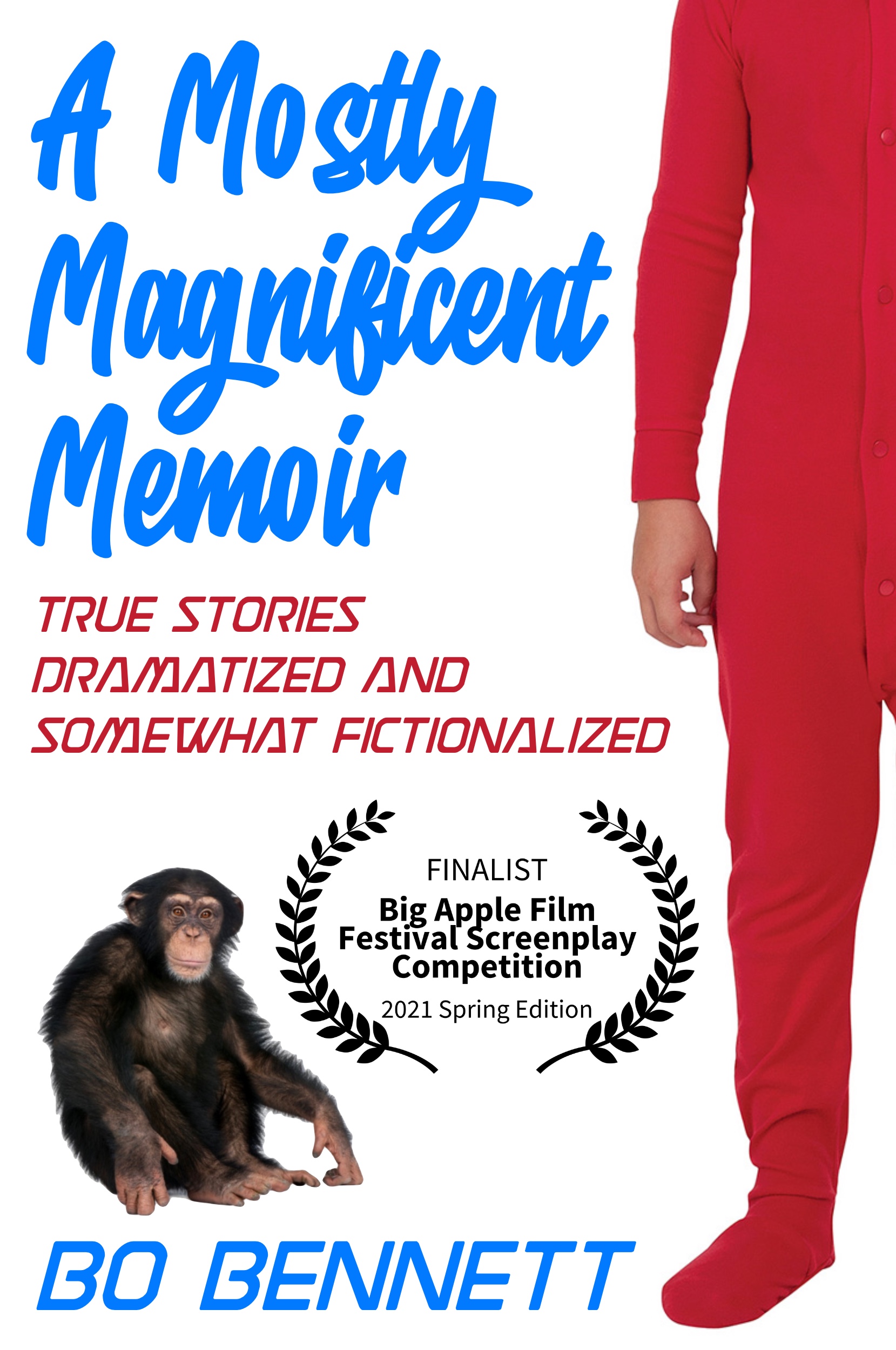
A Mostly Magnificent Memoir: True Stories Dramatized and Somewhat Fictionalized
by Bo Bennett · 2025 · 160 pages
Terminally ill James Murphy gathers loved ones to deliver his life's eulogy, framing a darkly comedic coming-of-age story of surviving a chaotic, alcoholic household in 1970s-80s Connecticut.
Synopsis
AI Pitch Package
For producers, scouts & managers
Logline
Dying at 48, James Murphy gathers his family for one last eulogy speech, forcing him to reckon with the chaotic, alcohol-soaked Connecticut childhood that made him who he is — before he runs out of time to say it right.
Short synopsis
Terminally ill James Murphy returns to his childhood home to prepare a final address to everyone he loves. The visit unlocks a lifetime of memories: growing up under the boozy, combustible reign of his parents Fred and Delores, hustling his way through a working-class Connecticut town, surviving teenage arson schemes and heartbreak, and learning early that the truth and a good story rarely match. Framed by his terminal diagnosis and closing eulogy, James' coming-of-age is raucous, self-destructive, and tender by turns — a portrait of a family that never said 'I love you' but never stopped proving it in their own chaotic way.
Extended synopsis
Why it adapts
The eulogy framing device gives the sprawling anecdotal memoir a clean three-act container: present-day diagnosis, extended flashback coming-of-age, and a return to the frame for a cathartic final speech — the same structure that makes Big Fish and The Fabelmans work as single films rather than series. The material is vignette-heavy but unified by one voice and one emotional throughline (mortality forcing honesty), which favors a tight 100-110 minute feature over an ongoing series that would dilute the eulogy's stakes.
Adult audiences 30-65 who gravitate toward bittersweet, R-rated memoir dramedies — viewers of The Tender Bar, The Fabelmans, and This Is Where I Leave You, plus readers of misery-adjacent-but-funny memoirs (Augusten Burroughs, David Sedaris) looking for a theatrical or awards-season adult drama rather than IP-driven tentpole fare.
Adaptation Readiness Score
75 / 100
- The 'dying man delivers his own eulogy' frame is a genuinely poster-worthy hook — it gives an episodic childhood memoir an urgent, emotional spine and a built-in reason to flash back
- A string of vivid, specific, highly filmable set pieces (the perm disaster, the baseball card empire, the gasoline-fire 'seek and destroy' scheme, the prom betrayal) that read like they're already storyboarded
- A colorful, castable ensemble — boozy, larger-than-life parents; a UFO-obsessed mother; loyal siblings — in the vein of successful dysfunctional-family dramedies
- The material spans roughly two decades of loosely connected vignettes; a feature will need a tighter central through-line (a relationship, a wound, a countdown) to avoid feeling like a clip-reel of anecdotes
- Tonal balance between raucous comedy and terminal-illness framing is delicate — without careful modulation it risks whiplash or feeling manipulative rather than earned
- Large supporting cast (parents, siblings, friends, girlfriends) will need consolidation/composite characters to fit a 100-120 page screenplay
- Threadlight: Book One of the Old Roads by Demo Author
- THELUCKIEST DEAD MAN ALIVE by Richard Green
- Music from the Heart: Symphony of Evolution by Zirva Safarov
- فراس by SHADI ZIAD