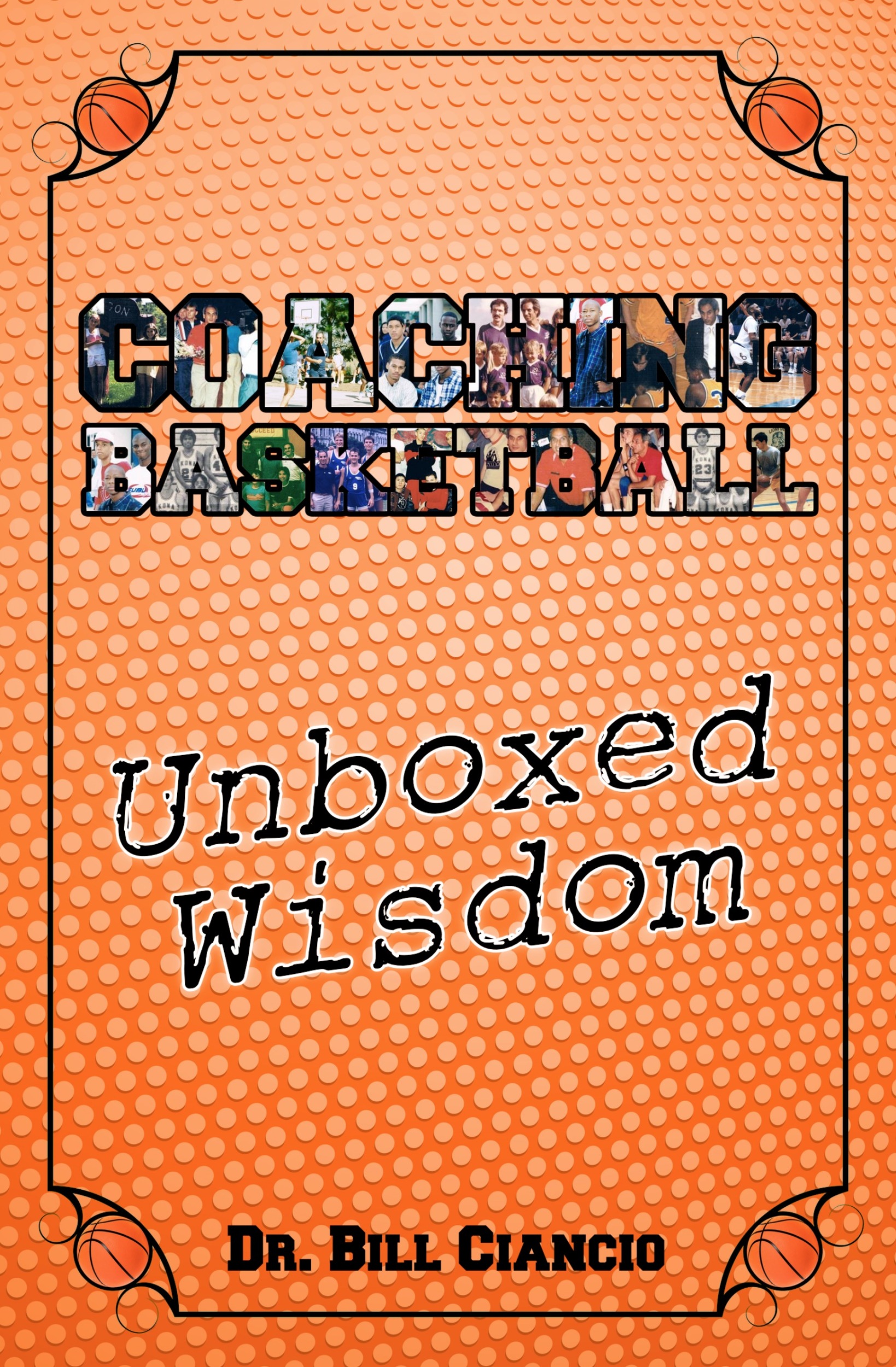
Coaching Basketball: Unboxed Wisdom cover
Documentary / Non-Fiction Documentary Series

Coaching Basketball: Unboxed Wisdom

by Dr. Bill Ciancio · 180 pages

Logline

A veteran basketball coach with nearly six decades of experience shares his hard-won philosophy on building winning teams, developing young players, and finding wisdom beyond the scoreboard.

Synopsis

Dr. Bill Ciancio begins his journey as a naturally gifted cherry-picker on Chicago playgrounds, discovering that anticipation and speed could manufacture easy baskets. A parish priest nurtures his early coaching instincts, and by college Ciancio is already leading CYO teams. His formal coaching career, however, brings hard lessons: assuming that educational institutions reward innovation gets him fired multiple times, and his early authoritarian persona—demanding perfection, never smiling—proves unsustainable and inauthentic. These failures force him to question not just his tactics but his fundamental reasons for coaching. The book's philosophical core emerges as Ciancio reads voraciously—over 100 basketball texts plus parenting books like Dorothy Briggs's Your Child's Self-Esteem—and attends Final Fours throughout the 1980s, meeting greats like Valvano, Wooden, and Al McGuire. Each mentor contributes a piece to his evolving system: Wooden's 1-to-10 instruction ratio, Valvano's improvisational defenses, McGuire's 'sting' trapping philosophy, and Paul Westhead's relentless full-court repetition. Ciancio synthesizes these into 'Billy Ball'—a high-tempo, disruption-based, transition-first style built on habits rather than rigid plays. Ciancio's deepest growth comes from single parenthood and the parenting principles he applies to coaching. Shifting from ego-driven to encouragement-driven, he develops a team culture rooted in Briggs's seven principles—genuine encounter, trust, empathy, and others—and codifies his standards as simply 'Play Hard, Play Together, Have Fun.' His most celebrated team starts four sophomores to an 7-18 record, then builds to 30-4 two years later, losing only to the eventual CIF and state champion. The story demonstrates that sustained player development outperforms short-term talent acquisition. Practical chapters cover year-round planning, in-season practice design, conditioning through competition rather than punishment runs, game management, playoff psychology, and media relations. Ciancio argues that officials deserve respect, social media demands caution, and press coverage is a double-edged sword best managed with transparency and humility. His 'ICE' philosophy—teaching players to respond rather than react to provocation—reflects a broader conviction that coaches shape citizens, not just athletes. The book closes with a defining moment: during a blowout win, a sophomore tells Ciancio, 'Coach, let the peacocks fly,' signaling that the players have internalized the system and no longer need micromanagement. Ciancio accepts this as the ultimate coaching achievement—a team so well-taught it can self-direct. He urges coaches to develop a Growth Mindset, trust their preparation, and find satisfaction not in trophies but in the lasting impact on players who go on to become coaches, graduates, and contributing members of society.

AI Pitch Package

For producers, scouts & managers

Logline

Over six decades on hardwood floors and Chicago playgrounds, a fired-and-rehired basketball coach dismantles his own ego to build a system that turns teenagers into self-directing athletes and citizens.

Short synopsis

Dr. Bill Ciancio's coaching life reads like a blueprint for failure that somehow produces mastery. Fired repeatedly for being ahead of his time, he rebuilt himself by reading parenting books alongside basketball texts, shadowing legends like John Wooden and Jim Valvano, and applying child-development psychology to practice design. The result was 'Billy Ball'—a high-tempo, disruption-first system codified around three rules: Play Hard, Play Together, Have Fun. His signature achievement: a team that started 7-18 with four sophomores and finished 30-4 two years later, losing only to the eventual state champion.

Extended synopsis
Bill Ciancio grows up on Chicago's playground basketball circuit, where he discovers that anticipating the game—reading passes before they're thrown, positioning before the shot—gives a physically ordinary kid an edge. A parish priest spots his instincts and channels them toward coaching. By college, Ciancio is running CYO programs. He enters institutional coaching convinced that smart ideas earn their own reward. They don't. He gets fired. Then fired again. Each termination is a data point he eventually learns to read correctly. The turnaround begins in libraries and gyms simultaneously. Ciancio attends Final Fours through the 1980s, gaining access to coaches who are operating at the sport's highest levels. Wooden gives him the 1-to-10 instruction ratio—one correction for every ten affirmations. Valvano gives him improvisational defense. Al McGuire gives him the 'sting' trap. Paul Westhead gives him the repetition doctrine that burns habits into muscle memory. But the most transformative text isn't a basketball book—it's Dorothy Briggs's Your Child's Self-Esteem, which rewires how Ciancio understands the relationship between authority and development. Single parenthood accelerates the transformation. Raising children alone forces Ciancio to live the principles he'd been reading about—genuine encounter, empathy, trust—and he begins applying them to his locker room. The authoritarian who never smiled becomes a builder of psychological safety. The shift isn't soft; it's strategic. Players who feel seen take more risks, recover faster from failure, and police each other's effort without being asked. The culminating sequence—four sophomores, an ugly 7-18 first season, then a systematic climb to 30-4—functions as proof of concept for everything Ciancio has built. The team loses in the postseason only to the eventual CIF and state champion. More telling than the record is a single moment during a blowout win when a sophomore tells Ciancio to 'let the peacocks fly,' signaling that the players have internalized the system completely. Ciancio steps back. That moment, he argues, is the only trophy that matters. The book's final argument—that coaches are in the citizenship business, not the scoreboard business—lands with specific weight because Ciancio earns it through documented failure, documented reinvention, and documented results. The alumni network he leaves behind includes coaches, graduates, and community contributors who trace their formation directly to three rules and a man who learned, late and painfully, to stop coaching for himself.
Why it adapts
The visual opportunities are specific and plentiful. Chicago playground basketball in the 1960s and 70s is a documented cultural world—there is existing archival footage, photographic records, and a network of surviving participants. The 1980s Final Four sequences offer the chance to build episodes around legendary coaches who are already part of sports documentary canon: Wooden's famously spare practices, Valvano's manic energy, McGuire's New York street-philosopher persona. These figures function as guest-star episodes within the larger arc, giving the series marquee moments that can be cut into trailers. Ciancio himself is a distinctive on-camera subject—a self-described failure who accumulated enough specific, nameable wisdom to produce a 30-4 season. That tension between humility and expertise is camera-ready. The 'let the peacocks fly' moment is a poster image: a coach stepping back on the sideline during a blowout, arms folded, watching his players run the system without him. The visual language of restraint is more powerful than celebration. The series also has a built-in structural device: each episode can open with a 'Billy Ball' principle stated plainly, then demonstrate how Ciancio learned it the hard way. Marketability lives in the authenticity gap. At a moment when sports content is dominated by nine-figure contracts and celebrity coaches, Ciancio's career at the high school and small-college level is genuinely counterprogramming. Parents watching their kids play youth basketball are not looking for NBA mythology—they want to understand what good coaching actually looks like at the level they can see. This series meets them there, with receipts.
Format recommendation
Documentary Series

The material is inherently episodic—distinct coaching eras, named mentors, a pedagogical evolution across decades—and benefits from the visual texture that only archival footage, court-side access, and talking-head interviews with former players can provide. A feature documentary compresses too much; the philosophical arc requires room to breathe across four to six episodes, each anchored to a specific phase of Ciancio's evolution. The format also allows practical coaching content to serve as structural tissue between narrative beats, giving the series genuine utility for the coaching and sports-education audience.

Comp titles
The Scheme (HBO, 2020)
Demonstrates that mid-level basketball coaching careers—outside the NBA and blue-chip programs—can sustain a compelling documentary when the central figure has a strong ideological point of view and a paper trail of consequences.
Last Chance U (Netflix, 2016-2020)
Closest structural analog: a coach with an unorthodox philosophy operating outside elite visibility, where player development and personal formation are inseparable from wins and losses. Same audience, same emotional register.
Earn Everything (Amazon/NFL Films, 2023)
Shows that sports-philosophy content built around a coaching voice—rather than celebrity athletes—can find a dedicated streaming audience when the methodology is concrete and the stakes are human.
The Playbook (Netflix, 2020)
Direct format comp: a docuseries in which coaches articulate their personal rules for competition and life, exactly the architecture Ciancio's material supports across multiple episodes.
Cheer (Netflix, 2020)
Proves that small-program, non-professional sports docs break through when the coach-athlete relationship is emotionally specific and the underdog trajectory is earned rather than manufactured.
Audience

Primary: male sports fans 35-65 who grew up playing organized basketball or coaching youth and high school programs—the audience that sustains shows like The Playbook, Last Chance U, and 30 for 30 on ESPN+. Secondary: educators, youth coaches, and parents of athletes who consume sports-adjacent self-improvement content. Tertiary: Chicago regional audience with nostalgia investment and a market for local sports documentaries. The coaching-methodology layer gives the series crossover potential to the professional development and leadership content space currently dominated by podcasts.

Tone
intimate hard-won philosophical underdog instructional character-driven

Adaptation Readiness Score

72 / 100

Visual storytelling 70
Dialogue strength 65
Character distinctiveness 75
Hook strength 68
Format fit 78
Market timing 74
Strengths
  • The underdog arc — four sophomores going 7-18 then building to 30-4 — is a proven cinematic engine with natural episodic structure perfect for a documentary series
  • Ciancio's mentor constellation (Wooden, Valvano, McGuire) gives the series access to basketball royalty and built-in archival footage opportunities that money can't easily manufacture
  • The personal-meets-professional throughline of single parenthood reshaping his coaching philosophy gives the series emotional depth and a human hook beyond X's and O's
Adaptation friction
  • The book's structure leans instructional and philosophical rather than narrative-driven — a development pass needs to identify the specific seasons, games, and players that become the spine of each episode
  • Secondary characters (the players, assistant coaches, rivals) are underdeveloped as distinct screen presences; the series needs recurring faces audiences can invest in across episodes
  • The 'wisdom manual' framing competes with dramatic tension — the series will need to foreground conflict, setback, and stakes in each episode rather than arriving at lessons too cleanly

Listed on 2026-06-16
Back to directory