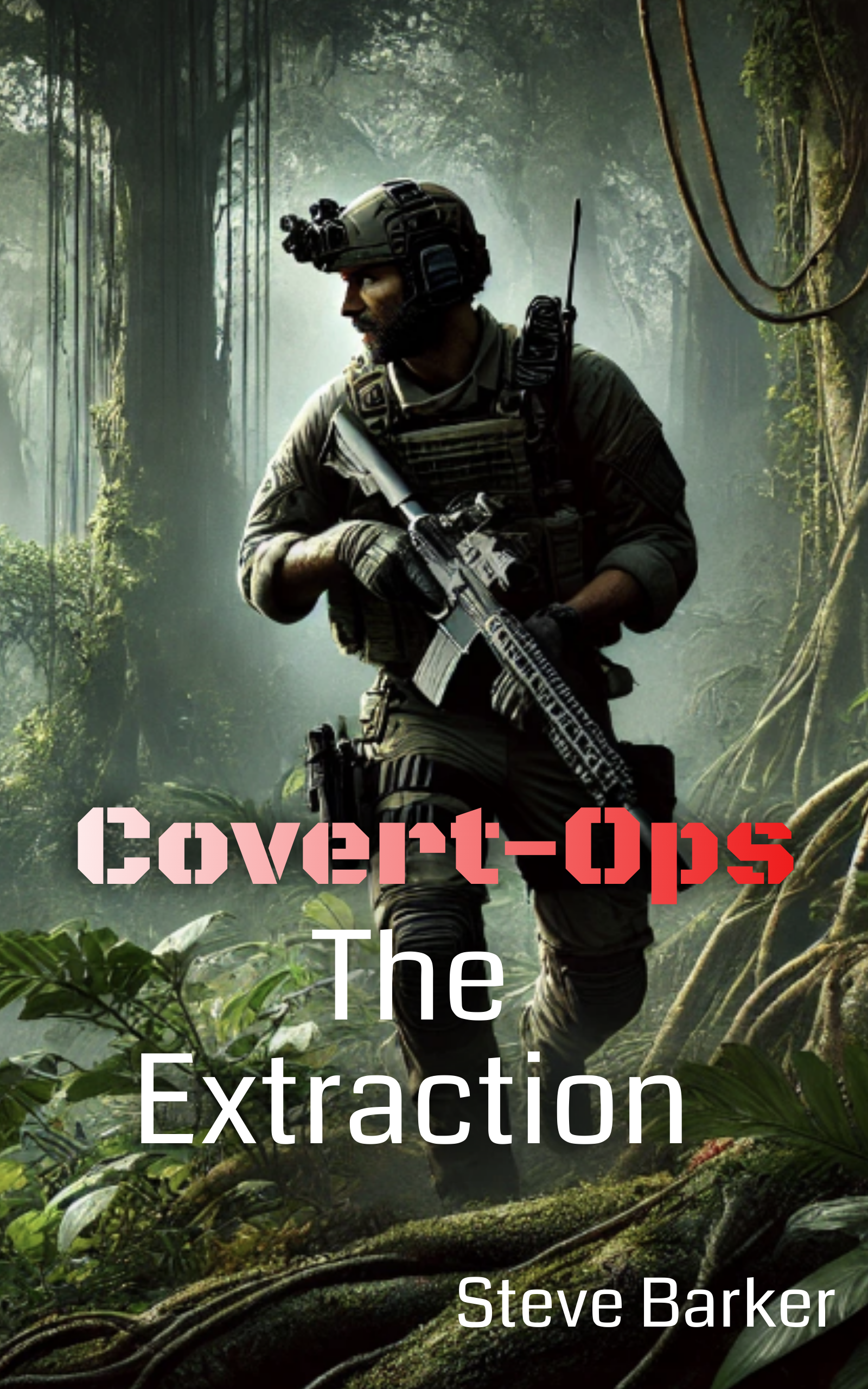
Logline
When a corrupt customs official entraps two young people for a Caribbean cartel, PTSD-scarred ex-British soldier Steve Barker and his team have days to storm a jungle compound guarded by six ex-special-forces killers before the prisoners are executed.
Short synopsis
Steve Barker, a sardonic, PTSD-afflicted ex-British soldier, steps off a Caribbean cruise in San Juan with his partner Lucy. Their holiday cover is paper-thin: Steve has already killed a man on deck with a spoon. A fixer called Bear hires the team to extract two hostages, American James Rapson and Peruvian Ana Martinez, who were entrapped by a corrupt customs official and are now held for ransom by a cartel on the island of Saint Ann. A warehouse arms deal turns into a firefight, and a blue-striped envelope suggests a criminal network is already tracking them. The team inserts by helicopter into the rainforest, with the cartel's boss, his enforcer and six ex-special-forces bodyguards waiting at the camp.
Extended synopsis
Steve Barker and Lucy arrive in San Juan posing as cruise tourists. Steve has already killed a man on the ship's deck with a spoon, which establishes both his skills and the damage behind them. They meet teammates Simon, Derek and George, then meet Bear, a well-connected fixer, at Fort Castillo San Cristobal. Bear explains the job. James Rapson and Ana Martinez were set up by a corrupt customs official and sold to a drug cartel in the rainforest of Saint Ann. The fee is one million dollars, half up front, and the window is short.
The team recces the fort for ambush points, then splits across Old San Juan to buy weapons, comms gear and jungle clothing. The night-time arms deal in a derelict warehouse becomes a firefight. Steve and Lucy kill two attackers, and the team executes a third outside. The dealer escapes with part of their cash, but the weapons are theirs. A blue-striped envelope on one of the dead men links the ambush to a criminal network from a previous mission on Saint Halb, so the team assumes the boat transport is compromised and the cartel is already ahead of them. They hire ex-Army Air Corps pilot Butch and his Eurocopter Dolphin for a dawn insertion.
Saint Ann is hostile from the first step. The team crosses dense rainforest, meets a jaguar, rigs a vine rope across a flooded river and survives a robbery attempt in the village of Barble. In the rundown town of Hyde, local source Tennille confirms the hostages are alive. She also warns that cartel boss Aron has arrived with six ex-special-forces bodyguards and plans to relocate within two weeks. Cross-cut with this, the camp shows what the hostages face. James, Ana, Eliza and Ralf have spent two months in a lightless bamboo cell on minimal food. Aron and his enforcer Ryan execute a debtor in front of them and load a drug shipment onto a truck.
Back in Hyde, three cartel scouts ambush the team as it retrieves its stashed weapons. Steve, Derek and George kill two, and a sniper shot saves Lucy from the third. A camp-layout sketch on a dead scout confirms the target and shortens the clock. With their cover partly blown, Steve leads the team on a direct jungle route to the abandoned house Tennille marked as a staging point, two kilometres from the compound. The plan is to hit before Aron moves or kills the prisoners. George and Lucy take sniper positions, Derek runs comms, and Steve and Simon make the close-quarters assault to bring out James, Ana, Eliza and Ralf and return them alive to San Juan. The source material builds to this assault, so the series will need to design and dramatize the full climax and aftermath.
Why it adapts
The material is built from distinct, poster-ready set pieces: a spoon kill on a cruise deck, a firefight in a derelict Old San Juan warehouse, a dawn helicopter insertion with a teammate kicked out of the door, a jaguar encounter, a vine-rope river crossing, a street ambush in Hyde, and a night assault on a jungle compound. The settings shift from colonial fort to cruise ship to rainforest to ramshackle town, which gives a limited series built-in visual variety and a strong sense of place at manageable scale. The ticking clock (a two-week relocation deadline and the threat of execution) provides forward momentum across episodes.
The ensemble is the commercial hook. Steve is a sardonic, PTSD-afflicted operator, and the spoon kill tells you who he is in the first scene. Lucy is a full partner who gets sniper work and her own near-death moment. Simon, Derek and George give the team distinct roles. On the other side, Aron, his enforcer Ryan and six ex-special-forces bodyguards are credible, professional antagonists. The hostages Eliza and Ralf, along with James and Ana, give the stakes a human cost, and the lightless bamboo cell gives the cartel storyline its own dread.
The main development work is deepening character and tightening moral clarity. The source treats the team's execution of a captured attacker casually, and a streaming audience will need that handled deliberately, either as a character-defining choice for Steve or as a consequence that returns later. The hostage and cartel storylines need to grow into full parallel threads, and the Saint Halb network and the blue-striped envelope offer a ready-made mythology for a second season. The source stops before the assault, so the writers' room must build the climax and aftermath. The package is pitchable as a contained, muscular, six-hour action-thriller with franchise potential.
Format recommendation
Limited Series
The story is a clean mission structure (recruitment, procurement, insertion, jungle trek, recon, assault) with distinct locations and escalating set pieces, which suits a tight 6-episode run. At 180 pages, and with the source stopping at the staging point, it would be thin for a feature. A limited series gives room to build out the hostage storyline, the cartel and the team's backstory. The author's format choice holds up, provided the hostage and cartel material is expanded substantially.
Comp titles
Extraction (2020)
Same core promise: a deniable team goes into hostile territory to pull out a captive against a ticking clock, with practical, high-volume action.
SAS Rogue Heroes
British military irreverence, a sardonic ensemble of dangerous men and women, and violence played with dark humor.
Black Doves
A British, tonally dry couple of operatives whose relationship is part of the engine, with sharp banter between bursts of violence.
The Ministry of Ungentlemanly Warfare
A small, specialized team on a deniable mission, with a roguish tone and a clear three-act raid structure.
Audience
Adults 18-54, skewing male but with a real crossover audience through the Steve/Lucy partnership. These viewers watch action-thriller streaming hits like Extraction, Jack Ryan, Gangs of London, SAS Rogue Heroes and Special Ops: Lioness. They respond to team-based military action, international locations and British-flavored dry wit.
Tone
gritty
propulsive
sardonic
sweaty
ensemble-driven
ticking-clock