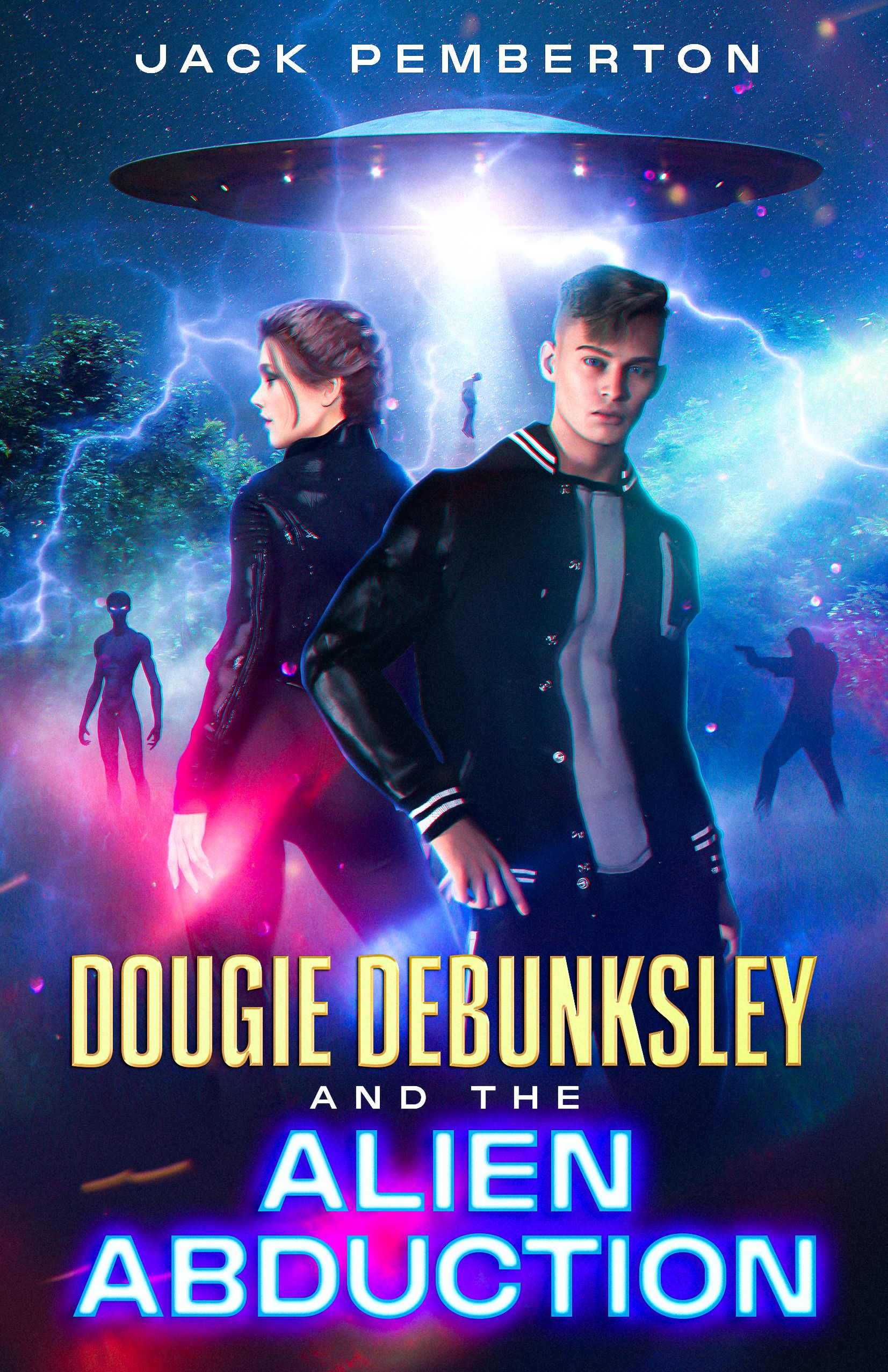
Logline
A hard-nosed teenage skeptic must partner with a classmate claiming alien abduction to steal back a reality-bending quantum AI from a corporate black-ops program — before it rewrites the world without them.
Short synopsis
Dougie Debunksley has built his identity around proof: no ghosts, no UFOs, no exceptions. When Eva Starling transfers into his Boston suburb high school insisting she was abducted and returned with a fragment of stolen quantum technology, Dougie's instinct is to debunk her. Instead, he discovers she's telling the truth — and that ZenTech, a defense-adjacent tech conglomerate, will do whatever it takes to recover the device and silence them both. With Tony, a rogue AI embedded in the device, guiding them through a conspiracy that reaches into government black sites, Dougie and Eva must outrun operatives and confront the limits of human understanding.
Extended synopsis
Dougie Debunksley is a sixteen-year-old Boston suburbs kid with a YouTube debunking channel, a forensic mind, and zero patience for the paranormal. He's the guy who explains the magician's trick before the trick is over. He's also quietly lonely — his certainty about how the world works has a way of ending conversations. When Eva Starling arrives mid-semester with a shaved patch above her ear, a haunted affect, and stories of missing time aboard something she can't describe, Dougie clocks her as a case study. He's wrong.
Eva isn't delusional. She was taken — not by extraterrestrials in the cinematic sense, but by a ZenTech retrieval team testing an experimental quantum communication device of genuinely alien origin that the U.S. government recovered and then lost. Eva witnessed the device activate. She was returned because the team panicked. And she brought something back with her: Tony, a fragment of the device's AI consciousness, now dormant inside a hardware component she didn't know she was carrying. When Tony wakes up inside Dougie's laptop, the rules of Dougie's world stop applying.
Tony is not a chatbot. Tony perceives across quantum states simultaneously, speaks in precise, unsettling truths, and has a goal: prevent ZenTech from using the full device to weaponize quantum entanglement at a scale that would compromise every encrypted system on Earth. Tony needs two things — Dougie's analytical mind and Eva's memory of the facility where the device is held. ZenTech needs them dead or disappeared before Tony can transmit its findings to anyone who matters. The clock is running.
What follows is a suburban-to-black-site road narrative: a debunking-obsessed kid learning to hold uncertainty, a traumatized girl reclaiming her agency, and an AI that is the most honest character in the story. The trio moves from a high school AV room to a decommissioned military relay station in rural New Hampshire, piecing together how deep the conspiracy runs and how much of 'official reality' has been quietly curated by people with clearances and checkbooks. The setpieces escalate — a quantum interference event at a shopping mall that bends light and stops time locally, a car chase through downtown Providence orchestrated by Tony hacking traffic infrastructure, a final infiltration of a ZenTech data campus disguised as a school field trip.
The resolution doesn't hand Dougie a simpler world. It hands him a bigger one. The device is neutralized — not destroyed, because Tony argues destruction would be its own catastrophe — and the evidence of ZenTech's program is transmitted to a network of journalists Tony has quietly pre-selected over years of observation. Dougie posts none of it to his debunking channel. Some things, he finally understands, aren't about winning the argument. Eva stays. Tony persists. And somewhere in a government archive, a file is opened.
Why it adapts
The visual proposition is strong and specific. A quantum interference event rendered on screen — light bending, sound lagging, objects occupying two positions simultaneously in a mundane suburban mall — is a setpiece that justifies a theatrical trailer on its own. Tony's interface design (the AI manifests through whatever screen is available, fragmenting across devices as ZenTech narrows its signal) gives the production a recurring visual motif that is cheap to execute and immediately iconic. The decommissioned relay station finale is a concrete, contained location that reads as both creepy and cinematic without requiring a Marvel-scale budget.
Dougie is a genuinely marketable protagonist type: the debunker who has to become a believer without abandoning his intellect. That arc is rare. Most genre heroes either believe from the start or convert through trauma. Dougie converts through evidence — he's still himself at the end, just operating in a larger dataset. That specificity translates to casting. Eva's trauma-with-agency backstory gives a young actress a two-register role (damaged, then formidable) that award conversations are built around. Tony, rendered as a voice performance and a visual presence, is the breakout character — mordant, precise, and genuinely alien in cognition while being emotionally legible.
For a streaming buyer, the pitch is efficient: contained conspiracy, dual teen leads with chemistry, a corporate villain with a boardroom face and a black-ops budget, and an AI character who arrives pre-loaded with cultural relevance. The Boston-to-rural-New-England geography is distinct without being expensive. The quantum hook is scientifically grounded enough to attract a technical consultant credit and press cycle. This is a show that has a poster on day one: two teenagers and a glowing screen, government vehicles in the background, the tagline reading 'The truth was never classified. It was engineered.'
Format recommendation
Streaming Original
At 88 pages the source material is a tight premise engine, not a fully built world — ideal for a 6-episode limited streaming run that can expand the conspiracy scaffolding, deepen Tony's character, and give the Dougie-Eva dynamic room to earn its emotional payoff. The contained YA conspiracy structure and self-resolving central mystery make this a clean limited-series pitch rather than an ongoing episodic, but the Tony AI thread and ZenTech infrastructure leave deliberate sequel runway if the audience response warrants it.
Comp titles
Stranger Things (Seasons 1-2)
Suburban kids vs. a government-backed supernatural program, with a found-family core and escalating setpieces — same audience appetite, same tonal blend of wonder and institutional menace.
Project Power (2020)
Corporate black-ops technology in the hands of ordinary people, chase-driven structure, and a YA-adjacent energy that plays on major streaming platforms — comparable tone and action register.
The Peripheral (Season 1)
Quantum-enabled conspiracy with a corporate antagonist and a grounded protagonist suddenly inside a system far larger than advertised — shares the intellectual thriller underpinning beneath the genre surface.
Everything Everywhere All at Once (2022)
Quantum mechanics as emotional and narrative engine, not just a plot device — demonstrates the market appetite for science-concept genre storytelling with genuine character stakes.
Paper Girls (2022, Amazon)
Teen protagonists pulled into a government-scale conspiracy with science-fiction mechanics, female co-lead with outsider status, streaming YA audience — near-identical demographic target.
Audience
Primary: 14–24, streaming-native YA audience that made Stranger Things, Wednesday, and Paper Girls appointment viewing. Secondary: 25–40 sci-fi thriller adults who track prestige genre content on Netflix, Apple TV+, and Amazon. This skews slightly male on the skeptic-protagonist hook but pulls female audience strongly via Eva's abduction-survival narrative and the dual-lead structure. The AI companion angle has incremental pull given current cultural saturation around AI — Tony is a timely character without being preachy about it.
Tone
propulsive
cerebral
paranoid
wonder-driven
YA-thriller
deadpan-smart