Logline
Steve Barker, a self-confessed first-class fool, guides nervous first-time solo travellers through packing, booking traps, airport chaos and first-night panic, proving confidence is just a private record of survived embarrassing mistakes.
Short synopsis
First Class Fool is a dry, self-deprecating survival guide to the part of solo travel nobody films: the bag that weighs as much as a small dog with opinions, the booking page with a fake countdown timer, the gate change, and the midnight arrival at a locked building. Steve Barker rejects the fantasy of cinematic calm and offers a smaller goal, 'survive first, impress nobody.' As a screen property, it is a host-led factual series that follows real first-timers through each stage of a trip, from packing to booking, airport, arrival and eating alone. It turns the quiet humiliations of beginner travel into comedy and practical reassurance, and builds to a modest payoff: arriving in one piece, passport intact, phone charged, bed located.
Extended synopsis
The book's central argument is that looking lost is not a moral failure. Solo travel confidence is assembled from small wins, not handed to the deserving. Barker opens by demolishing the beginner's fantasy of effortless calm and a tasteful bag, and replaces it with the real first day: confusing signage, minor administrative failures, and the particular panic of standing still while everyone else seems to have a purpose. His only goal for that day is 'survive first, impress nobody.'
The early chapters take on the two places beginners lose the most: the suitcase and the booking page. On packing, Barker diagnoses the 'just in case' trap, where anxiety passes itself off as preparation, and argues for one good bag over three bad ones, a short non-negotiables list (shoes, chargers, toiletries, documents), and the view that every unnecessary object is a vote against your own mobility. On booking, he walks through urgency countdowns, hidden fees, seat-selection traps and budget-airline restrictions. He covers what to book early and what to leave flexible, and why you should read the accommodation details before you stand outside a locked building at midnight.
The middle section is the emotional core. It treats first-day nerves as something to manage through motion and small routines, not manufactured calm. It covers eating alone without 'Victorian orphan energy', treating visible confusion as information rather than shame, and telling real gut instinct from the body lobbying for chips. The thesis is that competence is not the absence of anxiety but the habit of continuing anyway: checking the sign again, asking the question early, refusing to let embarrassment turn into paralysis.
The closing chapters follow the journey through security rituals, boarding passes, gate changes and carry-on traps, then the stretch from landing to bed. The book ends without a transformation. Solo travel confidence is a private record of survived awkward decisions, and arriving intact is a more respectable achievement than it sounds. The reader is left equipped rather than inspired, which suits a series built on reassurance and comedy.
Why it adapts
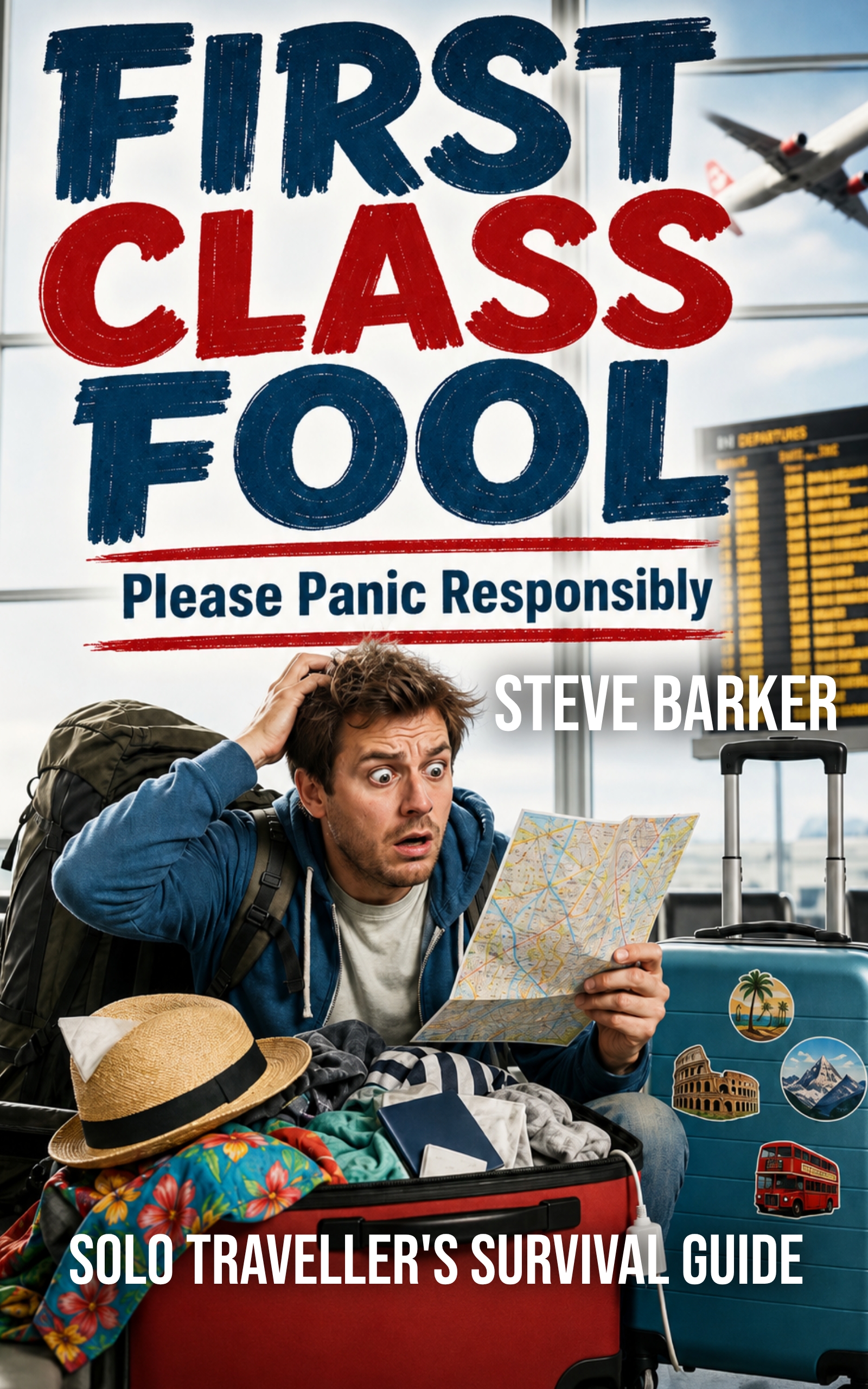
The hook is a clear, relatable promise: a travel show for people who are scared of travelling. Most travel TV sells a fantasy of competence, and this series sells the opposite. The poster is easy to picture: one overpacked suitcase, one tiny person, one enormous departures board. The title 'First Class Fool' gives the show a brand and a host persona in four words, and the structure of five or six 30–45 minute episodes follows the traveller's own timeline.
The book is rich in set-pieces that can be shot for real: the overweight bag at check-in with the dog-sized suitcase gag, the booking-page countdown timer visualised as a ticking comedy villain, the budget-airline gate measuring box, the gate-change stampede, the dinner-for-one in a full restaurant, and the late-night walk to a locked building. Each is visual, relatable and comic, and each can be staged with real first-time travellers plus a host or on-screen guide. Graphics for 'useful alertness versus pointless drama' and gut instinct versus 'the body lobbying for chips' offer ready-made, shareable formats.
The honest caveat is that the book is a guide, not a story. Barker's voice is the asset, but the series needs a cast of real first-time solo travellers, either one per episode or one recurring arc, to supply the stakes and emotional payoff the page doesn't have. The modest, reassuring ending suits a feel-good franchise: each episode ends with a small, real win, and the format can renew by destination, trip type or traveller. It also has strong short-form spin-off potential in packing, booking and airport clips, which lowers marketing cost and builds an audience before launch.
Format recommendation
Documentary Series
The book is a modular how-to guide with no single narrative arc, so it fits a host-led, multi-episode factual series, not a feature. Its chapters map onto episodes by trip stage (packing, booking, airport, arrival, eating alone), and each stage can be dramatised by following real first-time solo travellers. A feature would have nothing to resolve, and a scripted series would invent characters the book doesn't contain.
Comp titles
The Reluctant Traveler with Eugene Levy (Apple TV+, 2023)
This is the closest tonal match: a self-deprecating, anxious host turns travel discomfort into comedy while still delivering useful, aspirational content.
Stanley Tucci: Searching for Italy (CNN/Max, 2021)
It proves that a character-led travel format with a warm, wry host can break out. It also shows how to build a franchise from a repeatable, episode-per-destination structure.
Race Across the World (BBC, 2019–)
It shows how ordinary people making real travel decisions under pressure (budgets, logistics, wrong turns) create compelling unscripted TV, which is the model for following real first-timers.
Somebody Feed Phil (Netflix, 2018–)
It is an upbeat, low-stakes, feel-good travel series with broad appeal and an easy co-viewing, comfort-watch tone.
The Trip to Greece (Sky/IFC, 2020)
It is a reference for dry, deadpan comic observation of the small humiliations of travel.
Audience
Primary audience is adults 25–54, skewing female and first-time or anxious travellers, plus the large aspirational group who want to travel solo but haven't started. Secondary audience is comfort-viewing travel fans and travel-hack content consumers (TikTok and YouTube budget travel, packing tips). They watch The Reluctant Traveler, Stanley Tucci: Searching for Italy, Somebody Feed Phil, Race Across the World and similar light factual travel fare.
Tone
self-deprecating
dry
reassuring
relatable
practical
warm