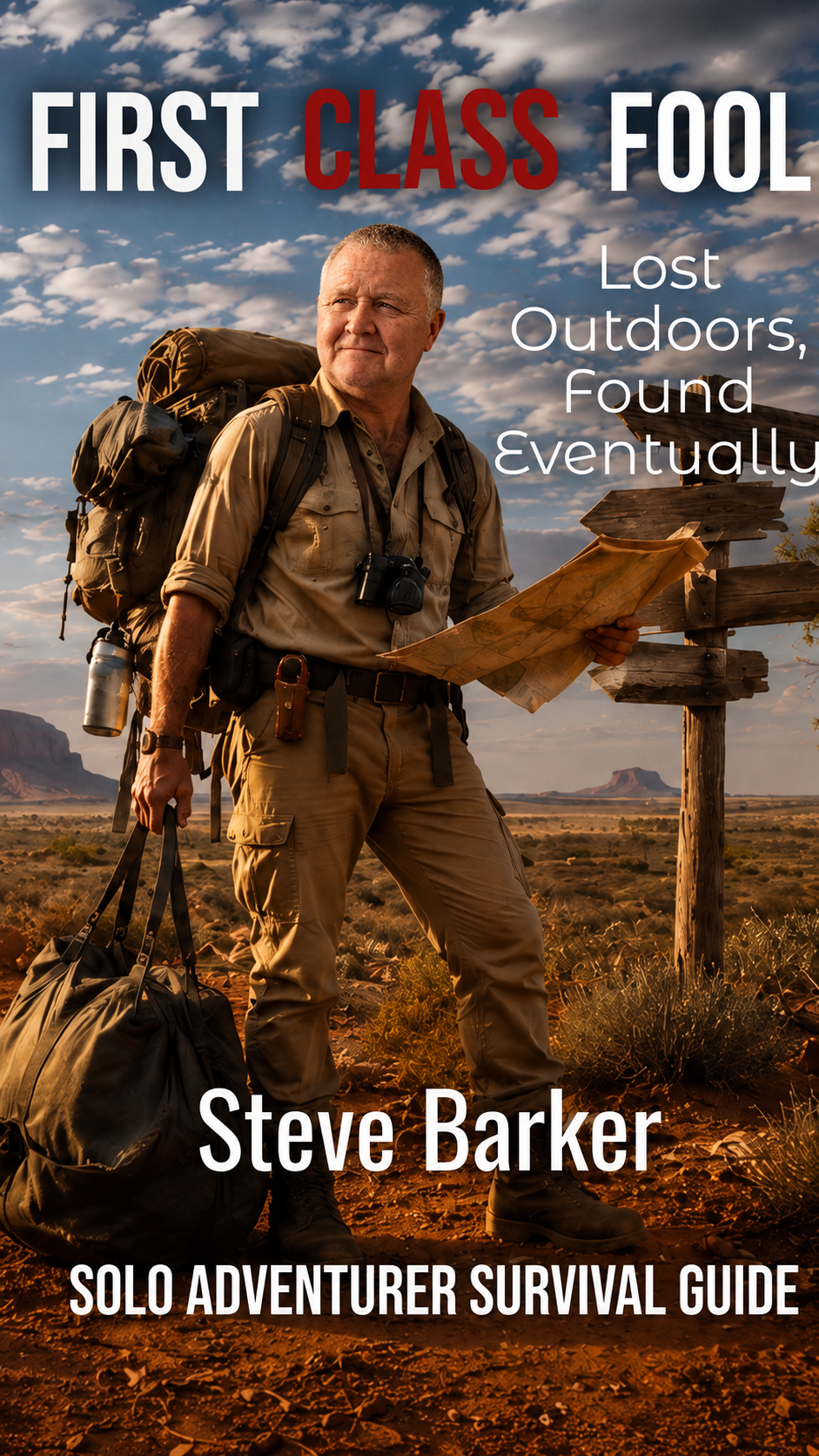
First Class Fool: Lost Outdoors, Found Eventually cover
Documentary / Non-Fiction Documentary Series

First Class Fool: Lost Outdoors, Found Eventually

by Steve Barker · 280 pages

Logline

A solo outdoorsman dismantles the myth of rugged effortlessness, guiding inexperienced walkers through the humbling, often hilarious reality of navigating weather, terrain, and their own overconfidence in the British countryside.

Synopsis

First Class Fool opens by establishing its central premise: the outdoors is not a managed attraction staged for human convenience, and the greatest obstacle most solo walkers face is not the terrain but their own mild, innocent overestimation of themselves. Barker introduces the distinction between inconvenience and danger, between curiosity and entitlement, and between the heroic fictional self who plans routes indoors and the actual person who has to climb the hill. The tone is wry, warm, and consistently funny, treating the reader as a sensible adult who has simply not yet been corrected by a muddy field. The book moves through the practical architecture of outdoor travel: how to choose routes that match real fitness rather than aspirational fitness, how to read route descriptions that use words like 'gentle' and 'easy' as euphemisms for suffering with scenery, how to match distance, terrain, elevation, and daylight to the person actually doing the walking. Barker is especially sharp on the ego traps — the sunk-cost fallacy of pressing on because you drove there, the social comparison error of using a stranger's confidence as your risk assessment, and the pride that translates warning signs into insults. Navigation receives detailed, unsentimental treatment. Barker defends paper maps, demystifies compass use, exposes the optimistic limitations of GPS apps, and describes the specific humiliation of discovering you have followed a livestock trail for forty minutes with great confidence. The recurring advice — check early, check often, backtrack before wrongness becomes mileage — is delivered with enough comic precision that it reads as entertainment while functioning as instruction. Weather is framed as an active character with no interest in your itinerary. Barker walks through rain, wind, fog, heat, and cold, explaining not just their physical effects but their psychological ones, particularly for the solo traveller who has no companion to share the blame or break the biscuit packet. The layering chapter reframes clothing adjustment as personal climate management rather than vanity, and the chapter on delaying or abandoning plans makes a sustained, funny argument that changing your mind before the sky does it for you is outdoor intelligence, not cowardice. The manuscript closes as Barker begins addressing kit and the seductive trap of outdoor retail, suggesting the book will continue building toward a full practical philosophy of solo travel. The cumulative argument is that confidence outdoors is built quietly, through manageable repetitions, honest self-assessment, and the willingness to find your own foolishness genuinely funny. The reader is left not with a checklist of heroic achievements but with a more durable gift: the habit of paying attention before consequences arrive.

AI Pitch Package

For producers, scouts & managers

Logline

Self-deprecating outdoorsman Steve Barker exposes the gap between the heroic walker you imagine yourself to be and the mud-caked fool you actually are, one humbling British hillside at a time.

Short synopsis

First Class Fool is a wry, instructional memoir-in-motion about solo walking in Britain — specifically about how ordinary people with ordinary fitness and extraordinary overconfidence routinely misread terrain, weather, maps, and themselves. Steve Barker is the guide you wish you'd had: funny, honest, and constitutionally incapable of pretending that a compass is intimidating or that a soggy retreat is shameful. The book dismantles the outdoor ego trap chapter by chapter — navigation, weather, kit, route planning — arguing that competence is built not through heroic sufferfests but through small, repeated, honestly assessed trips into the countryside, where the ground does the teaching.

Extended synopsis
Steve Barker opens with a provocation: the British countryside is not a managed attraction, and the gap between the walker you plan to be on a Tuesday evening with a map and a biscuit and the walker you actually are on a wet Saturday with the wrong boots is the funniest and most instructive distance in outdoor sport. His subject is not danger. It is mild, widespread, democratically distributed overconfidence — the kind that convinces sensible people to press on past a warning sign because they drove two hours to be there. The book moves through the practical architecture of solo walking — route selection, distance and elevation calibration, navigation by paper map and compass, the seductive unreliability of GPS apps — treating each topic as both a practical skill and a comedy of errors. Barker's recurring finding is that bad decisions outdoors are rarely stupid; they are the product of optimism applied to the wrong information at the wrong moment. His navigation chapters are especially sharp: the specific humiliation of following a livestock trail for forty minutes with complete confidence is rendered with surgical comic precision. Weather is treated as an active, indifferent character. Barker walks through every condition the British uplands can produce and examines not just the physical consequences but the psychological ones — particularly for the solo traveller who has no companion to share blame, biscuits, or the decision to turn back. The layering chapter reframes clothing management as personal climate control; the retreat chapter makes a sustained argument that changing your mind before the sky does it for you is intelligence, not weakness. Cumulatively, the book constructs a practical philosophy of solo travel built on honest self-assessment, manageable repetition, and the willingness to find your own foolishness genuinely funny. Barker's argument is that confidence outdoors is not a trait you arrive with but a habit you build — quietly, incrementally, through paying attention before consequences make it mandatory. The reader finishes not with a trophy list but with a more durable asset: the reflexes of someone who checks early, backtracks without shame, and knows the difference between inconvenience and danger. As a screen property, the material transcends the how-to format because Barker is a character as much as a guide — an unreliable narrator of his own competence, whose every misadventure is also a lesson. The British landscape itself functions as an ensemble cast: the indifferent moor, the vindictive weather front, the path that appears on the map but not on the ground. The show this becomes is part practical education, part landscape documentary, and entirely about the comedy of human beings overestimating themselves in beautiful places.
Why it adapts
The core visual proposition is unusually clean: a man, a landscape, and a gap between expectation and reality that closes in real time on camera. Every chapter of the book translates to a documentable expedition — Barker sets out with a declared route and a declared plan, and the episode is the distance between that plan and what the ground, weather, and his own overconfidence produce. The comedy is inherently cinematic because the stakes are immediately legible to anyone who has ever been cold, lost, or wrong in a beautiful place. The British uplands — Peak District, Cairngorms, Brecon Beacons, Dartmoor, the Lakes — deliver extraordinary production value at relatively contained budget, and the seasonal variation alone generates a visual texture that changes dramatically episode to episode. Barker himself is the key asset. He is not a survival expert or an elite athlete; he is a thoughtful, funny, occasionally foolish person who has paid close attention to his own mistakes. That is a rare and marketable presenter quality — self-deprecating without being clownish, authoritative without being intimidating. A viewer who has never held a compass can follow him; a viewer who has been navigating for thirty years will still find something corrected. The show's instructional spine means every episode has a concrete takeaway, which sustains audience loyalty and generates the social-media clip economy (the livestock trail forty-minute detour, the layering system performed in full during a hailstorm) that drives discoverability on streaming platforms. The format also has franchise legs. Season one could cover the English uplands; season two Scotland; season three Wales and the coastal long-distance paths. Guest episodes featuring equally fallible walkers of different fitness levels and experience offer demographic variety without diluting the central voice. This is a low-jeopardy, high-warmth, landscape-first series that fits the current commissioning appetite at BBC Two, Channel 4, and BritBox precisely because it does not ask audiences to fear for anyone's life — it asks them to recognise themselves.
Format recommendation
Documentary Series

The book is structured as a series of discrete thematic modules — navigation, weather, kit, route planning, ego management — each of which maps naturally to a self-contained episode with its own visual challenge, instructional payload, and comic set piece. A documentary series allows Barker to function as on-screen presenter-protagonist, placing his self-deprecating voice and real British terrain at the centre of each episode rather than abstracting them into dramatic reconstruction. The format also sustains an audience relationship over multiple instalments, which suits the book's cumulative, habit-building philosophy far better than a single feature runtime.

Comp titles
Mortimer & Whitehouse: Gone Fishing
Closest tonal twin on British screens — a practical outdoor activity reframed as a vehicle for two fallible, funny men being honest about their own limitations, with landscape as emotional backdrop. Barker occupies the same warm, self-aware register and targets the same BBC Two / BritBox audience of adults who find competence funnier than heroism.
The Repair Shop
Demonstrates the British appetite for skilled-craft television that is patient, instructional, and emotionally warm without manufactured jeopardy. First Class Fool offers the same reassurance that things can be learned, done properly, and enjoyed without competition or spectacle.
Wild Isles
Establishes the cinematic appetite for British landscape as protagonist. Barker's series would inherit that visual grammar — moor, fell, coastal path, grey sky breaking into extraordinary light — while placing a human fool at the centre rather than an apex predator.
How to with John Wilson
American comp that proves the instructional-comedy hybrid works as prestige streaming content when the presenter is a genuine eccentric with a specific, obsessive point of view. Barker's wry Britishness is a distinct flavour that travels the same lane.
Taskmaster
Not a direct format comp, but evidence that British audiences will watch competent adults fail at bounded physical challenges with great enthusiasm when the framing is comic and the stakes are personal rather than life-or-death. The 'fool versus landscape' dynamic is structurally similar.
Audience

Adults 35–65, predominantly UK, with strong streaming crossover potential for North American Anglophile audiences on BritBox, BBC iPlayer, and Channel 4. These viewers already watch Mortimer & Whitehouse: Gone Fishing, The Repair Shop, Countryfile, and Julia Bradbury's walking series; they are practically literate, suspicious of manufactured jeopardy, and loyal to presenter-led formats built on warmth and hard-won expertise rather than competition.

Tone
wry warm instructional self-deprecating observational grounded

Adaptation Readiness Score

72 / 100

Visual storytelling 78
Dialogue strength 55
Character distinctiveness 70
Hook strength 75
Format fit 74
Market timing 76
Strengths
  • Barker's wry, self-deprecating comic voice is a genuine screen asset — the 'humiliation as instruction' tone maps directly onto the confessional-comedy register that's thriving in British factual television right now (think Dara Ó Briain's science series or Ed Gamble's food docs)
  • The British countryside as both setting and antagonist is visually rich and productively underused on screen — muddy bridle paths, fog-swallowed ridgelines, and rain-lashed gear failures give a location-driven series its own distinct visual identity without requiring exotic or expensive locations
  • The premise has a built-in structural engine: each episode can follow a walk from overconfident planning through comedic failure to earned competence, giving the series a repeatable, satisfying arc that commissioners can immediately picture and schedule
Adaptation friction
  • The book's greatest strength — Barker's interior comic voice correcting the reader in real time — is also its adaptation friction; that voice needs a strong on-camera persona or co-presenter dynamic to survive the translation from page to screen, and that's a casting question the book can't answer on its own
  • Secondary characters are largely absent from the synopsis; a documentary series needs recurring human texture beyond the solo walker — fellow hikers, reluctant companions, local experts, or even adversarial weather presenters — to sustain audience investment across multiple episodes
  • The thematic architecture is essayistic rather than narrative-driven; without a throughline quest, a personal transformation arc, or a defined endpoint (a specific route, a challenge completed), each episode risks feeling like an illustrated chapter rather than a compulsive 'what happens next' viewing experience

Listed on 2026-06-29
Back to directory