Logline
Stranded in a foreign town with no itinerary and no one to impress, a self-declared first-class fool invents absurd micro-missions, breaks every unwritten local rule, and discovers that a park bench is travel's most powerful vantage point.
Short synopsis
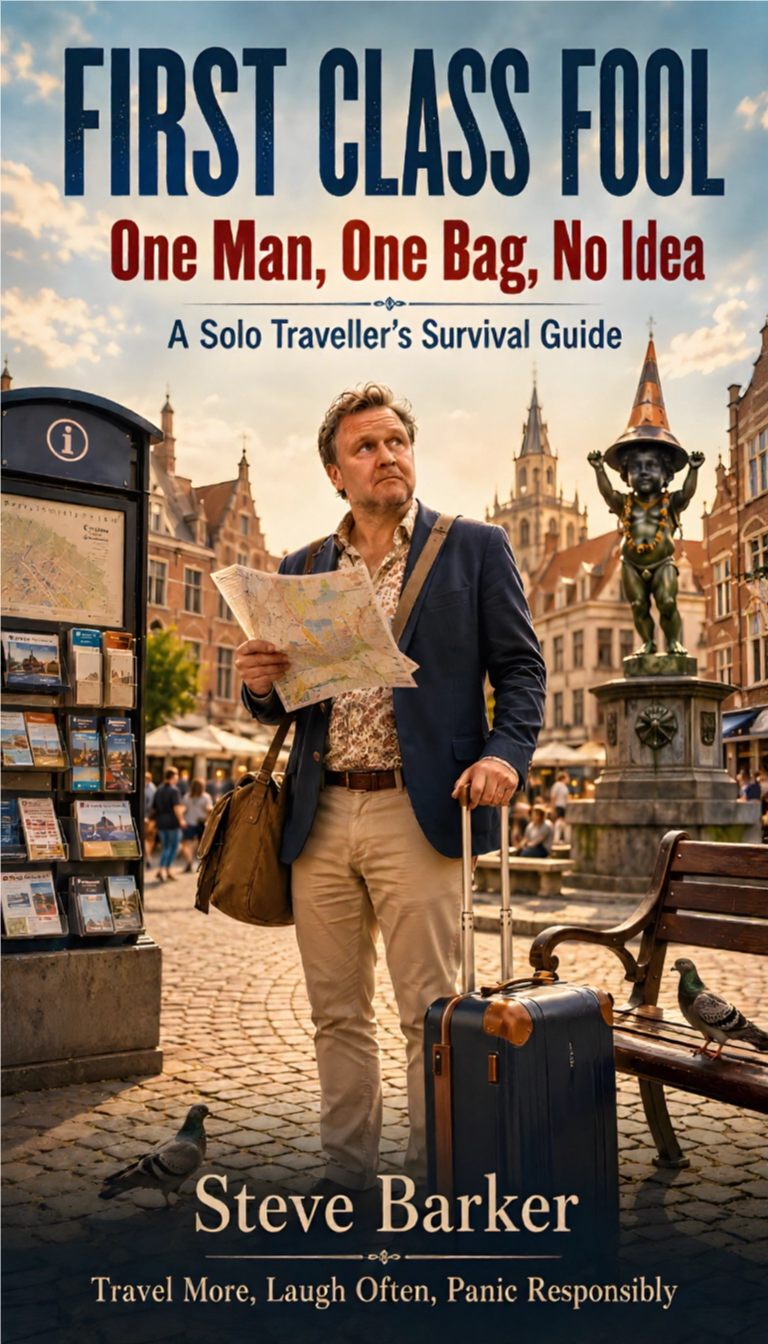
The moment the hotel door clicks shut, the triumphant arrival turns into an unanswered question: now what? Steve Barker's First Class Fool treats solo travel as a comedy of unstructured freedom. His answer is the 'small foolish mission': find the oldest visible thing in town, track down the most baffling public notice, identify the statue least able to justify its existence. Along the way he blunders through each destination's invisible rules about queues, doorways, café counters and bench etiquette, and learns to recover with a smile instead of a speech. The book builds to a case for the bench as observation post, where the traveller stops consuming a place and lets it perform. It is dry, self-deprecating and quietly wise.
Extended synopsis
First Class Fool begins by demolishing the myth of the triumphant arrival. Getting somewhere is a logistics win, not an experience. The real test starts when the hotel door closes and a day with no instructions stretches ahead. Barker argues that structured transit gives travellers purpose, while freedom exposes how few of us know how to simply occupy a place. The deflation after arrival, the pull of the hotel room, and the paradox that liberty is harder than logistics are all played for dry comedy.
The middle of the book moves from diagnosis to method. Barker's central device is the small foolish mission: a deliberately low-stakes quest specific enough to give direction and absurd enough to prevent self-importance. Examples are finding the oldest visible thing in town, hunting down baffling public notices, and judging which statue is least able to justify its existence. His claim is that failing at a small mission beats succeeding at a grand one, because the wrong turns and misidentified landmarks produce the accidental encounters that become real travel memory. He pairs this with a guide to reading a place through pace, movement and body language, and warns against both gawping and forced assimilation.
Chapter Four turns to the hidden rulebook every destination runs on: the unwritten customs of queues, doorways, café counters and bench ownership that locals absorbed over decades of unremarkable Tuesday mornings. The solo traveller learns these laws only by breaking them in public. Barker catalogues the small civic transgressions and the graceful recoveries: brevity, adjustment, a smile, never a speech. He names overconfidence as the traveller's most reliable enemy, the small win that convinces you that you've mastered a town you've known for forty minutes.
The book closes on the bench. Rest, Barker argues, is one of travel's most intelligent modes. A seated traveller stops consuming a place and starts receiving it: the repetitions, rhythms, invisible territories and small human theatre that a purposeful walker misses. The bench becomes a command centre and a small democratic zone, where solitude stops being a condition and becomes a position. There is no destination at the end, only a cultivated disposition: enough curiosity and enough humility to let a place correct you gently and repeatedly.
As a screen property this is an essayistic, presenter-led comedy-travelogue, not a narrative. It would be built on new production, with each chapter's thesis becoming an episode-length field experiment shot on location.
Why it adapts
The hook translates to a poster and a pitch deck: a lone traveller, a bench, and a hand-drawn list of ridiculous missions. The missions are inherently visual and episodic. Examples are the hunt for the statue that least justifies its existence, the oldest visible thing in town, and the most baffling public notice. Each is a ready-made cold open, with built-in structure (quest, wrong turn, accidental encounter, wry payoff) and natural opportunities for on-screen graphics, maps, annotated signage and deadpan voiceover.
Chapter Four is the strongest comedic engine: a recurring segment in which the presenter deliberately and innocently breaks a local rule at a café counter, doorway or queue, with locals reacting on camera and the 'brevity, adjustment, smile' recovery as a running gag. It gives each episode a different cultural flavour without leaning on tourist cliché. The bench chapter offers a distinctive formal counterpoint: locked-off, patient, sound-designed sequences where the town performs and the presenter simply watches. That gives the series a visual signature that sets it apart from the high-energy travel show.
The marketing angle is clear: a counter-programming alternative to aspirational, bucket-list travel TV, built on lowered expectations and a lovable fool of a guide. It is cheap to produce (a small crew, a single presenter, public spaces), easy to scale across locations, and has natural social clips. The caveats are real. The book has no narrative spine, so a distinct presenter persona and a season-long throughline (for example, a gradual shift from anxious wanderer to confident bencher) must be built in development. The series also depends heavily on Barker's, or a chosen host's, on-screen charisma, which should be tested before any pitch goes wider.
Format recommendation
Documentary Series
The book is a thesis-driven, chapter-by-chapter essay collection with no plot arc, so a feature would flatten it into a single joke. Its five movements (arrival, missions, rules, bench) map onto half-hour episodes, each a self-contained field experiment with a clear premise. The format depends on a charismatic on-camera presenter and fresh location shooting, which is the main production risk.
Comp titles
The Reluctant Traveler with Eugene Levy
A self-deprecating, anxious-but-curious solo presenter turns the discomfort of travel into the comedy, which is the same engine as Barker's 'first-class fool'.
Somebody Feed Phil
A warm, gentle, repeatable travelogue format that proves audiences will follow an affable guide through small human moments rather than headline attractions.
Joe Pera Talks with You
Deadpan, low-stakes observational comedy that finds profundity in mundane rituals. It shares the tone of Barker's bench philosophy and his reverence for unremarkable Tuesday mornings.
Stanley Tucci: Searching for Italy
A presenter-led, place-first docuseries with premium production values and an essayistic sensibility, showing the prestige travel lane that a quirkier take could sit beside.
Audience
Primarily adults 30-65 who skew educated and slightly bookish, with strong overlap among solo and independent travellers, armchair travellers, and fans of gentle British-style observational humour. They watch The Reluctant Traveler, Somebody Feed Phil, Stanley Tucci: Searching for Italy, Detectorists and Joe Pera Talks with You, and read travel essays and humorous memoir. Secondary appeal to a post-pandemic audience interested in slow travel, solitude and anti-itinerary culture.
Tone
dry
self-deprecating
observational
gentle
wry
contemplative