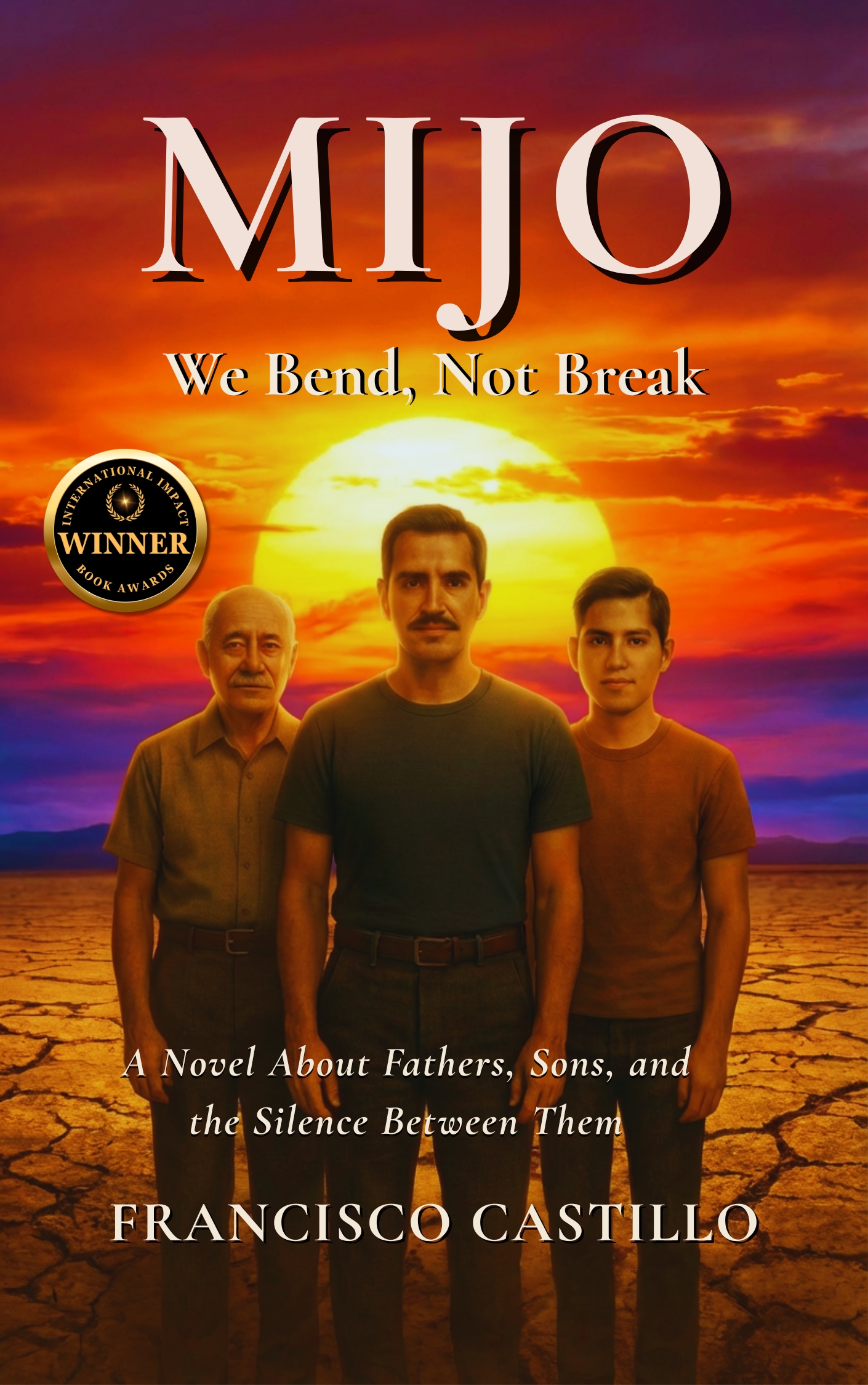
Synopsis
The story opens in 1955 Michoacán, where seven-year-old Joaquín yearns for acknowledgment from his stoic, land-bound father. That emotional starvation calcifies into adulthood: Joaquín inherits not only the dying agave farm but his father's emotional distance. Pushed by drought, the memory of a friend murdered by narcos, and his wife Antonia's quiet courage, Joaquín agrees to cross the border into California in late 1978. The crossing nearly kills them—a deceitful coyote abandons the group in the desert, and Antonia collapses, revealing she is two months pregnant. Strangers pool their last water and carry her to safety, modeling a communal tenderness Joaquín cannot yet access.
Settling in Hollister as undocumented farmworkers, Joaquín picks tomatoes under brutal conditions while Antonia gestates in an aluminum migrant trailer under the shadow of ICE raids. Their son Alejandro is born in a county clinic under precarious legal status. When the nurse asks Joaquín if he'd like to hold his newborn, he refuses—but allows his finger to be gripped by Alejandro's tiny fist, an act he describes as being chosen. The pattern of near-connection and retreat defines Alejandro's childhood: Joaquín watches but does not scoop up his son on first steps, praises his grades obliquely in the garage, and responds to Alejandro's art aspirations with fear disguised as contempt—then leaves drawing pencils outside his bedroom door as a wordless apology.
Alejandro grows up caught between his father's survival rules—blend in, stay quiet, do not stand out—and his own hunger for selfhood. He joins the Prop 187 student walkouts at fourteen, argues with Joaquín about belonging and freedom, and eventually meets Elena Reyes, a psychology student whose own absent father makes them fluent in the same emotional dialect. They build a life together carefully, moving into the Martínez household temporarily, marrying, and having Gabriel. Alejandro discovers he has inherited his father's paralysis around tenderness: he can only hold Gabriel while walking, needing motion to short-circuit his fear of intimacy. The 2008 recession deepens his absences from home, and Joaquín—now retired—unexpectedly becomes a present, patient grandfather to the child he could never quite reach as a father.
Joaquín's lungs fail by 2013, decades of field chemicals taking their toll. His COPD diagnosis forces a confrontation with dependency: the man who equated asking for help with weakness must now accept oxygen tanks, scheduled medications, and his son's vigil. It is Gabriel—innocent of the family's history of silence—who climbs into the hospital bed with a stuffed dragon and tells Joaquín that dragons get better when the whole village helps. Joaquín places a shaking hand on his grandson's hair. Alejandro is simultaneously offered a life-changing promotion to Phoenix, which would fund all of Joaquín's medical care. He declines, choosing presence over income, finally articulating what his father never could: that proximity matters more than provision.
The book closes with the birth of daughter Sofía during a January storm, Joaquín stationed in the waiting room despite medical risk, refusing to repeat the mistake of staying in the parking lot the night Alejandro was born. He claims the rocking chair in the living room, sings Michoacán songs Alejandro has never heard, and learns—slowly, imperfectly—to receive care. The cycle does not break cleanly; it bends. Alejandro becomes a Licensed Marriage and Family Therapist, applying his lived experience to helping other families heal the same generational wounds. The memoir argues that masculinity, cultural identity, and inherited trauma need not be destiny—that the men in immigrant families can choose, one agonizing gesture at a time, to do something different.
AI Pitch Package
For producers, scouts & managers
Logline
An undocumented Mexican immigrant father spends four decades unable to touch his son with tenderness, until a dying man and an innocent grandson force three generations to finally choose presence over silence.
Short synopsis
Spanning 1955 Michoacán to 2010s California, MIJO tracks two men—Joaquín, a stoic farmworker shaped by drought, narco violence, and a dangerous border crossing, and his son Alejandro, a first-generation American who inherits his father's emotional paralysis even as he fights to break it. The series moves through landmark American moments: undocumented farm labor, Prop 187, the 2008 recession, DACA-era anxiety. At its center is a simple, devastating question: can a man raised without tenderness learn to give it before it's too late? The answer arrives not through confrontation but through a series of wordless, agonizing gestures across four decades.
Extended synopsis
The series opens in Michoacán, 1955. Seven-year-old Joaquín works the agave fields alongside a father who communicates exclusively through labor and silence. The emotional template is set: worth is measured in endurance, love is expressed through provision, and asking for help is the same as dying. By the late 1970s, drought has killed the farm and narco violence has killed Joaquín's closest friend. He and his pregnant wife Antonia cross into California through the Sonoran Desert, abandoned mid-crossing by a coyote who takes their money and vanishes. Antonia collapses. Strangers—other migrants, equally desperate—pool their last water and carry her out alive. Joaquín watches this communal act of care with the expression of a man observing a foreign language he was never taught.
Why it adapts
The memoir is loaded with images that are already frames: a newborn fist closing around a refusing father's finger in a county clinic; drawing pencils placed silently outside a teenager's door; a man unable to hold his infant son unless he is walking; a small boy climbing into a hospital bed with a stuffed dragon while an old man with an oxygen tank tries not to cry. These are not described moments—they are shots. The visual language of the story is already cinematic: withheld gesture, loaded domestic space, bodies that cannot reach each other across a room. The Sonoran Desert crossing is a full setpiece—dehydration, betrayal, a collapsing pregnant woman, strangers pooling their last water—that functions as the series' pilot-ending hook and anchors the mythology of the family's American origin.
Format recommendation
Limited Series
This material spans nearly sixty years, three generations, and multiple tectonic American political moments—Prop 187, undocumented labor law, DACA anxiety, the 2008 recession—none of which can breathe inside a two-hour feature. A 6-to-8-episode limited series structure allows each decade to function as its own chapter with a distinct visual and emotional register, while the serialized form earns the slow, earned payoff that is the memoir's entire argument. The contained ending and resolved arc make an ongoing series inappropriate; this story has a finish line.
Comp titles
Americanah (2021, Amazon)
A prestige limited series built on the interior emotional life of a protagonist navigating cultural identity across decades, with a love story at the structural center. Same target audience, same willingness to let silence and gesture carry dramatic weight.
Coco (2017, Pixar/Disney)
Not a direct comp in format, but proof of concept for the commercial appetite for multigenerational Mexican family stories that take masculinity, legacy, and grief seriously. Establishes the audience's emotional fluency with this specific cultural grammar.
When They See Us (2019, Netflix)
Demonstrates that a limited series built around systemic injustice and the interior lives of Brown men can dominate the awards conversation and generate massive streaming viewership. Same platform DNA, same documentary-adjacent prestige positioning.
Lessons in Chemistry (2023, Apple TV+)
A period-set limited series about a protagonist whose public identity is constrained by the era's rules, while their private emotional life drives the real story. Shares the structure of social-political backdrop + intimate family drama + clear awards trajectory.
The Swimmers (2022, Netflix)
A true-story immigrant survival narrative with a harrowing setpiece journey at its center, positioned as prestige streaming with awards ambitions. The Sonoran Desert crossing in MIJO is this film's English Channel—the physical ordeal that externalizes the emotional stakes.
Audience
Primary: Latino adults 25-54, the most underserved and loyalty-driven audience in prestige streaming, actively seeking authentic cultural representation (the audience that made Gentefied, One Day at a Time, and Selena: The Series into passionate communities). Secondary: the broad prestige-drama audience for family sagas about inherited trauma and masculinity—viewers who consumed This Is Us, Beef, and When They See Us. Tertiary: awards-season watchers and literary-adaptation enthusiasts who follow the memoir-to-screen pipeline (Just Mercy, The Glass Castle). The immigrant family drama with a masculinity-and-tenderness thesis has a proven crossover lane into general-market prestige.
Tone
restrained
elegiac
visually spare
emotionally precise
multigenerational
unsparing
Adaptation Readiness Score
79 / 100
Character distinctiveness
82
Strengths
- Iconic, castable father-son emotional architecture — the 'chosen by the fist grip' birth scene and the hospital dragon moment are the kind of quietly devastating images that attract prestige actors and awards campaigns
- The generational three-act spine (Michoacán → Hollister → Gabriel's childhood) maps naturally onto a limited series episode structure, with each generation's emotional wound and partial healing functioning as a self-contained act
- Cultural specificity is both market-ready and emotionally universal — the undocumented crossing, Prop 187 walkouts, and agave-farm inheritance ground the story in a world underrepresented on prestige TV while speaking to themes any audience recognizes
Adaptation friction
- The interior register of memoir — Joaquín's emotional life is largely inferred through gesture and omission, which is powerful on the page but will require screenwriters to externalize subtext into dramatizable conflict without flattening the story's deliberate restraint
- Dialogue as documented in memoir tends toward the emblematic rather than the performable; the screenplay will need original scene construction to give Joaquín and Alejandro confrontation scenes with dramatic stakes that don't exist explicitly in the source
- Alejandro's therapist resolution risks reading as tidy closure in a story whose emotional truth is built on incompletion — a development pass should stress-test whether the ending earns its hope or softens the harder landing the material has been building toward
Listed on 2026-05-03
Back to directory