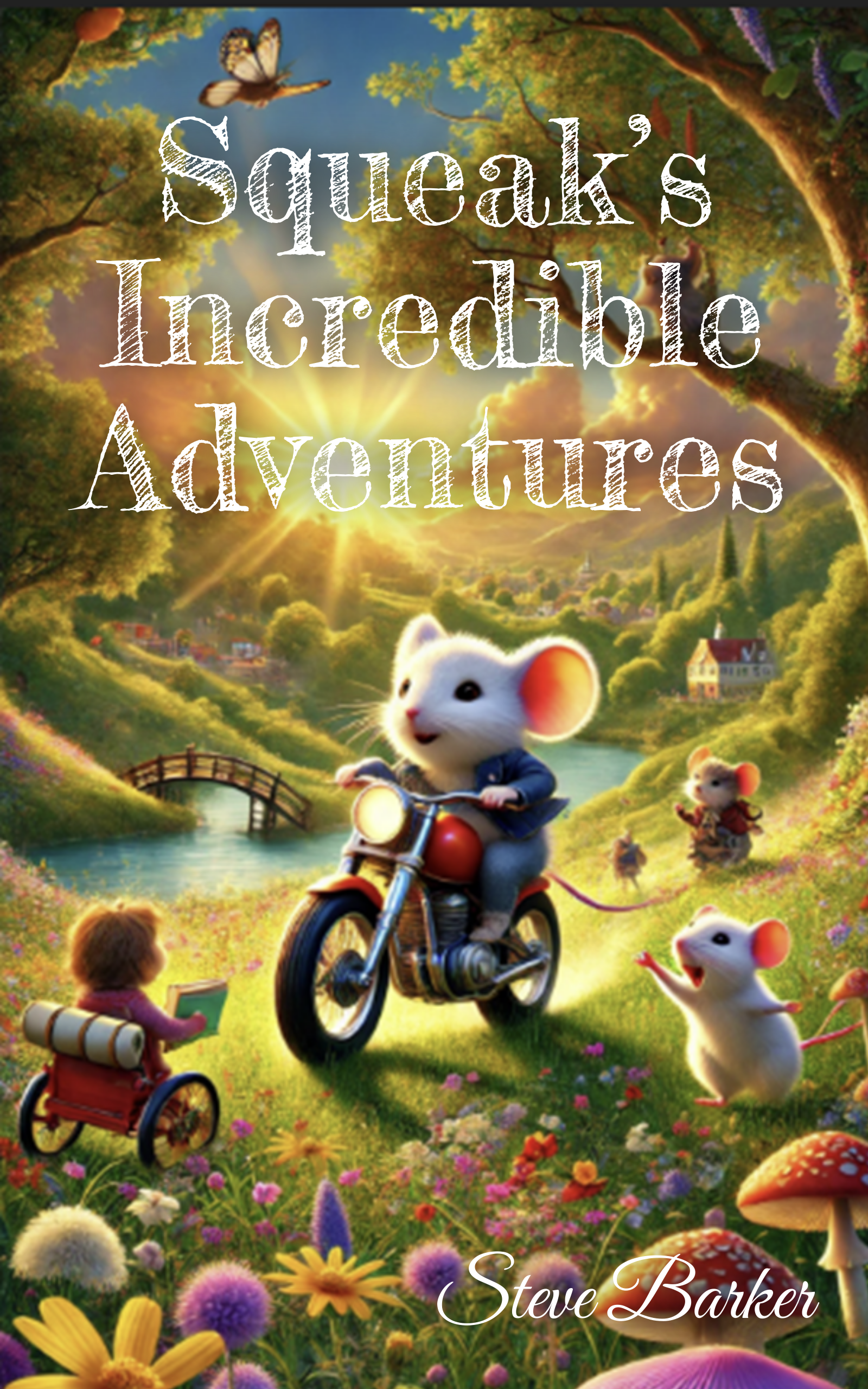
Squeak's Incredible Adventure cover
Children's Episodic Series

Squeak's Incredible Adventure

by Steve Barker · 69 pages

Logline

Squeak, a small but big-hearted mouse, proves that courage, kindness, and teamwork can overcome any obstacle — whether on Sports Day, a forest journey, in school, or on a seaside holiday.

Synopsis

In Rodent Village, tiny mouse Squeak dreams of winning the Annual Mouse Sports Day despite his small size. Bully Rumble mocks him, but Squeak finds an ally in Bella, a wheelchair-using mouse who also longs to compete. They train together, inspire the village, and on race day Squeak crosses the finish line just ahead of Rumble while Bella races brilliantly alongside him. They stand on the winner's podium together, proving that heart and determination matter more than size or ability. In his second adventure, Squeak rides his shiny motorbike through the countryside, visiting his grandfather at a cosy tavern and sailing a river to surprise his parents. Deep in a forest with friends Pip and Nibbles, he meets Elder Willow, who tells the legend of a brave mouse named Chip who stood up for the mistreated. Inspired, the trio spreads kindness across the land, and when Squeak returns home he finds his village transformed — all creatures, including rabbits with walking frames and squirrels in wheelchairs, living and working together with mutual respect. At Whisker Wonders Academy, Squeak and his four friends — Bella, Pip, Nibbles, and Hatty the red squirrel — form the Amazing Superpower Club, celebrating each member's unique strengths. When Pip, who has dyslexia-like struggles, cannot grasp her maths homework, Squeak patiently guides her using patterns and visualisation while the whole club supports her. Pip completes her homework and earns an Outstanding Achievement award at the school assembly. The club becomes famous for championing inclusion, proving that differences are superpowers and every child has something extraordinary to offer. On a long-weekend holiday to the Isle of Wight, Squeak spots Hop, a lonely rabbit with a walking frame watching a football game from the sidelines. Squeak invites Hop to play, then welcomes Lou, a mouse in a wheelchair, and soon a joyful mixed-ability kickabout brings together squirrels, hedgehogs, foxes, and more. The evening ends with dancing and arcade games at the caravan park clubhouse. Hop confesses he never thought anyone would include him, and Squeak declares that everyone belongs on the pitch. Across all four stories, the message is consistent and warm: it is not size, speed, or ability that defines a champion, but the size of one's heart. Squeak's world grows richer with every friend he includes, and each adventure reinforces that a kinder, fairer community is built one small courageous act at a time.

AI Pitch Package

For producers, scouts & managers

Logline

Squeak, a small-hearted mouse in a world of bigger animals, must prove that courage, kindness, and radical inclusion can transform Rodent Village — one daring adventure at a time.

Short synopsis

In Rodent Village, undersized mouse Squeak refuses to accept a world that sidelines anyone who looks or moves differently. Across four self-contained adventures — a high-stakes Sports Day, a motorbike journey through enchanted countryside, a school club that reframes difference as superpower, and a seaside holiday that turns a lonely rabbit into a teammate — Squeak builds a community where every creature belongs. Each story delivers a clean emotional arc, a memorable new friend, and a villain whose cruelty is answered not with force but with stubborn, contagious warmth.

Extended synopsis
Squeak is the smallest mouse in Rodent Village, which makes him exactly the right hero for a world full of creatures who feel overlooked. When the Annual Mouse Sports Day arrives, bully Rumble assumes size equals destiny. Squeak trains alongside Bella, a wheelchair-using mouse who wants to compete just as fiercely, and the two push each other past every limit Rumble sets for them. On race day they share the podium, redefining what winning looks like for a whole village watching. In his second adventure, Squeak takes his shiny motorbike through sun-dappled countryside — visiting his grandfather at a riverside tavern, sailing a winding river, and arriving home through a forest where the ancient Elder Willow tells the legend of Chip, a mouse who stood between the powerful and the mistreated. The story lands in Squeak like a spark. He and friends Pip and Nibbles carry kindness outward like a ripple until, returning home, Squeak finds Rodent Village already changed: rabbits with walking frames and squirrels in wheelchairs working and living side by side with everyone else. At Whisker Wonders Academy, Squeak and his four closest friends — Bella, Pip, Nibbles, and Hatty the red squirrel — formalise what they have always been: the Amazing Superpower Club. When Pip's dyslexia-adjacent struggles make maths homework feel impossible, Squeak quietly reframes the problem through patterns and pictures until Pip solves it herself. The club's approach spreads through school, culminating in a whole-assembly moment where difference is publicly celebrated as strength. On a long-weekend trip to the Isle of Wight, Squeak spots Hop — a rabbit with a walking frame watching a football game he assumes is not for him. Squeak waves him onto the pitch, then waves in Lou, a mouse in a wheelchair, then half the caravan park. By evening the game has become a party: squirrels, hedgehogs, and foxes dancing in a clubhouse that, an hour earlier, none of them expected to share. Hop's confession — that he never believed anyone would include him — is the emotional spine of the whole series in a single line. Taken together, the four stories form a coherent children's universe with a stable cast, escalating ambition, and a moral throughline that never lectures. Squeak is not a saint; he is a kid who gets nervous, makes mistakes, and keeps showing up anyway. That specificity is what makes the message land, and what makes the property expandable well beyond these four founding adventures.
Why it adapts
Rodent Village is a world that earns its own atlas. Every location in the source material — the Sports Day track, the riverside tavern, the motorbike road through sun-lit countryside, the forest clearing where Elder Willow holds court, the academy with its assembly hall, the Isle of Wight caravan park pitch at dusk — is a distinct visual setpiece with a different colour palette and a different emotional temperature. A production designer can build an instantly recognisable style guide from the first episode and then modulate it as Squeak's world expands. The motorbike alone is a piece of iconic character design: a tiny mouse in a helmet on a gleaming machine is a poster and a plush toy before a single frame is animated. The ensemble cast is the series' other major asset. Bella in her wheelchair, Hop with his walking frame, Lou, Pip, Hatty — these are not token diversity additions. They are the co-leads. Their physical distinctiveness means every character reads clearly in a long shot, which is a fundamental animation requirement, and their differentiated personalities give writers conflict and warmth to mine across dozens of episodes without repeating themselves. The Amazing Superpower Club is already a ready-made title sequence: five characters, five different silhouettes, five clearly legible powers. That is a streaming thumbnail that converts. The inclusion messaging is not a liability; it is a sales tool. Public broadcasters, streaming platforms with education mandates, and school-distribution channels are all actively commissioning content that represents disability as ordinary and joyful rather than tragic or inspirational-in-a-condescending-way. Squeak does that with specificity — Bella is a racer, not a lesson — which is why it will survive a pitch meeting with a network standards executive and a toy-licensor in the same room. The IP is small in page count and enormous in commercial surface area.
Format recommendation
Episodic Series

The source material is already structured as four discrete, self-contained episodes with a consistent cast, a recurring home-base setting, and a clear moral throughline — the exact architecture of a preschool or early-primary animated series. Each episode introduces one new friend and one new challenge, which is the proven beat of properties like Bluey or Peppa Pig that sustain multi-season runs. A feature would collapse the anthology structure and lose the episodic rhythm that makes the IP expandable.

Comp titles
Bluey (2018–present)
Same target age band, same warm ensemble family unit, same ability to embed emotionally sophisticated themes — disability, fairness, belonging — inside 7-minute stories that adults and children watch together without condescension.
Hilda (Netflix, 2018–2023)
A small, big-hearted protagonist journeys through richly illustrated landscapes, meeting new creatures each episode while a stable friendship group grounds the series. Shares Squeak's sense of whimsy, its contained village world, and its appetite for quiet moral courage over action spectacle.
Paddington (film franchise, 2014 / 2017)
A gentle outsider whose unfailing politeness disarms a hostile world. Squeak shares Paddington's tonal register — warm, funny, never saccharine — and both properties carry a strong disability-and-inclusion subtext that broadens their demographic appeal.
The Mitchells vs. the Machines (Netflix, 2021)
Demonstrates that animation built around neurodiversity and non-standard protagonists can perform commercially at scale. Squeak's cast of disabled and differently-abled animal characters positions the series in the same growing market segment that made Mitchells a streaming hit.
Hey Duggee (BBC, 2014–present)
Closest structural comp: an ensemble of small animal characters, episodic badge-or-challenge format, a clubhouse HQ, and gentle humour that works on multiple audience levels. Squeak's Amazing Superpower Club maps directly onto Duggee's Squirrel Club template.
Audience

Primary audience: children ages 3–7 and their parents or caregivers. Secondary audience: educators and disability-advocacy organisations seeking curriculum-adjacent content. The property targets families already watching Bluey, Hey Duggee, and Hilda — audiences who have demonstrated they will reward animation that takes inclusion seriously without turning every episode into a PSA. Merchandise potential is strong: the wheelchair-using, walking-frame-using, and neurodivergent characters in the main cast are underrepresented in toy aisles, which is a market gap several major licensors are actively trying to close.

Tone
warm inclusive gently comedic emotionally honest episodic optimistic

Adaptation Readiness Score

74 / 100

Visual storytelling 78
Dialogue strength 65
Character distinctiveness 72
Hook strength 70
Format fit 82
Market timing 80
Strengths
  • Anthological four-episode structure maps cleanly onto a prestige children's animated series format — each story is self-contained yet builds a consistent world and ensemble cast
  • Inclusion and disability representation delivered through joyful, non-didactic adventure aligns strongly with current broadcaster and streaming mandates (BBC, Disney+, Netflix Kids all actively seeking this)
  • Squeak's world — anthropomorphic woodland animals, a functioning village society, motorbikes and caravans — is visually rich and production-design-ready with clear tonal consistency across episodes
Adaptation friction
  • Character differentiation in the ensemble is thin on the page — Bella, Pip, Nibbles, Hatty, and Hop are primarily defined by their disability or role in the lesson, which risks flattening them into symbols rather than castable personalities with distinct comic voices
  • Antagonist dimension is underdeveloped: Rumble the bully appears only in episode one and has no arc, leaving the remaining three stories without meaningful dramatic opposition beyond logistical obstacles — episodic tension needs a recurring friction engine
  • The message-first architecture means story stakes can feel resolved too cleanly and quickly — each episode's emotional climax arrives without enough complication in the middle act, which will need stretching for even a 22-minute episode runtime

Listed on 2026-05-29
Back to directory