Logline
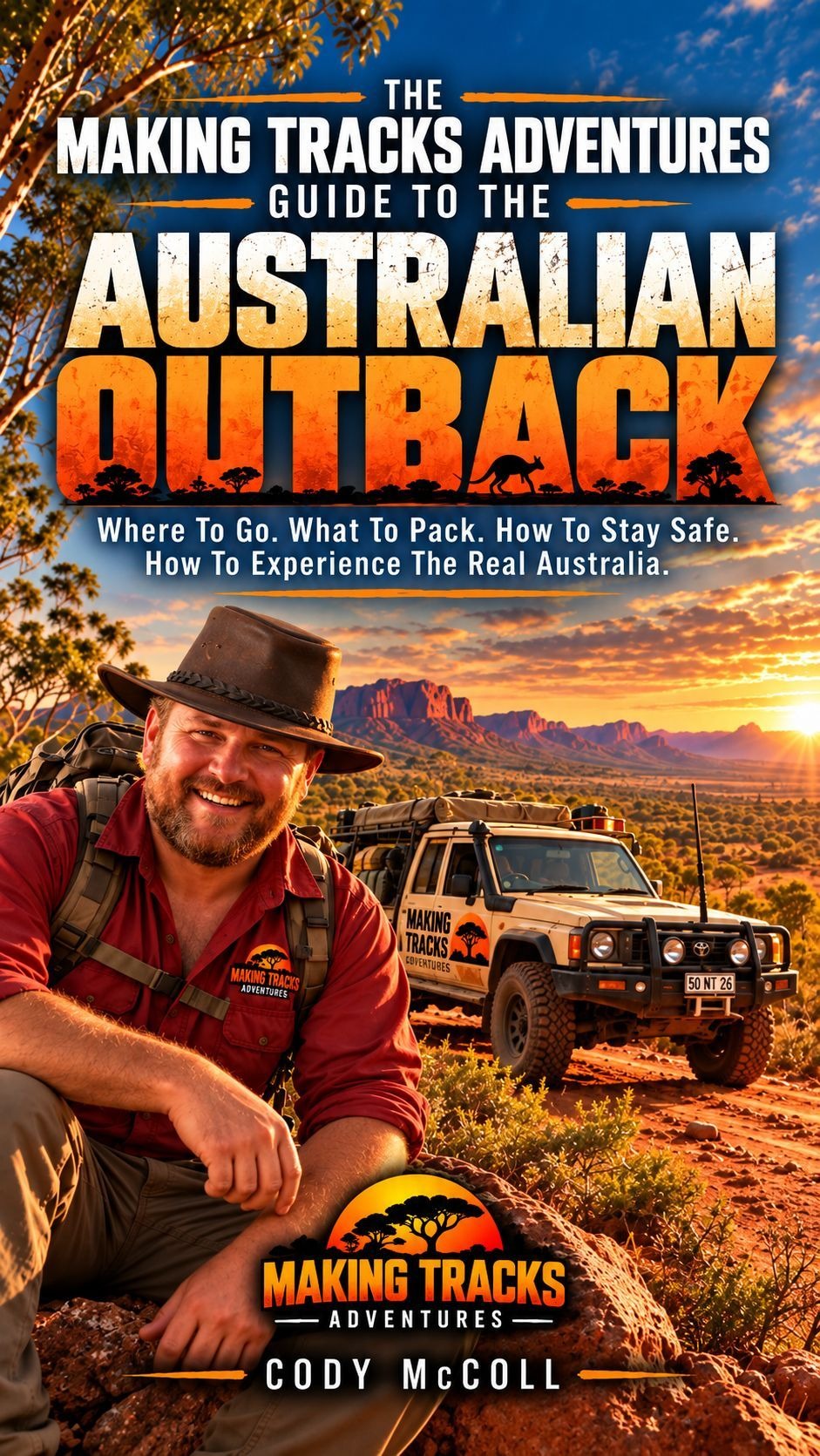
Host Cody McColl leads first-time travellers through the Red Centre, tropical north and desert country, teaching that turning back is a win and that preparation, respect and understanding—not bravado—decide whether remote Australia becomes an adventure or an emergency.
Short synopsis
Making Tracks Adventures reframes the Outback as a commitment, not a holiday. Across a multi-region journey, Cody McColl walks viewers through the decisions that make remote travel safe and rewarding: choosing a region and season, scoring a trip's difficulty, picking guided, tag-along or independent travel, and building itineraries with built-in decision points. The Red Centre, Kakadu, Cape York, the Channel Country and the Flinders Ranges become classrooms, each showing how scale distorts time, how a four-hour drive can erode fuel, daylight and energy, and how to get unbogged. Throughout, the series insists the interior is lived in, worked on and culturally significant, never empty. Its recurring thesis: adventure through preparation, respect and understanding.
Extended synopsis
The book is a practical planning guide, not a narrative, so the series needs a spine the page doesn't supply. The pitch is a host-led journey in which McColl accompanies a small cast of real travellers, each at a different experience level, from first-timer to couple planning a tag-along convoy, as they plan and then drive their trips. Each episode covers one decision: where, when, with whom, how hard, and what to do when it goes wrong.
The book's Part One dismantles the postcard idea of the Outback. Remoteness is measured in services, communication and access as much as kilometres. The interior is a working, inhabited and culturally significant landscape, and travellers learn to read it through vegetation, water and light. On screen this becomes the opening hour: the Outback as many places, not one red desert, from spinifex plains to tropical floodplains to the Gawler Ranges.
The middle of the book turns the lens on the traveller. The ten-point self-check, the seven-factor Challenge-Rating Checklist (scoring trips 7 to 21) and the comparison of guided, tag-along and independent travel as different distributions of responsibility are the most adaptable devices. They can become recurring on-screen graphics and a scoring ritual in which each traveller rates their own trip before departure and again after. Short scenarios, such as a group pre-agreeing to abort a hot walk or a passenger speaking up early about nausea, can be dramatised in real time with real travellers.
The back half is region-and-season driven: a worked seven-day Red Centre itinerary (Alice Springs, Tjoritja/West MacDonnell, Uluṟu-Kata Tjuṯa, Watarrka) with a flexible sixth day, tropical north wet-season closures and crocodile warnings, the Stop-Check-Choose rule, a step-by-step unbogging sequence, and the Outback Safety Margin. That last device shows how a slipped departure erodes a four-hour drive's reserves of time, fuel, daylight and energy. A nine-day gateway-to-close template and an eight-day Flinders Ranges example close the visible material. The final chapters were not available, so the closing message is inferred: resilient journeys, sound judgement under change, and respect for country and its people.
Why it adapts
The visual hook is scale. Drone and ground-level photography of the Red Centre, Kakadu's wet-season floodplains, Cape York tracks, the Channel Country and the Flinders Ranges give the series a distinct visual identity in each episode. The book also supplies set-piece moments that need no scripting: a vehicle getting bogged and recovered step by step, a wet-season road closure forcing a reroute, a group voting to turn back from a hot walk, and a convoy running late as fuel and daylight shrink. The Outback Safety Margin could be shown as a literal clock-and-fuel-gauge graphic over a real drive.
The cast would be the travellers, not the author. A mix of first-timers, a tag-along convoy and independents gives each episode its own stakes and personalities. McColl works as an on-screen guide, and the hook that turning back counts as success is a distinctive, counter-intuitive premise in a genre that usually celebrates pushing on. The Challenge-Rating score (7 to 21) can become a recurring branded graphic and a social-friendly format.
The main risks are that the book is instructional and lacks narrative, so casting, host charisma and a shooting plan matter more than the source text. Cultural content such as Arnhem Land permits, Uluṟu-Kata Tjuṯa and Tjoritja needs Traditional Owner consultation, consent and ideally First Nations voices and crew in front of and behind the camera. Safety messaging also requires expert review. With those in place, the project fits tourism-body partnerships, public broadcasters and streamers looking for aspirational but practical travel content.