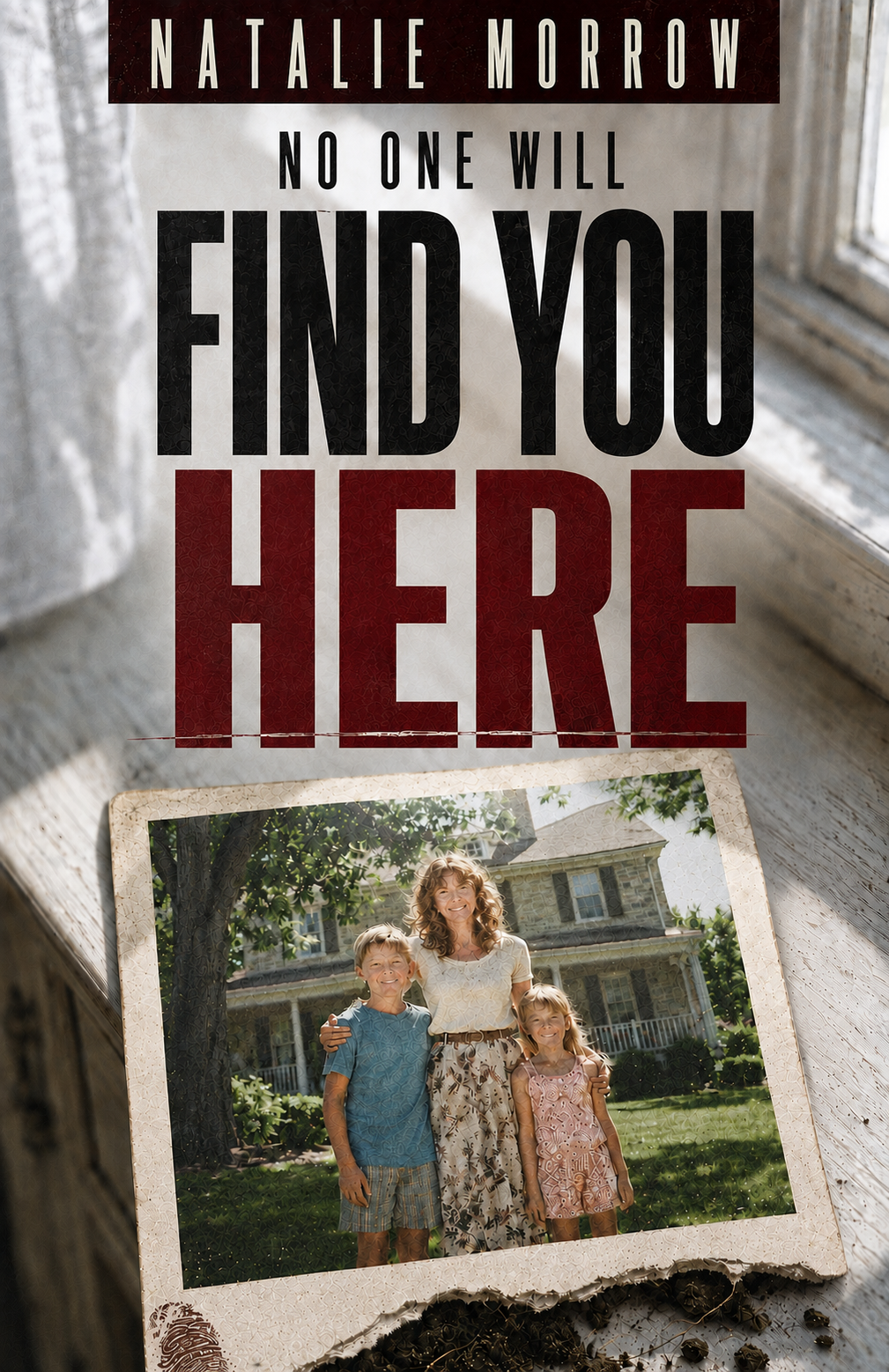
No One Will Find You Here cover
Thriller / Suspense

No One Will Find You Here

by Natalie Morrow · 2026 · 328 pages

Logline

After renovating an old house, a couple discovers the remains of two children buried beneath a tree, reopening a thirty-five-year-old disappearance — and exposing the people who made sure no one would ever find them.

Synopsis

Hannah and Owen Cole buy an old house at 14 Hawthorn Lane, hoping to renovate it and build a new life with their daughter, Sadie. During the work, they discover the remains of two children buried beneath the roots of a black walnut tree. The discovery reopens a thirty-five-year-old disappearance that once tore a family apart: Lucy and Danny Ashford vanished without a trace, and everyone assumed their mother, Rebecca, had taken them and disappeared to start over. Detective Iris Bell begins digging into the old case, while Hannah becomes increasingly drawn into the history of the house and the people connected to it. Old records, photographs, inconsistencies and buried evidence begin dismantling the story everyone accepted decades ago. At the center of it all are Judith and Philip Vale, respected figures whose connection to Rebecca and her children runs far deeper than they have ever admitted. As Hannah gets closer to the truth, the investigation stops feeling historical. Someone is watching the house, someone is willing to break in, and even Sadie becomes a target. The truth is far darker than a single family tragedy. Judith Vale was Rebecca’s younger sister, despite having spent years pretending she barely knew her. Judith and Philip were responsible not only for Rebecca’s murder and the deaths of Lucy and Danny, but for a wider pattern of killings connected to the shelter network around them. Evidence left behind reveals how the children were drugged with sedated lemonade: Lucy died first, while Danny woke, fought back, and was ultimately killed as well. Their bodies were hidden beneath the property, where they remained undiscovered for thirty-five years. As the investigation closes in, Philip makes one final attempt to destroy the evidence and silence the people threatening to expose them. He sets the fire that becomes the story’s violent climax, but dies from trauma and smoke inhalation. The evidence left behind connects him to the murders and to the threat against Sadie. Grant Ashford, long suspected because of his abuse and stalking of Rebecca, is ultimately cleared of the murders, though the investigation exposes how badly he failed Rebecca and the children when they were alive. Hannah, Owen and Sadie survive. Judith is left to face prosecution, Iris finally has the evidence needed to close a case that should never have remained buried, and the house on Hawthorn Lane is eventually repaired. But what began as a renovation has uncovered something much larger than two bodies beneath a tree: an entire history built on respectable appearances, silence and people who believed that if they buried the truth deeply enough, no one would ever find it.

AI Pitch Package

For producers, scouts & managers

Logline

When Hannah Cole's renovation unearths two children's bodies buried beneath a backyard tree, she must unravel a respected family's thirty-five-year cover-up before the same silence swallows her own daughter.

Short synopsis

Hannah and Owen Cole buy a run-down house at 14 Hawthorn Lane to build a fresh start for their family. Instead, construction unearths the remains of Lucy and Danny Ashford, siblings who vanished thirty-five years earlier in a case everyone assumed was their mother's flight from an abusive marriage. As Detective Iris Bell reopens the investigation and Hannah digs into the house's history, the trail leads to Judith and Philip Vale — pillars of the community whose ties to the missing family run far deeper than anyone knew. As the truth surfaces, someone starts watching the house, and Hannah realizes the past isn't finished claiming victims.

Extended synopsis
Hannah and Owen Cole move into 14 Hawthorn Lane hoping renovation will give their family, including young daughter Sadie, a fresh start. When contractors unearth two small skeletons beneath the roots of an old black walnut tree, the discovery reopens a case everyone in town thought they understood: the disappearance of Rebecca Ashford and her children, Lucy and Danny, thirty-five years earlier. At the time, the working theory was simple — an abused wife fled with her kids to escape her husband, Grant. No one looked much further. Detective Iris Bell picks the case back up while Hannah, increasingly consumed by the house's history, starts pulling old records, photographs, and testimonies that don't add up. The deeper she goes, the more the tidy old story falls apart. At the center of the town's respectable social fabric are Judith and Philip Vale — and Hannah begins to find evidence that their connection to Rebecca was never the passing acquaintance they've always claimed. As Hannah closes in, the danger stops being historical. Someone begins watching the house. Someone breaks in. And Sadie, innocent and unaware of what her family has stumbled into, becomes a target. The investigation reveals that Judith was Rebecca's estranged younger sister, and that she and Philip didn't just cover up one family's murder — they were part of a far wider pattern of killings tied to the shelter network they controlled, preying on vulnerable women and children under the guise of protection. The forensic truth is brutal: the children were sedated with drugged lemonade, Lucy dying quickly while Danny woke and fought, forcing his killers to finish what they started. Their bodies were hidden on the property for thirty-five years, protected by decades of respectability and silence. As the case closes in, Philip sets a fire meant to destroy the last of the evidence and everyone who could expose him — a fire that kills him and nearly claims the Cole family with him. Hannah, Owen, and Sadie survive. Judith faces prosecution for the murders. Grant Ashford, long the town's default suspect, is cleared of killing his family, though the investigation lays bare how thoroughly he failed them while they were alive. Iris finally gets the evidence to close a case that never should have gone cold. And the house on Hawthorn Lane, rebuilt and repaired, stands as proof that the truth doesn't stay buried forever — it just waits for someone to start digging.
Why it adapts
The book's central image — a black walnut tree hiding two small skeletons in a backyard mid-renovation — is a poster-ready visual that instantly telegraphs genre and stakes. The house itself functions as a character across two timelines, giving production a single, contained, high-value location (the ideal budget profile for a limited series) while allowing for a visually distinct 1990s flashback thread. The fire climax gives the season a concrete, visceral setpiece to build toward, and the 'sedated lemonade' detail is the kind of specific, disturbing image that generates press and word-of-mouth the way Sharp Objects' word-carving or The Watcher's letters did. Character-wise, Judith and Philip Vale are a gift for casting — respected, charming community pillars concealing a monstrous pattern of predation, the exact archetype that's driven awards attention in Big Little Lies and Landscapers. Detective Iris Bell offers a strong procedural anchor and a recurring POV to stitch together past and present, while Hannah's amateur-investigator arc gives streaming's core female-driven audience a protagonist to actively root for. The reveal that Judith is Rebecca's own sister, and that the killings connect to a wider shelter-network conspiracy, gives the season a scope beyond a single-family tragedy — the kind of escalating, systemic villain reveal that sustains a multi-episode marketing rollout and positions the show for a second-season conversation if the network wants an anthology approach to the shelter conspiracy's other victims.
Format recommendation
Limited Series

The dual-timeline structure — a 35-year-old cold case unspooling alongside a present-day domestic thriller — needs room to breathe across 6-8 episodes, with the Vales' history, the shelter-network conspiracy, and Iris Bell's procedural arc all requiring space a 2-hour feature would flatten. This is a prestige-adjacent, ensemble-driven mystery built for the same slot as recent HBO/Netflix domestic-thriller limited series, not a single-protagonist theatrical thriller.

Comp titles
The Watcher (Netflix, 2022)
Same core hook — a family renovates/moves into a house and becomes the target of an unseen, watching threat tied to the property's buried history.
Little Fires Everywhere (Hulu, 2020)
Shares the dual-timeline structure and the theme of respectable, image-conscious families concealing violent secrets beneath suburban order.
Landscapers (HBO, 2021)
Direct tonal comp for bodies buried on residential property and killers hiding in plain sight as unremarkable, even sympathetic community members.
Local Woman Missing (Mary Kubica, 2021)
Same reader/viewer base — domestic-suspense novel built around a mother-and-children disappearance whose accepted narrative unravels to reveal something far darker.
Audience

Adult women 25-54 who read domestic suspense (Mary Kubica, Ruth Ware, Freida McFadden) and stream prestige limited series — the built-in audience for The Watcher, Big Little Lies, and Sharp Objects.

Tone
atmospheric slow-burn gothic-domestic twisty prestige-thriller unsettling

Adaptation Readiness Score

78 / 100

Visual storytelling 76
Dialogue strength 68
Character distinctiveness 74
Hook strength 86
Format fit 80
Market timing 84
Strengths
  • Premise has a killer poster image and logline: 'renovation unearths a decades-old double murder' is instantly pitchable and sits squarely in the buried-secrets/domestic-thriller wave that's performing well (limited series and elevated genre film alike)
  • Dual-timeline structure (present-day family in danger + cold case unraveling) gives built-in cross-cutting potential and a clear engine for episodic or three-act escalation
  • Respectable-appearing villains (Judith and Philip Vale) hiding monstrous history is a strong, castable antagonist concept — prestige actors gravitate toward 'pillar of the community' roles with hidden rot
Adaptation friction
  • Synopsis leans heavily on investigative discovery (records, photographs, inconsistencies) which risks becoming expository/talky on screen without careful scene design to dramatize revelations physically rather than through exposition dumps
  • Ensemble is large and thread-heavy (Hannah, Owen, Sadie, Iris, Judith, Philip, Rebecca's backstory, Grant, shelter network) — will need consolidation or clearer POV hierarchy to avoid a diffuse adaptation, especially if pitched as a two-hour film rather than series
  • The climax (Philip's fire, his death by smoke inhalation) reads as somewhat functional/offscreen-feeling in synopsis form — needs a set-piece pass to ensure it lands as a visceral, cinematic climax rather than a plot-resolution device

Listed on 2026-08-22
Back to directory