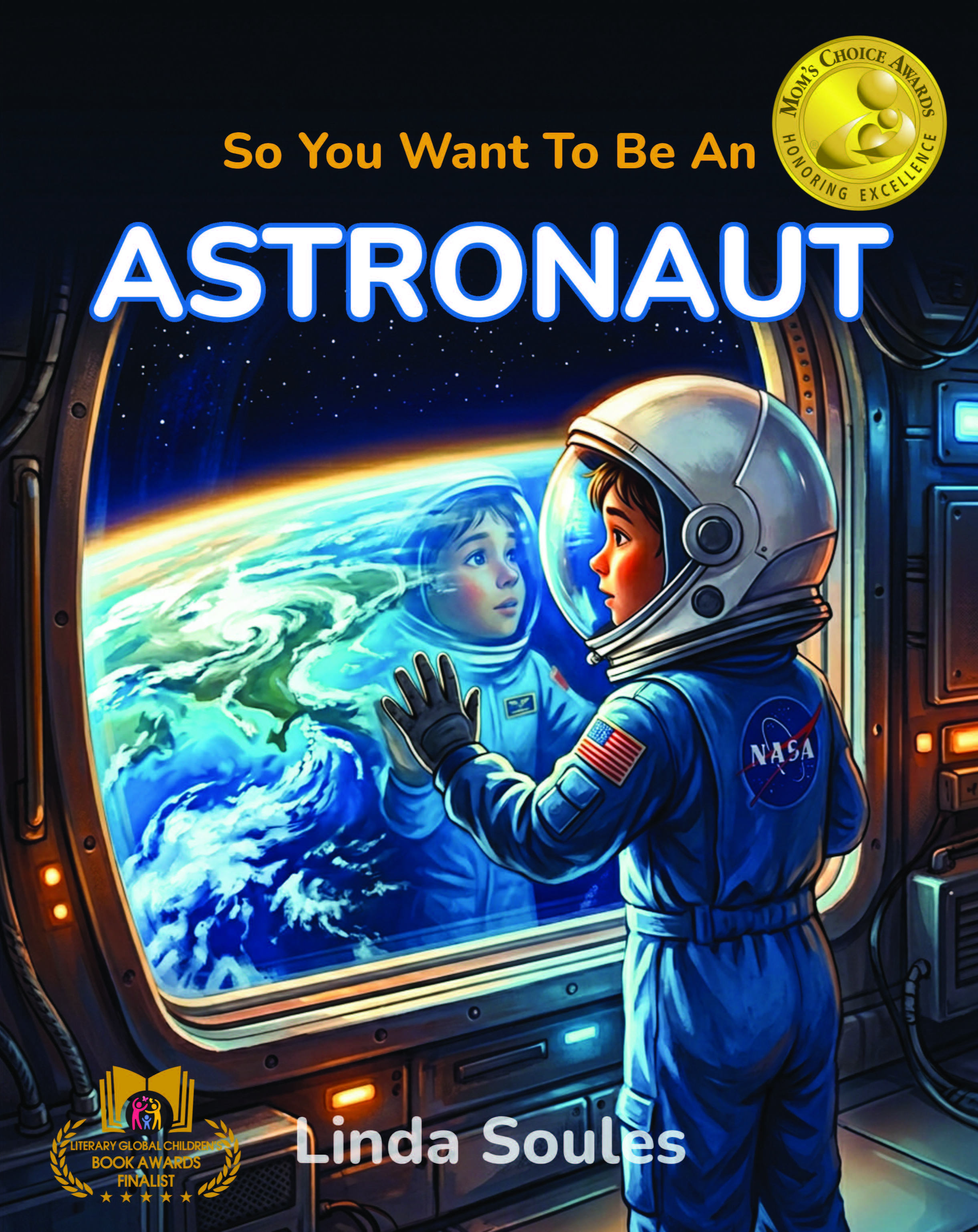
So You Want To Be An Astronaut cover
Children's Documentary Series

So You Want To Be An Astronaut

by Linda Soules · 29 pages

Logline

Addressing curious young readers directly, this illustrated career guide walks them through what astronauts actually do, from launch and spacewalks to loneliness and training, and shows how to start preparing now for a future among the star

Synopsis

The book opens by speaking directly to the reader: you want to leave the planet, and real people have done it. More than 700 people from over 45 countries have flown, and the next generation, through NASA's Artemis program, is headed back to the Moon and eventually Mars. The author frames astronauts not as daredevils but as scientists, mechanics, and explorers who work in orbit. The middle chapters describe the job in concrete detail. Astronauts run microgravity experiments, maintain the ISS, and perform spacewalks. They train for years in the Neutral Buoyancy Laboratory, in jets, on the "Vomit Comet," and in robotics, Russian, and emergency response. The book covers the tools of the trade, including the spacesuit, gloves, and Canadarm2, and gives a sample hour-by-hour day aboard the station. It also shows the people behind each mission: CAPCOMs, flight surgeons, flight directors, and engineers. The book is candid about the costs. Most of a career is spent on the ground, microgravity strains the body, and recovery is hard. The deepest hardship is missing birthdays, holidays, and ordinary moments with loved ones for six months or more. Against this it sets the rewards: the thunder of launch, the joy of floating, the view from the cupola, and the Overview Effect, the near-universal realization that Earth is one borderless, fragile home. Later sections list the qualities astronauts need: technical mastery, calm under pressure, teamwork, curiosity, diplomacy, mechanical versatility, and self-knowledge. They profile Yuri Gagarin, Mae Jemison, and Valentina Tereshkova, and add fun facts such as the way tears form spheres in space. A checklist helps readers decide whether the job fits them, and a glossary defines key terms. The ending is an invitation. The author urges readers to study everything, build fitness, practice staying calm, look through a telescope, and never accept that the dream is too big. Resource lists point to books, NASA websites, Space Camp, and backyard ISS spotting. The book closes with the message that astronauts go to see space but come home understanding Earth, and with the words: look up tonight, the stars are calling you.

AI Pitch Package

For producers, scouts & managers

Logline

Speaking directly to kids who dream of leaving Earth, this docuseries follows real astronauts and the ground crews behind them through training, launch, spacewalks, and months of isolation, revealing what the job demands and how viewers can start preparing.

Short synopsis

More than 700 people from over 45 countries have flown in space, and the Artemis generation is headed back to the Moon and on to Mars. This kids' docuseries uses the 'you' voice of Linda Soules's illustrated guide to show what astronauts actually do. They are scientists, mechanics, and explorers, not daredevils. Each episode takes one slice of the job: years of training in the Neutral Buoyancy Laboratory and on the 'Vomit Comet,' an hour-by-hour day on the ISS, spacewalks, and the mission control team on the ground. The series is candid about the costs, including long stretches on Earth, physical strain, and months away from family. It also delivers the payoff: the thunder of launch, the joy of floating, and the Overview Effect. Every episode ends with something viewers can try at home.

Extended synopsis
The series opens as the book does, with a direct address: you want to leave the planet, and real people have done it. A host, either an astronaut or a young science communicator, walks viewers through the numbers (700-plus flyers, 45-plus countries) and the new chapter led by NASA's Artemis program. The first episode reframes the astronaut as a working scientist, mechanic, and explorer, and sets up the series' question: do you have what it takes, and how would you find out? The middle episodes break the job into concrete, visual pieces. One follows the training pipeline: the Neutral Buoyancy Laboratory, jet flights, the parabolic arcs of the 'Vomit Comet,' robotics, Russian language, and emergency response. Another covers the tools of the trade, including the spacesuit, the gloves, and Canadarm2. A third plays out the book's sample day aboard the ISS hour by hour, with microgravity experiments, station maintenance, and a spacewalk. A dedicated episode goes to the people behind each mission: CAPCOMs, flight surgeons, flight directors, and engineers. The series then turns to the hard parts. Most of an astronaut's career is spent on the ground. Microgravity strains the body, and recovery is difficult. The deepest cost is missed birthdays, holidays, and ordinary moments with family during six-plus-month missions. Astronauts and their families speak to this on camera. The reward side follows: launch thunder, the joy of floating, the view from the cupola, and the Overview Effect, the realization that Earth is one borderless, fragile home. The final episodes cover character and call to action. One covers the qualities astronauts need: technical mastery, calm under pressure, teamwork, curiosity, diplomacy, mechanical versatility, and self-knowledge. It profiles Yuri Gagarin, Mae Jemison, and Valentina Tereshkova through archive and animation, with the book's fun facts, like tears forming spheres in space, as interstitial gags. The finale becomes a viewer's checklist, with study habits, fitness, staying calm, telescope use, Space Camp, and backyard ISS spotting. It closes on the book's line: look up tonight, the stars are calling you. Caveat for buyers: the source is a 29-page illustrated guide with no plot or fixed characters. The series would be built on the book's structure, voice, and chapter topics, and would need original access (NASA, ESA, or commercial-crew partners), archive licensing, and a host to carry the 'you' address.
Why it adapts
The material is built from visual set pieces that already exist on film or can be shot with partner access: the Neutral Buoyancy Laboratory, parabolic-flight weightlessness, launch, spacewalks, the Canadarm2, and the cupola view of Earth. The sample ISS day gives a ready-made episode structure with a ticking clock. Tears forming spheres and similar fun facts are strong short-form social clips for a young audience. The series has no fictional protagonist, but it can have distinctive human faces: working astronauts, flight surgeons, CAPCOMs, and the families who wait on the ground. The book's honest treatment of loneliness, missed birthdays, and the long ground-based career is what lifts it above a standard 'space is cool' show and gives parents something to engage with. The Gagarin, Jemison, and Tereshkova profiles add archival and animated material and a diverse set of role models. Marketability is strong. Artemis gives it a current news hook, and educators have a standing appetite for STEM content with real career pathways. Each episode can end on a 'try this tonight' action, such as ISS spotting or telescope use, which supports companion curriculum, a Space Camp tie-in, and a social campaign around 'look up tonight.' The main risk is that the book is thin, so the producer must secure access and archive rights and choose a host with real charisma.
Format recommendation
Documentary Series

The book is a topic-by-topic career guide with no narrative arc, so it maps naturally to a themed episode-per-chapter nonfiction series rather than a feature. The direct-address voice suits a host-led kids' docuseries with real astronauts, training footage, and at-home activities. A feature would feel thin, and a scripted format would have no story to dramatize.

Comp titles
Mission Unstoppable
A real-world STEM series for kids hosted by Miranda Cosgrove that spotlights working women scientists and engineers. It shares the same inspirational, career-awareness mission and young audience.
Return to Space
A Netflix documentary on SpaceX and NASA Commercial Crew that shows the scale and spectacle of modern launches. It is a good reference for access, visuals, and the human cost of spaceflight.
Countdown: Inspiration4 Mission to Space
A Netflix docuseries following ordinary people training for orbit. It supports the 'could this be you?' hook and the emotional beat of families left on the ground.
Space Explorers: The ISS Experience
A series that puts viewers inside the International Space Station with real astronauts. It is a direct precedent for the ISS day-in-the-life and cupola-view episodes.
Ada Twist, Scientist
A Netflix kids' series that models curiosity and experimentation for young viewers. It is a reference point for pairing a STEM career message with at-home activities.
Audience

Primary: kids 6-11 and their parents or teachers, co-viewing as family and classroom content. Secondary: space-curious adults and Artemis-era fans. Audiences of Mission Unstoppable, Magic School Bus Rides Again, Ada Twist Scientist, Bluey-adjacent family co-viewing, and NASA+ and Netflix space documentaries will respond.

Tone
wonder-filled inspirational candid educational direct-address hands-on

Adaptation Readiness Score

68 / 100

Visual storytelling 82
Dialogue strength 42
Character distinctiveness 55
Hook strength 70
Format fit 72
Market timing 74
Strengths
  • Built-in visual spectacle: launch, spacewalks, the cupola view, floating tears, Neutral Buoyancy Lab and Vomit Comet training. These are ready-made documentary set pieces with strong archival and NASA footage access.
  • A clear, modular structure (the job, the training, the costs, the rewards, the qualities needed, and how to start now) maps naturally onto episodic documentary architecture, with each chapter suggesting an episode or segment.
  • The book is candid about the costs of the career, especially missed birthdays and holidays and the physical toll, and sets them against the Overview Effect. That emotional counterweight gives a documentary an arc beyond a simple explainer.
Adaptation friction
  • It is a 29-page guide with no narrative protagonist or throughline. A documentary series needs real people with stakes, and the book offers only brief profiles of Gagarin, Jemison, and Tereshkova.
  • There is no dialogue or interview material on the page. Voice, personality, and on-camera texture would all have to be built from scratch through new interviews.
  • The direct-address, aspirational tone is aimed at young readers. It would need a deliberate format decision (kids' educational series vs. family docuseries) to find a clear buyer, in a space already crowded with NASA and space-exploration content.

More books in the directory
Listed on 2026-11-02
Back to directory