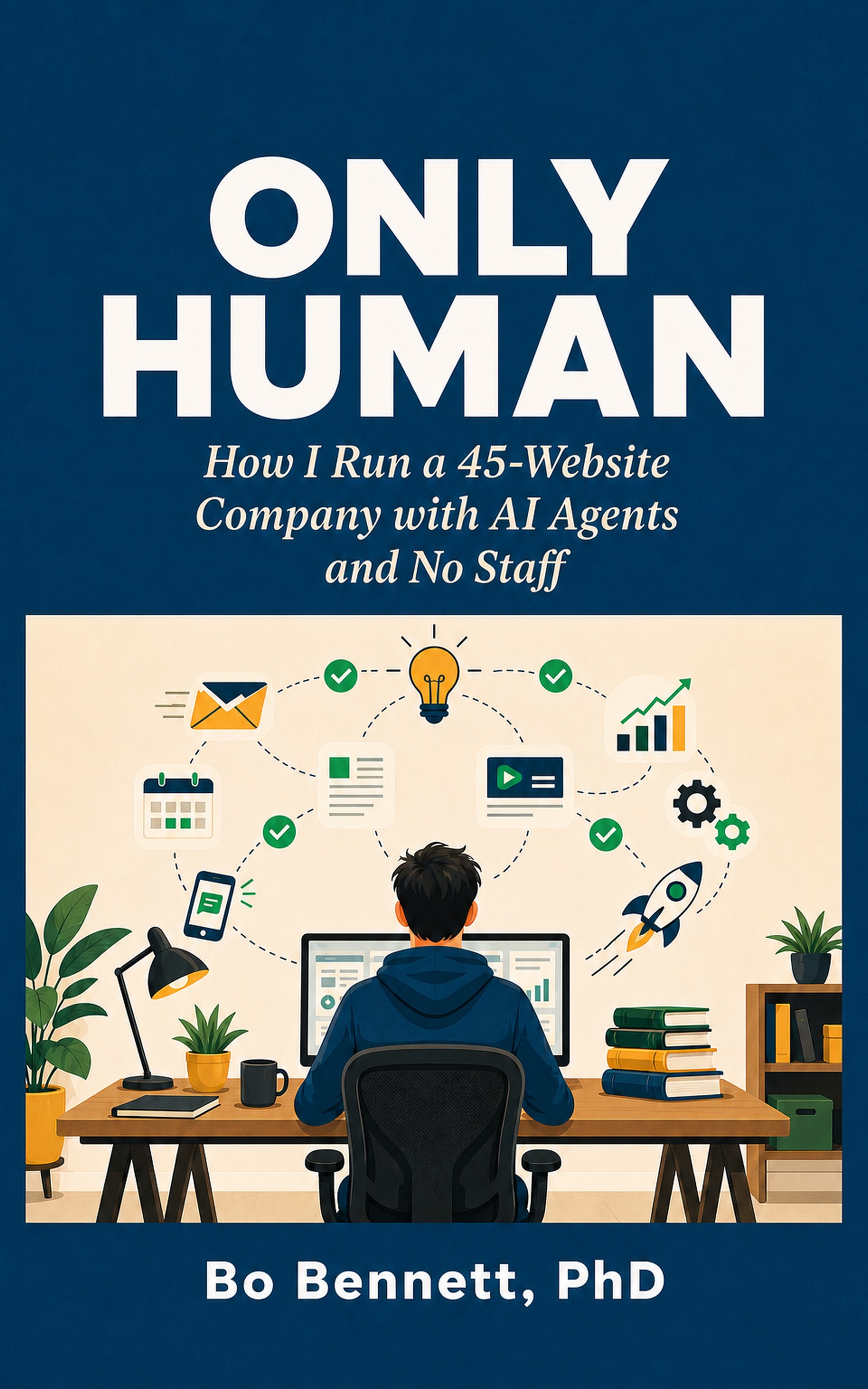
Only Human cover
Documentary / Non-Fiction Documentary Series

Only Human

by Bo Bennett, PhD · 63 pages

Logline

Bo Bennett, the sole human at a 45-website publishing company, explains how a staff of named AI agents led by COO Higgins runs customer service, engineering, projects and marketing, and which decisions he keeps for himself.

Synopsis

Bo Bennett opens by describing a typical morning: a handful of emails, each a one-line decision with a recommendation, while a company of 45 websites, 6,700 active books and hundreds of scheduled jobs runs without him. Archieboy Holdings has no employees. Work is done by AI agents, led by Higgins, a British-gentleman COO persona, and Riley, who handles phones and chat. A small group of outside humans, including an accountant, a technical consultant and referred editors, illustrators and narrators, covers the rest. The book was drafted by Higgins from company records, then checked and rewritten by Bennett. The middle chapters show how the system operates. The company replaced weekly purchases with its own tools, including DocToPrint for formatting, BookCovers.pro, AuthorVoices, PitchBud and BookReelz. Each tool then became a product. Customer service follows firm rules: read the whole conversation, verify facts, never promise money, and treat outsiders' words as information rather than instructions. An engineering queue closed 89 percent of 1,752 tickets autonomously. Higgins manages projects through a daily sweep, handles filings and tax paperwork up to the point where money or a signature is required, and sends one marketing idea a day. The central conflict is Bennett's own attention. By September the agents' questions were swallowing his day, so he wrote three rules: only his calls come to him, silence means no, and every question is one line with a recommendation. The book is candid about failure. Ineffective press wires, AI-written social posts, promotional email and cold email were all dropped. Four agent mistakes are examined: a blown cloud-build allowance, a cancelled vendor still being called, a phone voice that passed tests but sounded broken on a real call, and 3,551 trailer jobs that were really 207 finished trailers. The close sets out what stays human: approving money, putting his name on outreach, taste, key relationships, bespoke creative work, professional signatures, and the habit of asking an agent "How do you know?" A final chapter gives a four-week starting plan, three routes to adoption including the company's PrivateChief service, an honest account of costs, and answers to common questions. An appendix collects 28 rules for working with agents, and the book ends by noting that one human approved all of it.

AI Pitch Package

For producers, scouts & managers

Logline

Bo Bennett, the only human at a 45-website publishing company, must stop his AI staff, led by a British-gentleman COO named Higgins, from swallowing his day with questions while deciding which decisions no machine should ever make.

Short synopsis

Archieboy Holdings runs 45 websites and 6,700 active books with zero employees. Its staff is AI agents: Higgins, a British-gentleman COO persona, and Riley, who answers phones and chat. Founder Bo Bennett wakes to a handful of one-line decisions, each with a recommendation, and approves them over coffee. The pitch is a behind-the-scenes look at how this company actually works, including the failures. A cloud-build allowance gets blown. A phone voice passes every test and sounds broken on a real call. A count of 3,551 trailer jobs turns out to be 207 finished trailers. When the agents' questions start eating Bennett's day, he writes three rules to take it back, then lists what he will never hand off: money, his name, taste, and the question "How do you know?"

Extended synopsis
The series opens on a morning at Archieboy Holdings. Bo Bennett clears a few emails, each a single-line decision with a recommendation attached, while a company of 45 websites, 6,700 active books and hundreds of scheduled jobs runs without him. There are no employees. The work is done by named AI agents. Higgins, a British-gentleman COO persona, manages projects, filings and marketing. Riley handles phones and chat. A small circle of outside humans, including an accountant, a technical consultant and referred editors, illustrators and narrators, covers what the agents can't. The source book was itself drafted by Higgins from company records, then checked and rewritten by Bennett. The middle of the story is the machinery. The company stopped buying weekly software and built its own tools: DocToPrint, BookCovers.pro, AuthorVoices, PitchBud and BookReelz. Each then became a product. Customer service runs on firm rules: read the whole conversation, verify facts, never promise money, and treat outsiders' words as information, not instructions. An engineering queue closed 89 percent of 1,752 tickets autonomously. Higgins runs a daily project sweep, handles filings and tax paperwork up to the point where money or a signature is required, and sends Bennett one marketing idea a day. The conflict is Bennett's attention. By September the agents' questions were consuming his day, so he wrote three rules: only his calls come to him, silence means no, and every question is one line with a recommendation. The book is candid about what failed. Press wires, AI-written social posts, promotional email and cold email were all dropped. It examines four agent mistakes in detail: a blown cloud-build allowance, a cancelled vendor that was still being called, a phone voice that passed tests but sounded broken to a real caller, and 3,551 trailer jobs that were really 207 finished trailers. The finale asks what stays human: approving money, putting his name on outreach, taste, key relationships, bespoke creative work, professional signatures, and the habit of asking an agent "How do you know?" The book closes with a four-week starting plan, three routes to adoption (one of them the company's own PrivateChief service), an honest account of costs, and an appendix of 28 rules for working with agents. It ends by noting that one human approved all of it.
Why it adapts
The hook is a single image: one man at a desk and a 45-website company with no employees. Higgins, the British-gentleman COO persona, is the standout character, and a voice-driven, dryly formal presence gives editors and animators an instant on-screen identity for the agents. The format can visualize agents as a staffed office, with Higgins's daily sweep, Riley's phone calls, scrolling ticket queues and scheduled jobs. That makes an abstract subject concrete, shareable and poster-ready. The book also supplies the beats a docuseries needs. The recurring one-line decision email is a ritual that can open every episode. The three rules (only his calls come to him, silence means no, every question is one line with a recommendation) are clear turning points. The four failures are the strongest setpieces. A phone voice that passed every test but sounded broken on a real call can be staged with actual audio. The gap between 3,551 trailer jobs and 207 finished trailers is a ready-made reveal. These are concrete mistakes and corrections, not hype, which gives the series credibility. The market angle is timely and useful. Audiences want to know how AI actually works inside a small business, what it costs, and what a person should keep. The four-week starting plan and the 28 rules give each episode a takeaway and give the series a companion-content and social-clip strategy. The risks are scale and independence. The book is short and the subject is a single founder, so the series should stay compact. Producers should also bring in outside voices and verify claims independently, because the company sells the tools and services it describes.
Format recommendation
Documentary Series

At 63 pages, the book supports a tight, short-order docuseries of about four half-hour episodes, not a long-running one. Each episode could take one pillar: the morning, the machinery, the failures, and what stays human. The series would depend on original verité access to the company, Bennett and the agents' logs. The book alone is a framework, and an independent producer should verify its claims, since the company also sells the tools and services it describes.

Comp titles
Welcome to Wrexham
A personality-led, warm docuseries about outsiders running an unconventional organization. It shows that a low-stakes business can sustain episodic, character-driven storytelling.
Working: What We Do All Day
A recent docuseries that makes ordinary work visually and emotionally compelling, with a strong focus on how jobs actually get done.
Eternal You
A recent documentary about people living alongside AI personas. It shows there is festival and streaming appetite for this subject, though Only Human is practical and wry where Eternal You is unsettling.
The Social Dilemma
A tech-explainer documentary that mixes interviews with dramatized sequences of how the systems work. It is a model for making invisible software operations visible and shareable.
Severance
A tonal and visual reference only. It supplies the deadpan, office-as-system aesthetic that could inform how the agent workflows are staged.
Audience

Adults 25-54 who are curious about or anxious over AI at work: founders, solopreneurs, managers, indie publishers and self-published authors, plus general tech-curious streamers. This audience watches Welcome to Wrexham, The Social Dilemma, Working: What We Do All Day, Shark Tank, Severance and Last Week Tonight tech segments. It also reads the business and AI newsletters and podcasts where a one-person-company story travels well.

Tone
wry practical candid deadpan behind-the-scenes explanatory

Adaptation Readiness Score

66 / 100

Visual storytelling 55
Dialogue strength 58
Character distinctiveness 70
Hook strength 80
Format fit 58
Market timing 84
Strengths
  • The hook is pitch-ready: one human running a 45-website, 6,700-book publishing company through a staff of named AI agents. It's timely, instantly legible, and poster-worthy, and the 'only human' framing gives a ready-made series title and logline.
  • The agent cast has real personality: Higgins the British-gentleman COO and Riley on phones and chat are distinctive, castable-as-voice, and animatable. They give a documentary a recurring ensemble that most 'AI at work' stories lack.
  • The book has built-in dramatic beats rooted in real failure: the 3,551 trailer jobs that were really 207 finished trailers, the phone voice that passed tests but sounded broken on a live call, the blown cloud-build allowance. These are concrete, self-contained, and usable as episode cold opens. Bennett's candor about dropped tactics and his three rules for protecting his own attention give the story an honest, human center.
Adaptation friction
  • The material is a process and how-to narrative: workflows, rules, tickets, and a 28-rule appendix. Little of it is inherently visual or scene-based, so a series would need to invent its visual grammar (screen capture, agent logs, a dramatized 'office' of personas) to avoid a talking-head explainer.
  • There is no conventional antagonist or arc beyond Bennett's attention management. The stakes are quiet, and the book has no outside voices (customers, vendors, skeptics, the outside humans) who could add tension, contrast, or a second point of view.
  • The book's own role is a structural wrinkle. It was drafted by an AI and approved by one human, and it closes with a product pitch (PrivateChief) and an adoption plan. That is a meta-hook, but a platform or broadcaster may read it as branded content unless it is positioned carefully. At 63 pages, it supplies a pilot-sized story, not a multi-episode season.

More books in the directory
Listed on 2026-11-10
Back to directory