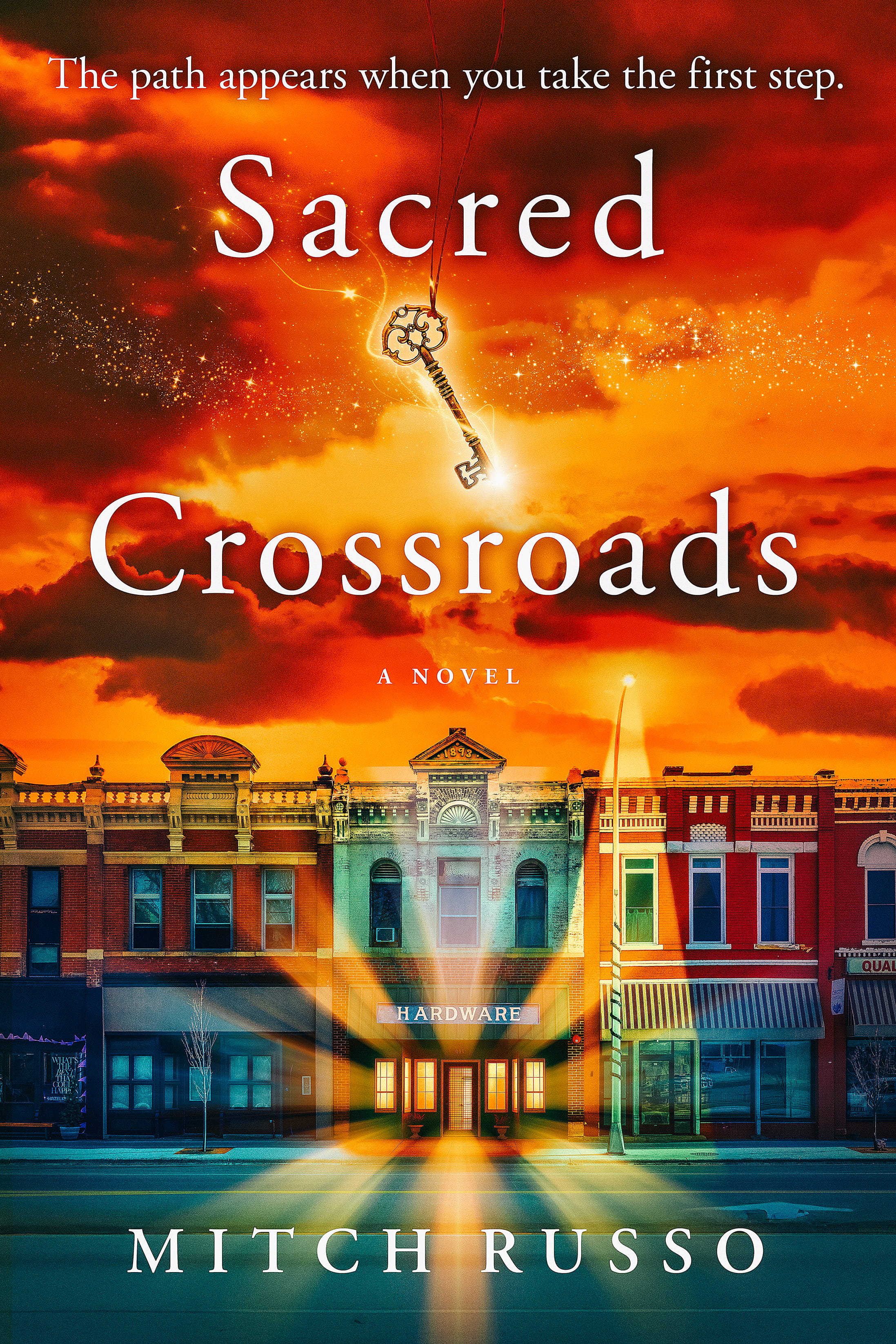
Sacred Crossroads cover
Fantasy Limited Series

Sacred Crossroads

by Mitch Russo · 223 pages

Logline

A grieving, rigidly rational hardware store owner must finally embrace the magic his family has guarded for generations, then rally his small town against a federal suppression program determined to bulldoze his store and normalize his neig

Synopsis

Noble Manning has run Manning's Hardware in Cedar Springs, Massachusetts, for 35 years, treating ledgers and inventory as armor against grief and against the strangeness his wife Eleanor photographed until she died chasing wild horses in Montana. When his daughter Sarah calls from Seattle at 3 a.m. to say her grandmother's key is glowing, Noble flees the store's awakening, but the Night Walker delivers a second key, and Eleanor's journal and unfinished final photographs force him to accept what he has long refused to see. He realizes the store is a threshold built on chosen ground, and that every customer carries two needs, the one they name and the one they cannot. As the gifts of the town spread (Mrs. Chen's memory-laden bread, Jack's singing wood, Maria's flowers), Business Association head Harold Whitaker summons Stanford Blackwell, a consultant who has normalized seventeen communities after witnessing real harm. Noble also reconciles with his father's ghost in a sealed room, learning why the family hid the truth. At a tense Association meeting, Blackwell's evidence of past tragedies sways the board. A tie vote, decided by Marcus Whitman's abstention, approves suppression, and a federal agent arrives with a decommissioning order and six bulldozers. Noble asks for one night, sees a vision of a Cedar Springs that has forgotten itself, and returns to find the community sitting in the street to block the machines. Even Harold's faction joins them. Noble is taken into federal custody, but he hands agent Diana Wells Eleanor's photographs. Diana discovers that her mother's supposed delusional death was built from edited evidence, and that the neural changes labeled toxic are actually enhancements. She breaks Noble out of a facility on the eve of a lobotomy-style procedure. Meanwhile, Blackwell, who lost his own wonder-filled bookstore years earlier, rereads his data and begins to doubt his life's work. When military helicopters and dampening equipment arrive, the town's gifts surface despite the suppression. News crews broadcast the standoff live, Diana exposes the falsified files, and Stanford confronts Colonel Matthews with his mother's story. A six-year-old, Sofia, delivers a message from the colonel's late mother, and he halts the operation. Cedar Springs holds. Stanford opens a bookstore beside the hardware store, Marcus begins building a playhouse, and Diana dedicates herself to undoing the program. Twelve years later, Noble's granddaughter Emma sees that the springs connect all the formerly suppressed towns, while a shadowy buyer, Victoria Kane, begins acquiring property in them. The work, Noble says, is not meant to be finished.

AI Pitch Package

For producers, scouts & managers

Logline

When a grieving, relentlessly rational hardware store owner discovers his shop is a magical threshold, he must embrace the family secret he's denied for decades and rally his Massachusetts town against a federal program set on bulldozing it.

Short synopsis

Noble Manning has run Manning's Hardware in Cedar Springs, Massachusetts, for 35 years, using ledgers and inventory to hold off grief and the strangeness his late wife Eleanor photographed. When his daughter calls at 3 a.m. to say her grandmother's key is glowing, the store wakes up, and Noble can't keep refusing what he sees. As the town's gifts surface (memory-laden bread, singing wood, impossible flowers), a consultant named Stanford Blackwell arrives to 'normalize' the community, backed by a federal order and six bulldozers. Noble has one night to decide whether to keep the family secret or defend it. Agent Diana Wells holds the evidence that could break the program open.

Extended synopsis
Noble Manning is a widower who treats his hardware store like a fortress. Eleanor, his wife, photographed the uncanny corners of the world until she died chasing wild horses in Montana. He answers her loss with order and refuses to look at what her pictures show. When his daughter Sarah phones from Seattle at 3 a.m. to say her grandmother's key is glowing, the store begins to wake. Noble runs from it. The Night Walker delivers a second key, and Eleanor's journal and unfinished final photographs close off his options. Cedar Springs is built on chosen ground, the store is a threshold, and every customer arrives with two needs: the one they name and the one they can't. As the town's gifts spread, Business Association head Harold Whitaker brings in Stanford Blackwell, a consultant who has normalized seventeen communities after witnessing real harm. Noble meanwhile reconciles with his father's ghost in a sealed room and learns why the family hid the truth. At a tense Association meeting, Blackwell's evidence of past tragedies sways the board. A tie vote, decided by Marcus Whitman's abstention, approves suppression. A federal agent arrives with a decommissioning order and six bulldozers. Noble asks for one night. He sees a vision of Cedar Springs after it has forgotten itself, and he returns to find his neighbors sitting in the street to block the machines. Even Harold's faction joins them. Noble is taken into federal custody, but he hands agent Diana Wells Eleanor's photographs. Diana finds that her mother's 'delusional' death was built on edited evidence, and that the neural changes the program labels toxic are enhancements. She breaks Noble out of a facility on the eve of a lobotomy-style procedure. Blackwell, who lost his own wonder-filled bookstore years earlier, rereads his data and starts to doubt his life's work. The climax is a live-broadcast standoff. Military helicopters and dampening equipment arrive, and the town's gifts surface anyway. Diana exposes the falsified files on camera, and Stanford confronts Colonel Matthews with his own mother's story. Six-year-old Sofia delivers a message from the colonel's late mother, and he halts the operation. Cedar Springs holds. Stanford opens a bookstore beside the hardware store, Marcus builds a playhouse, and Diana sets out to dismantle the program. Twelve years later, Noble's granddaughter Emma discovers that the springs link every formerly suppressed town, while a shadowy buyer named Victoria Kane quietly acquires property in them. The work, Noble says, is not meant to be finished.
Why it adapts
The premise reads on a poster: an ordinary New England hardware store, six bulldozers, and an entire town sitting in the street. The visual vocabulary is tactile and specific, with glowing keys at 3 a.m., singing wood, Mrs. Chen's bread unlocking memories, Maria's impossible flowers, and Eleanor's unfinished photographs that show what Noble refuses to see. Each gift is a standalone setpiece that practical effects and light-touch VFX can deliver on a limited-series budget, since most of the story happens in one contained, ownable location. The ensemble is the engine. Noble is a reluctant protagonist with a clear flaw and a clear transformation. Stanford Blackwell is a rare antagonist with a wound: he is a failed-bookstore-owner-turned-suppressor who gradually loses faith in his own data. Diana Wells has a personal stake and a cinematic mid-story prison break. Marcus's tie-breaking abstention, Harold's faction joining the sit-in, and Sofia delivering a dead mother's message to a colonel are strong ensemble beats that a series can set up and pay off properly. It is marketable because it dramatizes a current anxiety, institutions that call erasure 'normalization,' in a hopeful, emotionally generous register. The live-news standoff gives the finale a built-in set piece, and the twelve-years-later reveal of connected springs and an acquisitive Victoria Kane opens a franchise. The main production risk is that the book is short at 223 pages, so a writers' room will need to deepen the town's secondary characters and Blackwell's past to fill the episode count.
Format recommendation
Limited Series

The story has distinct movements (denial, awakening, the vote, the standoff, the aftermath) and a large ensemble of townspeople, each with a gift and an arc. A feature would reduce them to background color. A 6-8 episode limited series gives the town room to be a character, and the Victoria Kane and Emma coda sets up a second season without needing one.

Comp titles
Encanto
Shares the premise of a family and community defined by inherited, place-bound magic, with gifts that are both blessing and burden and a house at the center of the story.
A Man Called Otto
Matches the grieving, rigid widower who is slowly pulled back into community by the neighbors he keeps rejecting, with the same tearjerking, intergenerational warmth.
Locke & Key
Offers a comparable key-and-threshold mythology, a family secret passed down through generations, and a house that works as a magical engine for the plot.
Stranger Things
Pairs small-town ensemble fantasy with a government apparatus that fears and suppresses the extraordinary, including a facility, a rescue, and a broadcast-scale showdown.
Audience

Adults 25-54, skewing female, plus family co-viewers 14 and up. This is the audience for cozy-meets-epic fantasy and heartfelt ensemble dramas such as Encanto, A Man Called Otto, Resident Alien, Ted Lasso, Locke & Key, and Stranger Things. The small-town setting, themes of grief and community, and anti-institution politics also reach book-club and Hallmark-adjacent viewers.

Tone
warm wondrous grief-tinged ensemble-driven defiant small-town

Adaptation Readiness Score

76 / 100

Visual storytelling 80
Dialogue strength 70
Character distinctiveness 76
Hook strength 77
Format fit 74
Market timing 78
Strengths
  • A hardware store as a magical threshold is a distinctive, production-friendly central location. It gives a limited series a warm, tactile home base, and 'every customer carries two needs, the one they name and the one they cannot' is a ready-made episodic engine.
  • The town's gifts (Mrs. Chen's memory-laden bread, Jack's singing wood, Maria's flowers) are vivid, visual and character-linked. They suit ensemble storytelling and give each episode a signature image and a natural spotlight character.
  • The climax is built for screen: sit-in against six bulldozers, helicopters and dampening equipment, live news broadcast, and a six-year-old delivering a dead mother's message to a colonel. It has real emotional payoff, and the 'normalization' program gives the story a timely, resonant antagonist.
Adaptation friction
  • The story is front-loaded with interiority (grief, ledgers as armor, Eleanor's journal, the father's ghost). Noble's arc from rational skeptic to believer needs external dramatic action so it doesn't play as people talking about feelings.
  • The antagonist structure is crowded and resolves quickly. Blackwell, Harold, Diana, Colonel Matthews and Victoria Kane each carry a turn, and several conversions (Harold's faction joining the sit-in, Blackwell's doubt, the colonel halting the operation) happen fast and risk feeling convenient rather than earned.
  • At 223 pages the material is lean for a limited series, and the ending's 'twelve years later' coda with the springs network and Victoria Kane is more of a sequel tease than a resolution. The middle needs expansion to sustain 6-8 episodes.

More books in the directory
Listed on 2026-10-21
Back to directory