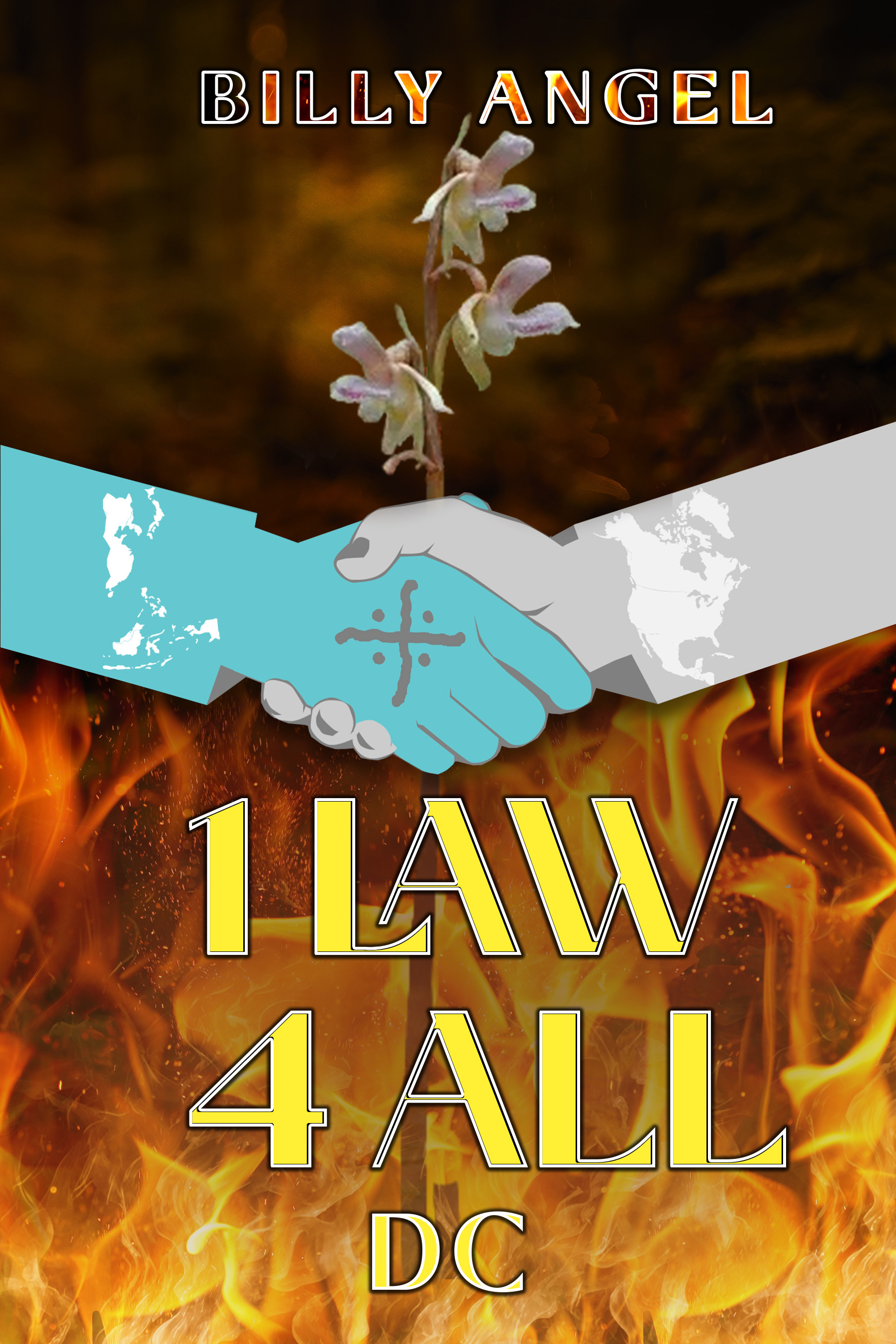
1 Law 4 All - DC
by Billy Angel · 280 pages
A tight-knit legal foundation uncovers a shadowy international organization behind a deadly ranch explosion, a groomed congresswoman, and a plot involving AI, bioweapons, and global political manipulation.
Synopsis
AI Pitch Package
For producers, scouts & managers
Logline
Hours after her DC wedding, Carol learns her 98-year-old grandmother and a mysteriously youthful stranger died in a staged ranch explosion, forcing her legal-activist Foundation to unmask a Nazi-rooted syndicate grooming a congresswoman and weaponizing AI.
Short synopsis
The '1 Law 4 All' Foundation, a circle of lawyers, activists and a DC political blogger, gathers at the Lincoln Memorial for the wedding of Carol and Karl. In Montana, Carol's 98-year-old grandmother Ida is visited by a much younger German-Brazilian stranger. He shares an unexplained intimate history with her, carries a notebook marked with a crooked cross and four dots, and seems to make her decades younger. Fake Mormon missionaries, actually assassins for a Brazil-based organization called the Group, scout the ranch. Cartel chemist Ramon then rigs a sleeping gas, thermite and propane leak, and the cottage explodes at dawn with two bodies inside. The Foundation flies to Montana on a senator's jet and reads the forensic evidence, which points to a professional hit tied to a global conspiracy.
Extended synopsis
Why it adapts
The book has a large ensemble, several separate threads (DC, Montana, the Group's recruitment pipeline, the cartel hitters) and an ending that opens the conspiracy rather than closing it, so it can't be squeezed into a feature. Season one can cover this book as an 8-10 episode arc, with the Foundation's investigative-team format and the 'DC' in the title supporting further seasons in new locations. Because the book mostly sets up the mythology, the writers' room would have to build out the middle and the payoff.
Adults 25-54 who like binge-able conspiracy thrillers and ensemble procedurals, with strong crossover appeal for older viewers and Western and heartland audiences. This is the audience for The Night Agent, Hunters, Yellowstone, Reacher and The Lincoln Lawyer. The AI and political-manipulation themes also appeal to viewers of current-affairs-driven thrillers like Mr. Robot and Black Mirror.
Adaptation Readiness Score
72 / 100
- The ranch explosion is a strong, cinematic setpiece with real procedural texture: Ramon's homemade sleeping gas, thermite clay balls, a propane leak, a night approach on electric mountain bikes, and the forensic trail left behind. It could anchor a pilot or a cold open.
- The premise has a clear pitch: a group of friends, one wedding, and a deadly explosion that unravels a Nazi-rooted global conspiracy involving AI, bioweapons, and groomed politicians. The scale suits an episodic, mystery-box thriller.
- The ensemble and the layered structure give a series room to work. The Foundation investigators, the Group's groomed asset EAR, the cartel hitmen, the fake missionary assassins, and Ida's mysterious visitor each have a distinct storyline that can run in parallel across episodes.
- The Foundation has a large, fast-introduced roster (Mac, Kitiona, Jimmy, Ben, Juan, Dominique, Bob, plus Carol and Karl). Several are defined mostly by profession or background, so no single protagonist or emotional engine is clear yet. Audiences and actors need one lead to anchor the investigation.
- The conspiracy is broad and somewhat familiar (Nazi roots, Bilderberg, quantum AI, anti-aging compounds, bioweapons). The most distinctive elements, Ida's rejuvenation and her intimate history with the stranger, are left unresolved, and the global stakes are told through exposition rather than dramatized.
- Much of the investigative momentum seems to come from discussion and analysis, such as emailing evidence mid-flight and talking through the Nepal robbery over drinks. That risks static scenes and needs more active, character-driven pursuit.
- 1 Law 4 All by Billy Angel
- First Class Fool: A Solo Traveller’s Survival Guide by Steve Barker
- Brother Against Brother Civil War by Steven D. Shepard
- Arsenal Code R.E.D. by Roger A. Jetter