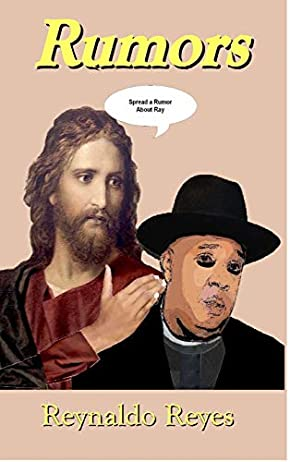
RUMORS
by Reynaldo Reyes · 90 pages
Reynaldo Reyes, a Brooklyn teenager plagued by paranormal visions after a Halloween night, must uncover the truth behind a malevolent deity's decades-long scheme tying him to the unsolved murder of rap icon Jam Master Jay.
Synopsis
AI Pitch Package
For producers, scouts & managers
Logline
A Brooklyn teenager haunted by escalating visions after a Halloween night must determine whether he's cursed by a malevolent god or losing his mind, as his prophecies collide with the real unsolved murder of rap icon Jam Master Jay.
Short synopsis
In 1980s Park Slope, teenage Reynaldo Reyes begins experiencing inexplicable phenomena after a Halloween party: phantom furniture-dragging, impossible visitors, a portal of fire in his kitchen. As he ages, the hauntings evolve into full religious mania—he becomes certain that Yahweh is a malevolent impostor god persecuting him to suppress a truth he alone can reveal. When Reynaldo claims to have foreseen the 2002 murder of Run-DMC's Jam Master Jay years in advance, his private cosmology collides with a real, still-unsolved crime. Psychiatric breakdowns, arrests, and betrayals pile up around him even as a Hollywood deal seems to fulfill an old prophetic dream—leaving the audience to decide if Reynaldo is a prophet, a victim, or dangerously unwell.
Extended synopsis
Why it adapts
The material spans four decades, requires a slow-burn accumulation of dread and religious mythology that a single feature can't hold, and lives or dies on the audience's uncertainty about the protagonist's reliability—something serialized television does far better than a two-hour film. A limited series (6-8 episodes) also allows the real Jam Master Jay case to be woven in as a season-long mystery engine rather than a single third-act reveal.
Adult genre-TV viewers (25-54) who follow prestige horror and true-crime-adjacent mystery—the Lovecraft Country / Servant / The Outsider crowd—plus hip-hop culture audiences drawn in by the Run-DMC/Jam Master Jay connection and 80s-90s Brooklyn nostalgia.
Adaptation Readiness Score
68 / 100
- A genuinely high-concept hook — a supernatural conspiracy narrative fused with the real, still-culturally-resonant unsolved Jam Master Jay murder gives instant pitch-ability and built-in audience curiosity
- Strong, specific eerie imagery (the winter bumblebee, the vanishing star, the flaming kitchen portal) that could anchor standout visual setpieces episode to episode
- A vivid, singular protagonist voice — an unreliable narrator convinced he's caught in a decades-long cosmic frame job — offers a fresh angle in the crowded prestige-horror/true-crime space
- Using a real murdered public figure and an actual unsolved (now partially adjudicated) case as the spine of a personal conspiracy narrative raises significant legal/clearance and reputational risk that any studio will flag early
- The narrative is heavily interior — visions, prophetic dreams, and psychological/spiritual conviction — which will need substantial dramatization and externalized conflict to avoid becoming narration-driven rather than scene-driven
- The unresolved, 'TO BE CONTINUED' ending works for open-ended mythology but currently lacks a satisfying season-one closing beat, making it harder to sell as a contained pitch
- Víctor Stranger : El destajador de monstruos by KeinZ
- First Class Fool by Steve Barker
- First Class Fool: Lost Outdoors, Found Eventually by Steve Barker
- Phun Lyfe by A K Stephen