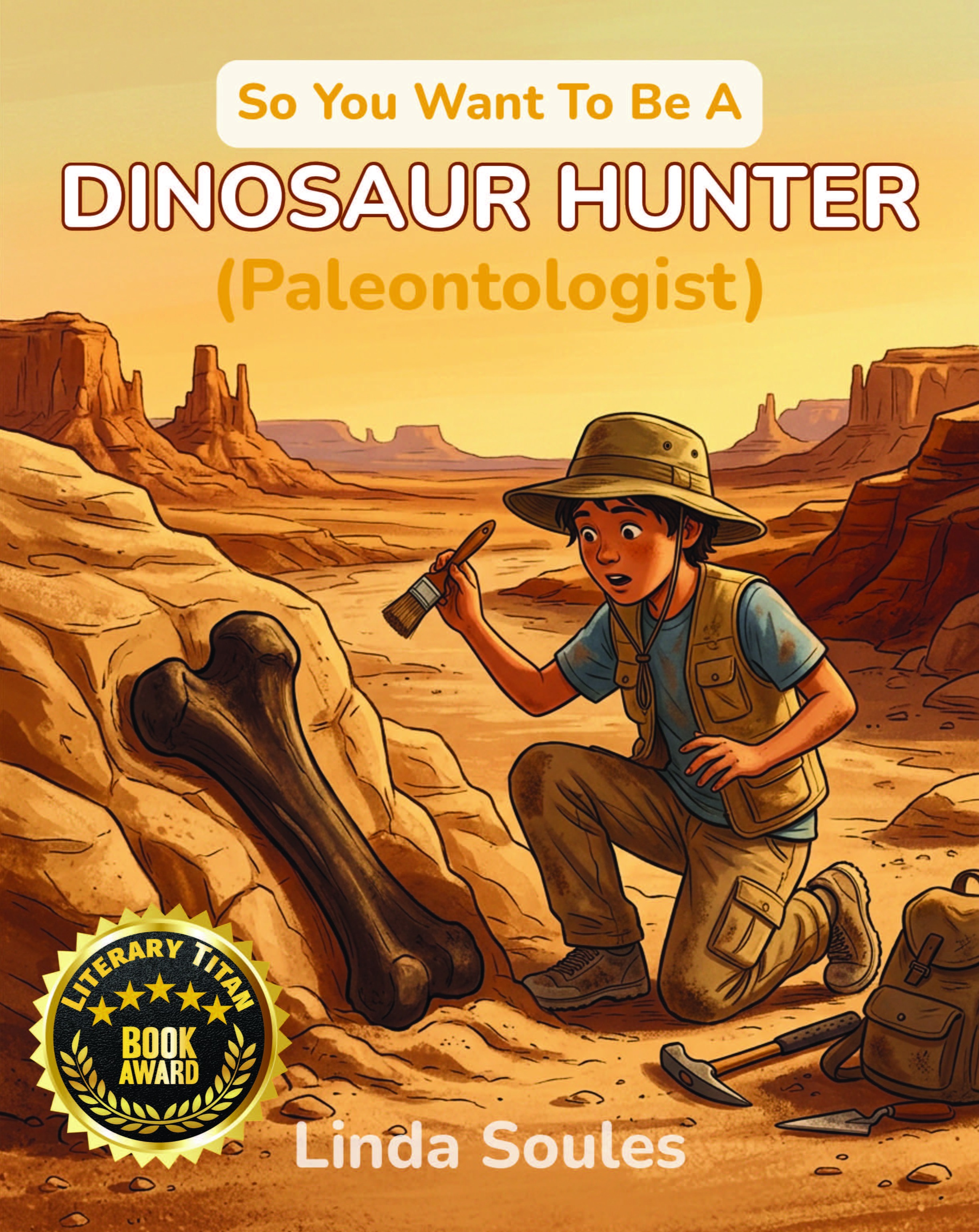
So You Want To Be A Dinosaur Hunter (Paleontologist) cover
Children's Episodic Series

So You Want To Be A Dinosaur Hunter (Paleontologist)

by Linda Soules · 26 pages

Logline

Addressed directly to curious kids, this illustrated career guide follows the imagined path of an aspiring paleontologist, weighing the thrill of discovery against grueling fieldwork, funding battles, and painstaking patience, to answer whe

Synopsis

The book opens by speaking directly to the reader: you want to be a dinosaur hunter. It defines paleontology as reading the story locked in fossils, covering 3.8 billion years of life rather than dinosaurs alone. It then walks through the work itself: finding fossils with a trained fossil eye, excavating grain by grain, mapping each find, protecting specimens in plaster field jackets, and studying them in prep labs and with CT scanners. It describes the settings, from remote badlands to quiet laboratories and museums, and the tools used in each. The middle sections set wonder against difficulty. The best part of the job is the moment of discovery, a handshake across deep time, along with the pleasure of assembling a skeleton that wide-eyed children later see in a museum. The hardest parts are physical: long days on your knees in the sun, progress measured in centimeters, and constant grant writing in a field where expeditions can die when money runs out. A surprise section shows that amateurs and kids have made landmark finds like Sue the T. rex and a species found by four-year-old Wylie Brys. It adds that a new dinosaur species is named about every two weeks and that birds are living dinosaurs. The book then makes the career concrete. A day-in-the-life timetable runs from a 5:30 AM field breakfast to evening note review. It introduces the people involved: field crews, preparators, curators, geologists, students, and paleoartists. It explains how the work helps people, by giving context for life's response to mass extinctions and by sparking curiosity in children. It lists the qualities needed, including patience, skepticism, interdisciplinary curiosity, storytelling, and comfort with revision, as well as unexpected needs like geology fluency and public communication. Profiles of Mary Anning, who was denied credit in her lifetime, Roy Chapman Andrews, and the dyslexic Jack Horner show varied paths into the field. Fun facts, practical preparation tips such as rock collecting, backyard digs, museum visits, and nature journals, reflective questions, and a self-check quiz follow. The ending is a glossary and an author's note that turns the question back on the reader. Choosing this life means conversing with the deep past and seeing life's fragile, astonishing chain. The book closes with resources for further learning and a final charge: find the page nobody has found yet, add your name to the margin, and keep digging.

AI Pitch Package

For producers, scouts & managers

Logline

A dinosaur-obsessed kid joins a field dig crew and learns that discovery comes only after sunburned knees, grant deadlines, and years of patience, yet amateurs and even a four-year-old have made landmark finds, so the next fossil could be theirs.

Short synopsis

Addressed directly to the reader, this 26-page illustrated guide asks: do you want to be a dinosaur hunter? It shows what paleontologists actually do, from spotting fossils with a trained eye to excavating grain by grain, mapping finds, wrapping bones in plaster field jackets, and scanning them in prep labs. It balances the wonder of discovery against the hard parts: hours on your knees in the sun, progress measured in centimeters, and constant grant writing. It profiles Mary Anning, Roy Chapman Andrews, and dyslexic Jack Horner, and shows that kids and amateurs have found major fossils. It ends with a day-in-the-life schedule, a self-quiz, a glossary, and a charge to find the page nobody has found yet.

Extended synopsis
This is a nonfiction illustrated career guide, not a narrative. It speaks to the reader as a would-be paleontologist. It opens by redefining the job: paleontology means reading the story locked in fossils across 3.8 billion years of life, not only dinosaurs. It then walks through the workflow: developing a fossil eye in badlands terrain, excavating grain by grain, mapping each find, protecting specimens in plaster field jackets, then studying them in prep labs, museums, and CT scanners. The middle of the book sets wonder against difficulty. The best moments are the instant of discovery, which the book calls a handshake across deep time, and the pleasure of assembling a skeleton that children later see in a museum. The hardest parts are physical and financial: long days on your knees, progress in centimeters, and grant writing that can end an expedition when money runs out. A surprise section shows that amateurs and kids have made landmark finds, including Sue the T. rex and a species found by four-year-old Wylie Brys. It adds that a new dinosaur species is named about every two weeks and that birds are living dinosaurs. The book then makes the career concrete. A day-in-the-life timetable runs from a 5:30 AM field breakfast to evening note review. It introduces the ensemble that makes a dig work: field crews, preparators, curators, geologists, students, and paleoartists. It lists the traits needed (patience, skepticism, interdisciplinary curiosity, storytelling, comfort with revision) and the unexpected skills, such as geology fluency and public communication. Profiles of Mary Anning, who was denied credit in her lifetime, Roy Chapman Andrews, and the dyslexic Jack Horner show different routes into the field. The back matter turns practical and reflective: fun facts, rock collecting, backyard digs, museum visits, nature journals, reflective questions, a self-check quiz, a glossary, and resources. The author's note hands the question back to the reader and closes with a charge to find the page nobody has found yet, add your name to the margin, and keep digging. A series would have to build characters and plot on top of this material. The book supplies the structure, facts, historical figures, and tone, but no protagonist or story arc.
Why it adapts
The hook is that a child's most universal fantasy, finding a dinosaur, is paired with an honest look at what the job takes. That gives a series a built-in emotional engine: big dreams against slow, hands-on work. The setpieces are visual and repeatable: badlands at sunrise, a crew on their knees brushing away grains of rock, plaster field jackets being wrapped, CT scans revealing a hidden skull, and fossils dissolving into animated flashbacks of the living animal. Every episode can end with a reveal, which is how kids' science series hold attention. The book also provides real characters to build from. Mary Anning, denied credit in her lifetime, Roy Chapman Andrews, and the dyslexic Jack Horner can anchor historical or mentor segments, and the dyslexia and credit stories give kids more than facts to connect with. Four-year-old Wylie Brys, who found a species, and amateur finds like Sue the T. rex give an on-screen kid a credible route to a big discovery. The ensemble of field crew, preparators, curators, geologists, students, and paleoartists gives a writers' room a cast with distinct skills. Marketability is strong: dinosaurs are evergreen, the educational angle suits broadcasters and streamers with curriculum mandates, and the format supports activity tie-ins such as backyard digs, nature journals, quizzes, and museum partnerships. The caveat is that this is a nonfiction guide with no protagonist or plot. A buyer would be licensing the premise, tone, and factual content, and the creative team would need to invent the lead kid, the mentor, and the season arc.
Format recommendation
Episodic Series

The book has no plot, so a feature has nothing to hold it, but its modular structure (find, dig, jacket, prep, study, plus historical profiles) maps neatly onto 11-minute or 22-minute kids' episodes. An ongoing series lets each stage of the paleontology workflow, and each real figure, anchor its own episode. The producer must be clear that the characters and season arcs would be created for the adaptation, with the book supplying the world, facts, and mission.

Comp titles
Ada Twist, Scientist
A recent Netflix preschool series that turns a children's book about scientific curiosity into a problem-of-the-week format. It shows how a nonfiction-minded picture book can become an episodic show.
The Magic School Bus Rides Again
A modern reboot that pairs a charismatic adult guide with kids on field-trip adventures that deliver real science. It is a direct model for pairing a dig-site mentor with young recruits.
Dino Ranch
A recent dinosaur-themed kids' series with proven demand for dinosaur content among ages 3-7 and a strong merchandise profile.
Octonauts: Above & Beyond
A current educational adventure series built around a crew with specialist roles, facts, and a mission-per-episode structure. It parallels the book's field crew, preparators, and curators.
Prehistoric Planet
Apple TV+ proved there is a large audience for scientifically grounded dinosaur imagery. It is a useful reference for paleoart-quality visuals and for family co-viewing.
Audience

Primary: kids 5-9 and their parents, especially STEM-curious and dinosaur-obsessed households, plus classrooms and libraries. Secondary: parents co-viewing, and museum and educational channels. These viewers watch Wild Kratts, Octonauts, Ada Twist, Scientist, Dino Ranch, Dinosaur Train, and Prehistoric Planet, and read Magic Tree House and Magic School Bus.

Tone
curious encouraging wonder-filled hands-on honest educational

Adaptation Readiness Score

66 / 100

Visual storytelling 78
Dialogue strength 42
Character distinctiveness 55
Hook strength 72
Format fit 64
Market timing 74
Strengths
  • Built-in visual world: badlands digs, plaster field jackets, prep labs, CT scans and museum halls are all vivid, tactile settings that suit an educational series, and the 'handshake across deep time' moment of discovery is a ready-made recurring emotional beat.
  • The real-life figures and stories (Mary Anning denied credit, Jack Horner's dyslexia, Sue the T. rex, four-year-old Wylie Brys) are castable and compelling, and they give a docuseries or animated anthology strong episode anchors.
  • Clear, kid-friendly structure with a direct-address voice, a day-in-the-life timetable, quizzes and hands-on activities that point toward an interactive, host-driven format. Dinosaur and STEM-career content has steady demand in kids' edutainment.
Adaptation friction
  • The book is nonfiction career guidance with no protagonist, plot, or dialogue; the 'you' reader is a blank slate, so there is no character arc or dramatic engine to sustain a scripted episodic series.
  • At 26 pages the material is a strong outline rather than a series bible; the stakes (funding fights, sore knees, slow progress) are real but stated rather than dramatized, and there is no season-long question to pull viewers forward.
  • The category is crowded with established dinosaur and STEM properties for kids, and the book offers no unique character or world to set it apart as a franchise.

More books in the directory
Listed on 2026-11-02
Back to directory