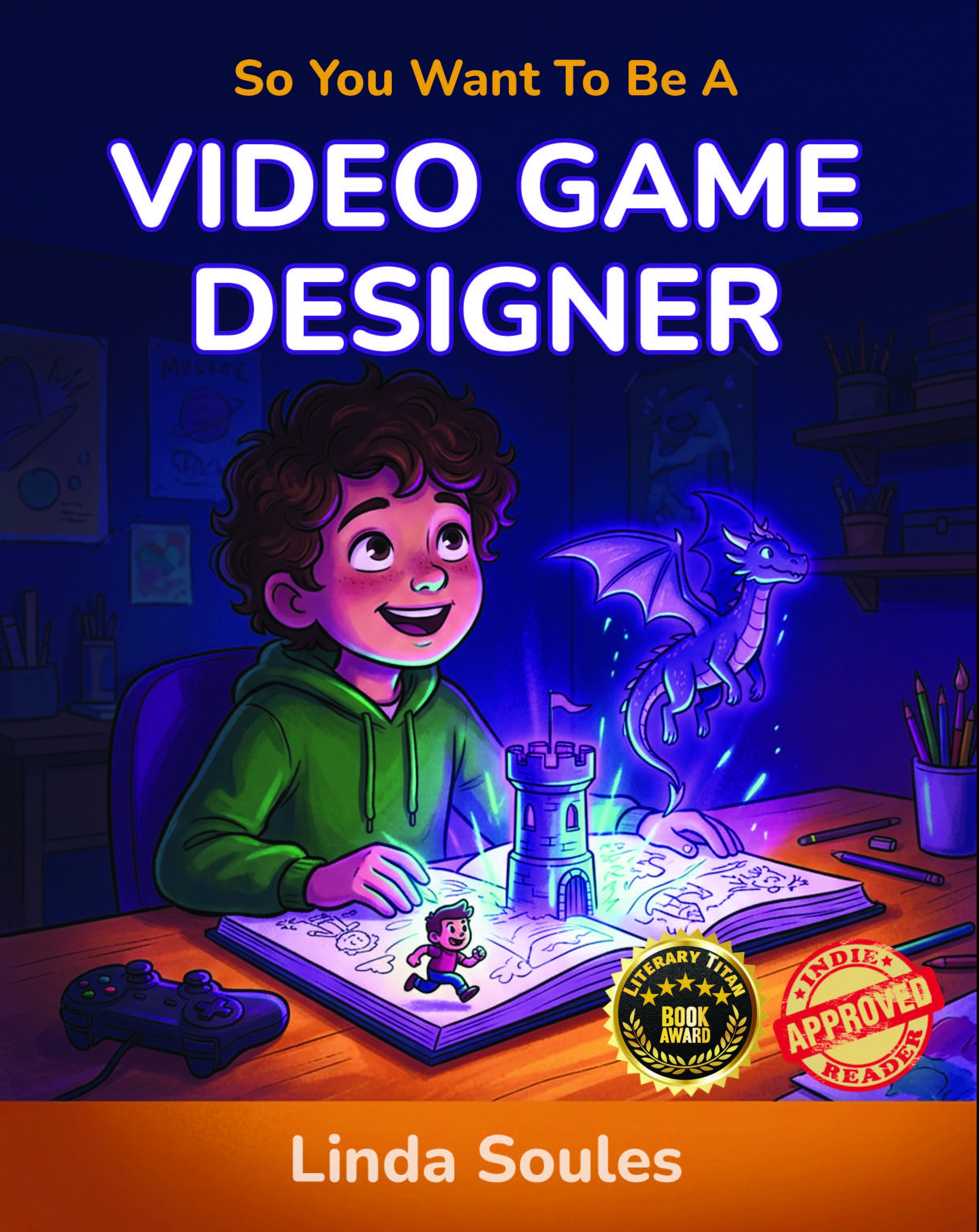
So You Want To Be A Video Game Designer cover
Documentary / Non-Fiction Documentary Series

So You Want To Be A Video Game Designer

by Linda Soules · 25 pages

Logline

A curious young reader considers whether they have what it takes to become a video game designer, learning the craft, tools, hardships, and rewards of building interactive worlds through iteration, playtesting, and an unrelenting sense of p

Synopsis

The book opens by inviting the reader to imagine building worlds from nothing, with the question "What if?" as a designer's most important tool. It describes the designer as part architect, storyteller, psychologist, and mad scientist, someone who obsesses over tiny details like the timing of a jump. It then separates the designer's role from that of artists and programmers: the designer owns the player's experience of challenge, fairness, and fun, and refines it through iteration. The middle chapters describe the practical reality of the profession. Designers work in collaborative studios with playtest rooms, use engines like Unity and Unreal, build rough prototypes, and watch real players struggle and succeed. The book is candid about the downsides: the first version will be terrible, finished games may be version one hundred twelve, much good work gets cut, and internet criticism can be loud and disproportionate. It also highlights surprises, such as beloved mechanics like the Quake rocket jump that began as bugs, and the fact that fun cannot be directly designed, only designed toward. A structured day in the life, from studying other games to a morning of documentation, noon playtest, afternoon debrief, and evening self-play, makes the work concrete. The book lists the many collaborators on a team, explains how games can teach, heal, and delight, and names the essential qualities: empathy for the player, systems thinking, iteration, understanding of motivation, and a lasting love of play. Unexpected needs include probability math and strong writing. Profiles of Shigeru Miyamoto, Roberta Williams, and Hideo Kojima, plus fun facts about Pac-Man, Mario, and Tetris, provide inspiration. The final sections turn to action. Readers are urged to design paper games, change the rules of familiar ones, use tools like Scratch, study storytelling, and playtest silently with friends. A reflective quiz asks whether the reader already thinks like a designer. The author's note ends on a moving message: a game is a space people will live inside, and the blank screen is someone's future memory. Resource lists and a series overview close the book, restating that a first version will be terrible and that building it anyway is the whole method.

AI Pitch Package

For producers, scouts & managers

Logline

Through the stories of working designers, from industry legends to first-time indie makers, a documentary series follows aspiring creators as they build terrible first prototypes, endure brutal playtests, and learn that fun can only be designed toward, never directly made.

Short synopsis

Based on Linda Soules' short career primer, this documentary series asks what it actually takes to design video games. Each episode takes one idea from the book: the 'What if?' spark, the terrible first version, the playtest room, bugs that became beloved mechanics like the Quake rocket jump, and the unglamorous day-to-day of documentation, debriefs and self-play. Working designers and newcomers demonstrate the craft on camera, while profiles of Miyamoto, Roberta Williams and Kojima give the history a human anchor. The series is candid about cut work, version 112 and internet pile-ons, and equally clear about why people stay: a game is a space someone will live inside, and a blank screen is a future memory.

Extended synopsis
The source is a roughly 25-page guide for curious young readers, not a narrative. That is both its limit and its opportunity. Its spine is a clean, repeatable thesis: a designer owns the player's experience of challenge, fairness and fun, and gets there only through iteration. The series would turn that thesis into a season structure, with each episode built on one chapter-sized idea and populated with real people who are mid-process. The opening episodes cover the mindset and the role. 'What If?' introduces the designer as part architect, storyteller, psychologist and mad scientist, obsessing over something as small as the timing of a jump. The next episode separates design from art and engineering and shows what a designer owns. We watch a designer rebuild one mechanic, such as jump arc or enemy telegraphing, until it feels right, and the audience learns to see that feel as authored. The middle of the season is the craft and the reality. Episodes follow a small team through a prototype built in Unity or Unreal, a playtest room where designers must stay silent while strangers fail, and the culture of cutting good work. A dedicated episode covers happy accidents: the Quake rocket jump, which began as a bug, and the fun facts around Pac-Man, Mario and Tetris. Another walks through the book's structured day, from morning documentation to noon playtest, afternoon debrief and evening self-play, to show how ordinary and obsessive the job is. The team episode surveys the many collaborators beyond designers, and the hardships episode treats online criticism honestly. The back half widens to purpose and pathways. One episode covers games that teach, heal and delight. Another profiles the pioneers (Miyamoto, Roberta Williams, Kojima) through archival material and, where rights allow, new interviews. The finale follows beginners making their first paper game, modding a familiar one, or building in Scratch, and closes on the author's line that the blank screen is someone's future memory. The series' repeated promise, that the first version will be terrible and building it anyway is the method, becomes both its emotional payoff and its marketing line. Producers should note that this is a format-and-thesis acquisition. Access, subjects and original reporting would have to be developed, and the profiled legends and franchises require clearance. The book supplies the structure, the tone and an unusually warm point of view on a field that is usually covered through crunch and controversy.
Why it adapts
The book's central idea is inherently visual: design is the invisible craft behind everything players feel, and a camera can finally make it visible. Setpieces write themselves. A jump re-tuned frame by frame until it feels right. A playtest room seen through one-way glass while a designer bites their tongue and a stranger gets stuck on a level. The Quake rocket jump recreated as a bug turning into a technique. A paper prototype taped together at a kitchen table. These are tactile, repeatable scenes that give each episode a signature moment. The book also supplies characters and a point of view. Miyamoto, Roberta Williams and Kojima give the series a pantheon, and the hardships chapter (version 112, cut work, loud online criticism) gives it honesty that most career-inspiration content lacks. The strongest creative approach is to pair those legends with a rotating cast of beginners and mid-career designers, so the audience watches people go from terrible first version to something playable. Marketability rests on a clear, poster-ready promise: the first version will be terrible, and building it anyway is the whole method. The series fits a well-established streaming genre, has natural educational and brand partnerships (engine makers, Scratch, schools), and is cheap to extend into companion content. The risk is that the source is thin and the legends' stories require rights and access, so the project needs a showrunner with industry relationships and original reporting rather than a straight adaptation.
Format recommendation
Documentary Series

The book is a 25-page guide with no single narrative arc, but it is organized into discrete, episode-sized ideas (the role, iteration, playtesting, bugs-as-features, a day in the life, pioneers) that map naturally onto a 6-episode season. A feature would flatten the how-to structure, while a series lets each episode pair one principle with real designers and a visible build.

Comp titles
High Score (Netflix, 2020)
Proves the audience for accessible, character-led video game history told through the people who made the games, with energetic graphics and a nostalgia-forward tone.
Abstract: The Art of Design (Netflix, 2017-2019)
The template for a craft-first docuseries where each episode follows one creative discipline and makes process and design thinking cinematic.
Mythic Quest (Apple TV+, 2020-)
Shows the appetite for studio-floor game development stories: playtests, creative clashes and the odd collaboration between designers, artists and programmers.
Console Wars (2020 documentary)
A recent game industry documentary that shows archival-driven storytelling about the business and personalities behind iconic games reaches mainstream streaming audiences.
Audience

Primary: 13-24 year-olds who play games and are curious about making them, plus students, parents and educators, with a strong co-viewing family skew. Secondary: millennial gamers drawn by the nostalgia of Mario, Pac-Man and Tetris. Their viewing habits include High Score, Abstract: The Art of Design, Chef's Table, Mythic Quest, and creator-driven YouTube channels about game design and development.

Tone
inspiring hands-on candid playful nostalgic educational

Adaptation Readiness Score

66 / 100

Visual storytelling 68
Dialogue strength 50
Character distinctiveness 62
Hook strength 66
Format fit 68
Market timing 78
Strengths
  • Video game culture and making-of storytelling are in strong demand. The subject has built-in audience appeal, and the Miyamoto, Williams and Kojima profiles, plus the Quake rocket jump, Pac-Man and Tetris lore, give a documentary series a ready roster of episodes and interview targets.
  • The book's concrete, visual structure suits episodic docs: a day-in-the-life (morning documentation, noon playtest, afternoon debrief, evening self-play), playtest rooms where real players struggle, and prototypes evolving from terrible to polished. Each of these can be shot with strong cinematic texture.
  • The candid, human tone ('the first version will be terrible,' version 112, internet criticism) gives a documentary series an honest emotional spine. The 'blank screen is someone's future memory' message works as a recurring theme and a closing beat.
Adaptation friction
  • As a 25-page career-guidance primer, it has no protagonist, narrative arc or real people with stakes. A series needs actual designers whose projects, failures and breakthroughs can be followed on camera.
  • The 'you' framing and addressed-to-reader voice would need reworking into a documentary point of view. Right now there is no distinctive on-screen presenter, subject or driving question to anchor a series.
  • The material is broad and lightly sourced (fun facts, profiles, lists). Without deeper reporting, original access, archival material, and interview commitments, it reads as an educational explainer rather than a premium doc series.

More books in the directory
Listed on 2026-11-02
Back to directory