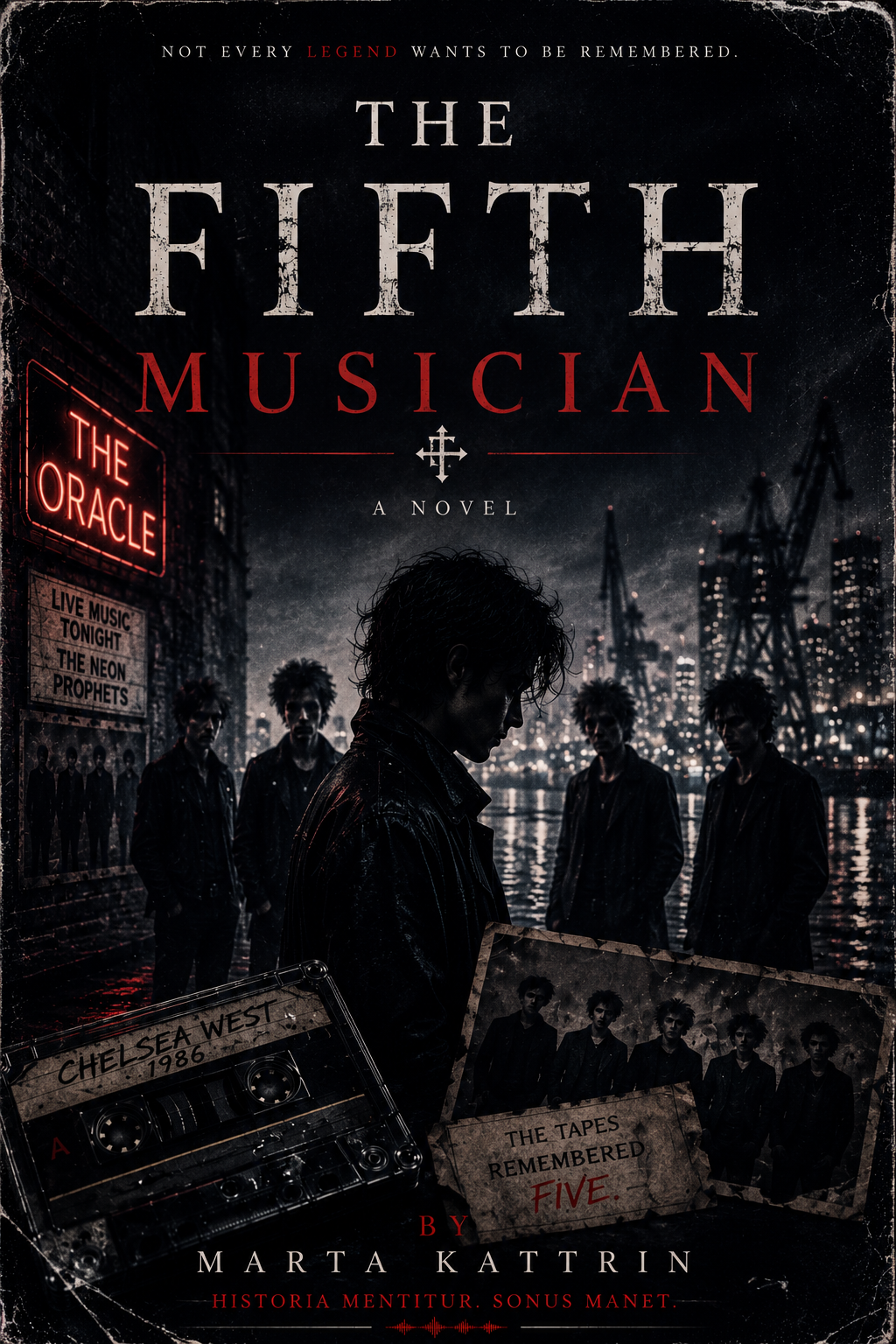
The Fifth Musician
by Marta Kattrin · 2026 · 360 pages
Forty years after the music industry erased a mysterious fifth musician, an investigation uncovers musicians across the world independently recreating fragments of his lost work — and a discovery that could overturn everything we believe ab
Synopsis
AI Pitch Package
For producers, scouts & managers
Logline
Marian Hale follows an anonymous recording sheet to an erased rock musician and a lost composition that makes listeners feel perfectly understood, then must stop its Prague premiere while craving it herself.
Short synopsis
Four decades after a legendary American rock band wiped its fifth member from history, Marian Hale receives an anonymous recording sheet bearing the name Alexander Verne. It leads her beneath the abandoned Oracle nightclub in Manhattan, to a hidden archive of doctored photographs, secret tapes and an unfinished piece called Resonance. Eleven seconds of it return her to a childhood memory with impossible clarity. Other listeners report something worse: the sense of being completely understood. Chasing Verne's erasure through London and Prague, Marian finds musicians who have never met independently composing identical fragments of the work. Someone is rebuilding Resonance on purpose. The full piece will premiere at Prague's Rudolfinum, and Marian is the only person who knows what it does.
Extended synopsis
Why it adapts
The story is a three-city investigation with a layered archive, a forty-year backstory and a slow build of converging musicians, which would be crushed into two hours. Six to eight episodes would let the mystery tighten, give the listeners damaged by Resonance room to register as people, and build to the Rudolfinum performance as a full-episode finale. It also resolves cleanly, so it works as a closed limited series without a second-season obligation.
Adults 25-54 who like cerebral, high-concept thrillers and music-driven drama, skewing slightly female and slightly older than genre-sci-fi fans. They watch Severance, Devs, Station Eleven, Daisy Jones & The Six and Tár, and they follow prestige limited series with strong soundtracks. A built-in secondary audience of music, audiophile and vinyl-culture fans gives strong organic marketing and soundtrack potential.
Adaptation Readiness Score
78 / 100
- The premise is a strong, pitchable hook: a rock band erased its fifth member, and a lost composition can make listeners feel perfectly understood. It gives producers a clear poster image and a big emotional question ('would you ever want it to stop?').
- The investigation structure suits a limited series. New York's abandoned Oracle nightclub, hidden archives in London, and a climactic concert at Prague's Rudolfinum give each episode a distinct world, a clear reveal, and an escalating sense of dread.
- The sound-driven concept lets a director and sound designer do something fresh. Eleven seconds of music triggers a vivid childhood memory, and musicians on different continents independently compose the same fragments. These are strong set pieces that would work on screen and in a trailer.
- The central device is music, and the effect is mostly internal: memory, attachment, being understood. A development pass needs to turn these into repeatable, dramatizable behavior (obsession, withdrawal, damaged relationships) so the audience sees the stakes and doesn't have to take them on faith.
- Marian Hale, as described, is mainly an investigator who follows evidence. Producers will want a sharper personal wound, flaw, or private stake so she has her own pull toward Resonance and her temptation in the finale lands harder.
- The Alexander Verne reveal and the antagonists ('the people behind it') are underspecified. A series needs a clear opposing force with a face, motive, and escalating moves across episodes, plus a reason for the 40-year gap that feels earned.
- Phoebe Moon's Adventure to Morocco by Jean Nine
- Ogarami: The Beginning of Darkness by Carnage Beast
- HOUSE OF MIRRORSHOUSE OF MIRRORS by Corey Lee Sims
- No One Will Find You Here by Natalie Morrow