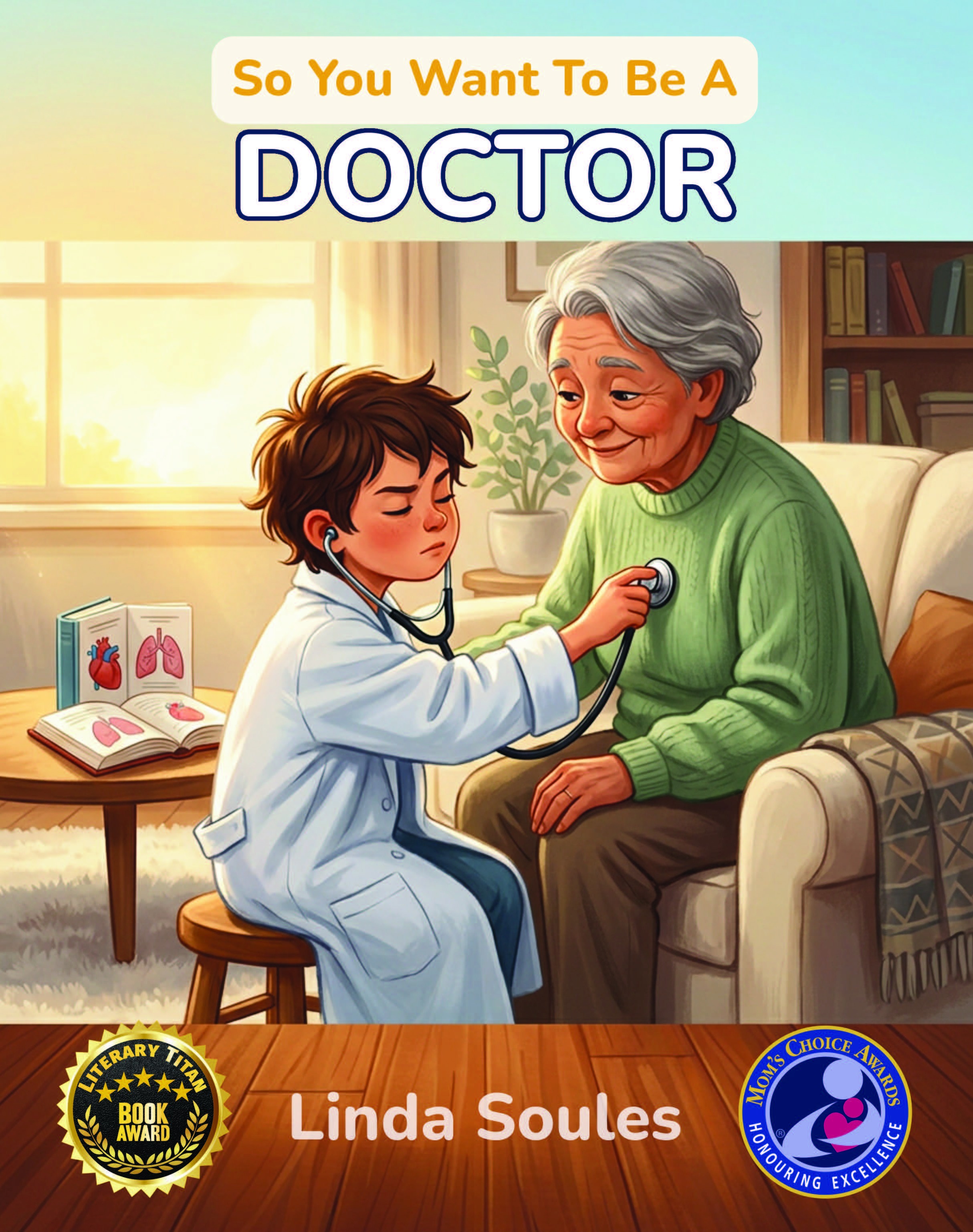
So You Want To Be A Doctor cover
Children's Episodic Series

So You Want To Be A Doctor

by Linda Soules · 26 pages

Logline

Addressed directly to curious kids, this illustrated career guide follows no single hero but invites the reader to imagine becoming a doctor, exploring the daily work, the long training, the heartbreak and the promise never to abandon a pat

Synopsis

The book opens by asking the young reader to imagine being a doctor, and reframes the profession as the world's greatest detective work. Every patient is a mystery, and the doctor's job is to ask questions, gather clues and work out what is happening in a body that cannot speak for itself. It stresses that medicine is both science and relationship, and that the best doctors see the whole person rather than just the condition. The middle chapters build a detailed picture of the profession. They explain the three-step diagnostic process and show the settings, from clinics and emergency rooms to refugee camps. They introduce tools such as the stethoscope, the reflex hammer, CT and MRI scans, and prescriptions. They are honest about the conflicts of the work: decisions made with incomplete information, patients who cannot be cured, burnout, and eleven to fifteen years of training. A story about the 1816 invention of the stethoscope from a rolled-up piece of paper shows how ingenuity and awkward problems shape medicine. The book then widens its view. A sample day runs from 7 AM rounds to 7 PM charting, and a chapter on the care team covers nurses, pharmacists, radiologists and social workers. It describes how a single doctor can protect a community, serve underserved places, or teach future doctors. Qualities such as curiosity, tolerance of uncertainty, communication, compassion and humility sit alongside unexpected skills like interviewing and probabilistic thinking. Profiles of Paul Farmer, Cicely Saunders and Elizabeth Blackwell show doctors who changed medicine through persistence and conviction. The back matter turns the book into practical guidance: fun facts, steps to prepare now such as first aid, volunteering and keeping a symptom notebook, a glossary of terms like the Hippocratic Oath and informed consent, and recommended books, websites and organizations. The author's note delivers the emotional climax, which is that the heart of medicine is not curing but the promise 'I will not abandon you.' It ends on an invitation: the reader only has to begin by asking the question, as every doctor does.

AI Pitch Package

For producers, scouts & managers

Logline

A curious kid with a symptom notebook sets out to learn how doctors solve the world's mysteries, but every case has missing clues, silent patients and no guaranteed cure, so the real lesson becomes a promise: never abandon anyone.

Short synopsis

Based on Linda Soules' illustrated career guide, this kids' series reframes medicine as the world's greatest detective work. The source has no hero, so the adaptation gives young viewers a surrogate: a curious kid with a symptom notebook who shadows doctors in clinics, ER corridors, labs and refugee camps. Each episode takes one case and one idea from the book, such as the three-step diagnostic process, the stethoscope's 1816 origin as a rolled-up sheet of paper, the care team behind every patient, or a 7 AM-to-7 PM day on the wards. Real pioneers like Elizabeth Blackwell and Cicely Saunders appear as historical detours. The season builds toward the book's emotional core: medicine is not about curing everyone, it is about the promise 'I will not abandon you.'

Extended synopsis
The book is a 26-page illustrated career guide addressed to the reader as 'you.' It has no characters and no plot. It does have a strong organizing idea, which is that every patient is a mystery and every doctor is a detective who must ask questions, gather clues and reason about a body that cannot speak for itself. A series adaptation has to build a recurring protagonist and case structure around that idea. We propose a young investigator, around nine years old, who keeps a symptom notebook (one of the book's own 'prepare now' suggestions) and is paired with a rotating roster of doctors, nurses and specialists. Each episode runs about 11 minutes, or 22 as a double, and is built on one chapter of the book. The three-step diagnostic process becomes the recurring case-solving engine. The tools become gadget reveals: stethoscope, reflex hammer, CT and MRI scans, prescription pad. The settings become the show's map, moving from a neighborhood clinic to an emergency room to a refugee camp. The care-team chapter gets its own ensemble episode, showing that nurses, pharmacists, radiologists and social workers are co-detectives rather than sidekicks. The book's honesty about hard things is the show's differentiator. It names decisions made with incomplete information, patients who can't be cured, burnout, and eleven to fifteen years of training. Those become the emotional beats of a season, not asides. History episodes use the book's profiles and stories as stylized flashbacks: Laennec rolling paper into the first stethoscope in 1816, Elizabeth Blackwell fighting for admission, Cicely Saunders pioneering hospice care, Paul Farmer bringing care to underserved places. The season finale pays off the author's note. After a case with no cure, the young protagonist learns that the doctor's true job is staying. The closing beat returns to the book's invitation: you only have to begin by asking the question. Each episode can end with a short real-world 'try this at home' segment drawn from the back matter, covering first aid, volunteering and a glossary word of the day, which gives the series built-in educational and curriculum value.
Why it adapts
The central hook is a poster-ready reframe: the doctor as detective. It gives the series a visual identity (a notebook, a magnifying glass, a stethoscope as a detective tool) and a repeatable structure of question, clues and deduction. The book's concrete elements give production design a lot to work with. A stethoscope invented from rolled-up paper in 1816 is a built-in period flashback. CT and MRI scans become animated 'inside the body' sequences. A 7 AM-to-7 PM day on the wards supplies a ticking-clock episode. Settings range from a cozy clinic to an ER to a refugee camp, so each episode can look different while the format stays consistent. Its distinctiveness is its honesty. Most kids' medical content stops at 'doctors help people,' while this book names uncertainty, incurable illness, burnout and the decade-plus of training. That gives the series real emotional range and a defensible place in a crowded preschool and early-elementary market. The care-team chapter supports a diverse, ensemble cast of nurses, pharmacists, radiologists and social workers. The profiles of Blackwell, Saunders and Farmer add representation and a biographical-segment format. Marketability is clear: STEM and career-curiosity programming is evergreen, schools and libraries are ready-made secondary channels, and the back matter (first-aid basics, a symptom notebook, a glossary of terms) converts directly into companion activities, apps and classroom guides. The limits are real. The book has no protagonist, and the creative team must build a character, a world and a season arc from scratch. Real-person profiles will need rights and estate clearance or fictionalized treatment, and the series will succeed or fail on the quality of that invented surrogate. The core idea of 'I will not abandon you' is strong enough to carry that work.
Format recommendation
Episodic Series

A 26-page nonfiction guide with no narrative arc cannot sustain a feature, and its chapter structure (diagnosis, tools, settings, care team, a day in the life, pioneers) maps cleanly onto standalone 11-minute episodes. The case-of-the-week detective frame is renewable and works for preschool-to-early-elementary co-viewing. The author's requested format is the right one, with the caveat that the series depends on inventing a recurring surrogate character.

Comp titles
Ada Twist, Scientist
A curious-kid investigator model that treats questions as the hero's superpower and wraps STEM content in a mystery-of-the-week structure for the Netflix preschool audience.
Ask the StoryBots
Shows that a single child-sized question can anchor an episode, and that factual career and body-science content can be entertaining and highly shareable.
Operation Ouch!
A proven kids' medical-education property, which shows demand for the human body, hospitals and real doctors among 6-12 viewers and their parents.
Doc McStuffins
Established that a doctor-centered kids' series can succeed commercially and emotionally, with strong themes of care, empathy and a toy and licensing ecosystem.
Odd Squad
A detective-framed, ensemble-driven series that pairs problem-solving with an educational curriculum and a warm, quirky tone.
Audience

Primary: children ages 5-9, with strong co-viewing by parents and teachers. Secondary: schools, librarians and STEM and career-exploration programs. Their households watch Bluey, Ada Twist, Scientist, Ask the StoryBots, Octonauts, Odd Squad and Wild Kratts, and look for content that is educational without feeling like a lecture.

Tone
warm curious earnest inquisitive educational heartfelt

Adaptation Readiness Score

62 / 100

Visual storytelling 68
Dialogue strength 42
Character distinctiveness 45
Hook strength 72
Format fit 62
Market timing 70
Strengths
  • The 'doctor as detective' reframe is a strong, pitch-ready hook. It turns a career guide into a mystery-of-the-week engine where every patient is a case, with natural episodic structure and a clear visual language of clues and deduction.
  • Rich, concrete visual material: the 1816 stethoscope invention from rolled-up paper, ERs, clinics, refugee camps, CT/MRI imagery, and a 7 AM-to-7 PM sample day. These could anchor animated segments, historical vignettes, and varied settings.
  • The emotional spine is clear and screen-ready: 'I will not abandon you.' The real-life profiles (Paul Farmer, Cicely Saunders, Elizabeth Blackwell) and the care-team chapter supply built-in story arcs and an ensemble. The STEM and career-curiosity angle also fits the educational kids' market.
Adaptation friction
  • The book has no protagonist, no dialogue and no narrative through-line. It addresses the reader directly, so a series needs invented, castable characters (a kid-detective lead, a mentor doctor, a care-team ensemble) before it can sustain episodes.
  • Much of the content is informational: glossary, prep steps, resource lists, fun facts. It needs dramatization into conflict and stakes, and the honest themes (burnout, incurable patients, uncertainty) need age-appropriate handling for a young audience.
  • The format question is open: preschool educational series, animated anthology, or live-action hybrid? Each implies a different tone, episode length, and buyer, and the 26-page source gives little guidance on which fits best.

More books in the directory
Listed on 2026-11-02
Back to directory