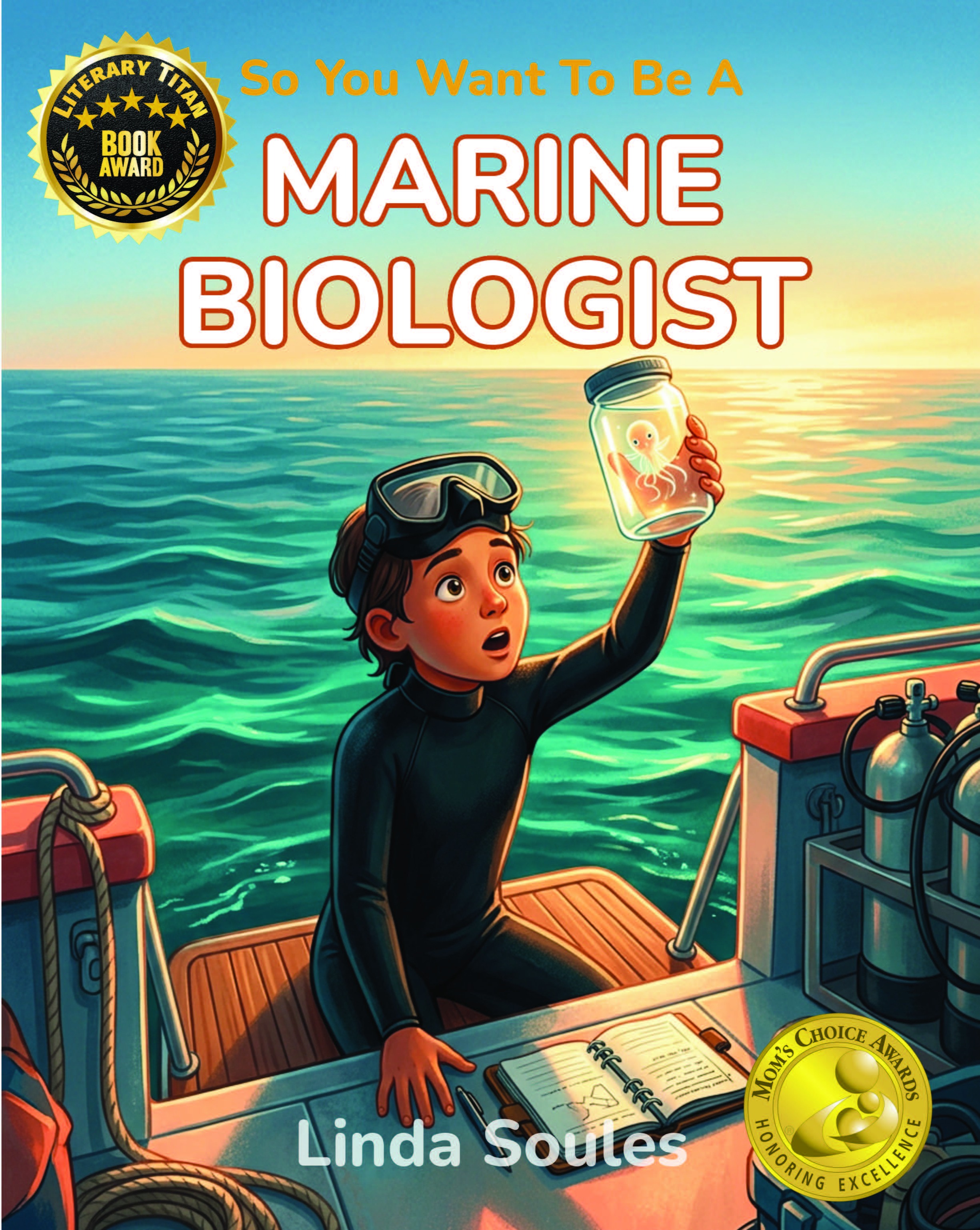
So You Want To Be A Marine Biologist cover
Documentary / Non-Fiction Documentary Series

So You Want To Be A Marine Biologist

by Linda Soules · 27 pages

Logline

A children's career guide invites curious young readers to imagine becoming marine biologists, walking them through the work, tools, hardships, and wonders of ocean science so they can decide whether to answer the sea's call and speak for i

Synopsis

The book opens by asking the reader to imagine being a marine biologist. It frames the ocean as Earth's largest and least explored place: it covers over seventy percent of the planet, produces more than half of our oxygen, and has barely been seen by human eyes. It explains that marine biologists are scientists who study everything from plankton to blue whales, in the field and in the lab, and that their work matters more as the ocean warms and changes. The middle sections describe the job in practical detail. Marine biologists work on reefs, in intertidal zones, and aboard research vessels, using scuba gear, underwater cameras, ROVs, plankton nets, and Secchi disks. The book celebrates the discoveries, the chance to be the first person to see and name a species, and the surprising science, such as the whale pump and the noisy deep ocean. It is equally frank about the hard parts: cold, wet, physically demanding fieldwork, seasickness, and years spent writing grant proposals for expeditions that may never be funded. A sample day at sea shows dives, data entry, and a troubling discovery of coral bleaching. The book then widens to the people and qualities involved. It covers the team of crew, lab technicians, conservationists, and educators, and how marine biology touches daily life through sustainable fisheries, cancer medicines from sponges, vaccine safety tests, and coastal protection from reefs and mangroves. It lists the qualities the work demands, including comfort in the water, patience, cross-disciplinary thinking, hope amid urgency, and willingness to be first, along with unexpected needs like data discipline and engineering intuition. Profiles of Sylvia Earle, Jacques Cousteau, and Eugenie Clark show what a career can look like, and fun facts about mantis shrimp, immortal jellyfish, and mimic octopuses add wonder. The ending turns practical and personal. Readers get steps to prepare now, such as visiting water, keeping a field notebook, cleaning beaches, snorkeling, and learning Latin roots. They also get a self-check quiz, a glossary, reading and website recommendations, and citizen-science projects. In the closing author's note, the book makes its final appeal: the ocean cannot speak for itself, and it needs people willing to go down, learn its logic, and speak on its behalf. 'If this inspires your passion, let it be you.'

AI Pitch Package

For producers, scouts & managers

Logline

A curious kid trades daydreams for a dive log as working marine biologists reveal the real job, from seasick grant-writing to first-ever species sightings, and why a warming ocean needs someone willing to speak for it.

Short synopsis

Based on Linda Soules' 27-page children's career guide, this family documentary series asks one question: could you be a marine biologist? Each episode takes a piece of the book, such as reefs, the intertidal zone, the deep ocean, life aboard a research vessel, and the team behind the science. Real scientists show what the job demands: cold fieldwork, seasickness, years of grant writing, and data discipline. They also show what it gives back, including naming new species and discovering how whales fertilize the sea. A bleaching-reef discovery drives the series' emotional spine. Along the way, profiles of Sylvia Earle, Jacques Cousteau and Eugenie Clark show what a career can look like. The series ends with a call to action for kids to start now.

Extended synopsis
The source is a short, instructional career guide for young readers, not a narrative novel. It opens with the ocean's scale: over seventy percent of the planet, more than half of our oxygen, and barely seen by human eyes. It defines marine biologists as scientists who study everything from plankton to blue whales, in the field and in the lab. The adaptation would keep that premise and the book's direct address to the viewer: imagine you're one of them. The book's middle section supplies the series' episode architecture and its best material. Marine biologists work on reefs, in tidepools and aboard research vessels, using scuba gear, underwater cameras, ROVs, plankton nets and Secchi disks. The book is frank about the downsides: cold, wet, physically punishing work, seasickness, and years spent writing grant proposals for expeditions that may never be funded. Its sample day at sea moves from dives to data entry to a troubling discovery of coral bleaching. That sequence is the natural template for a recurring 'day in the field' segment, with a real expedition replacing the book's composite one. The book then widens to the people and the stakes. It covers the crew, lab technicians, conservationists and educators, and shows how ocean science reaches daily life: sustainable fisheries, cancer medicines derived from sponges, vaccine safety testing, and reefs and mangroves that protect coastlines. It also lists the traits the job demands, including comfort in the water, patience, cross-disciplinary thinking, engineering intuition and hope amid urgency. Profiles of Earle, Cousteau and Clark give the series its historical lineage, and fun facts about mantis shrimp, immortal jellyfish and mimic octopuses supply wonder-driven cold opens. The ending is participatory: steps to prepare now, a self-check quiz, a glossary, reading lists and citizen-science projects, closed by the author's note that the ocean cannot speak for itself. A series would turn this into interactive tags and companion educational materials, ending each episode with something a kid can do this weekend. The producer's challenge is that the book has no plot or protagonist. The series needs a real cast of working scientists, ideally including early-career researchers, to supply the character and arc the page does not.
Why it adapts
The ocean is the most visual subject in documentary, and the book's content is built from setpieces: a plankton-net haul under a microscope, a mimic octopus changing identity, a mantis shrimp strike in slow motion, immortal jellyfish, an ROV descending into the noisy deep, and a reef visibly bleaching under a diver's camera. Each can open an episode or serve as a shareable clip. The book's fun-fact structure translates directly into short-form social content, which helps with discovery. The book has no characters of its own, so casting is the real creative task. The strongest version follows several real marine biologists at different career stages, from grad student to veteran, so the viewer sees the whole path the book describes, including seasickness and grant rejections alongside discovery. Archival and interview material on Earle, Cousteau and Clark gives the series a legacy layer. Rights for estates, archive footage and any living subjects would need to be cleared early. Marketability is strongest in the family and educational space. The book's 'let it be you' appeal, the self-check quiz and the citizen-science projects suggest a series with companion classroom materials and viewer actions, which appeals to streamers, public broadcasters and educational distributors. The risk is that the source material is thin: 27 pages of general guidance, not a proprietary story. Its value is as a format and framework, so the pitch should rest on the scientists, access and footage the production secures, not on the book's text alone.
Format recommendation
Documentary Series

The book is a modular, topic-by-topic career guide with no plot, so it maps to a multi-episode, host- and scientist-led format and could not sustain a feature. Its chapters (the job, tools, hardships, team, real-world impact, how to start) divide naturally into six to eight 22-30 minute family episodes. A series also gives room for real expedition footage and a through-line story, such as following a reef survey that finds bleaching.

Comp titles
Our Planet (Netflix, 2019)
Establishes global appetite for premium ocean and conservation storytelling with an urgent climate message. This series would swap narration-from-above for the working scientist's point of view.
Secrets of the Whales (Disney+/National Geographic, 2021)
Proves that animal-behavior science, such as whale culture and communication, can anchor a family-friendly documentary, which suits the book's whale pump and noisy deep-ocean material.
Chasing Coral (Netflix, 2017)
Models how a coral bleaching discovery can drive real tension and emotion on screen, similar to the book's sample day at sea.
Mission Unstoppable (CBS, 2019)
Shows that a kid-facing 'meet women in STEM and see the job' format can be programmed for family audiences.
Ask the StoryBots (Netflix, 2016)
Demonstrates that a children's educational format built around curiosity-driven questions and career exploration can succeed on a major streamer.
Audience

Primary: kids 7-12 and their co-viewing parents, plus teachers and schools as an educational secondary market. Adjacent: adult nature-documentary viewers who watch Our Planet, Blue Planet II and My Octopus Teacher. Also young women and girls interested in STEM careers, given the Earle and Clark profiles.

Tone
awe-driven earnest hands-on urgent but hopeful family-friendly curiosity-led

Adaptation Readiness Score

68 / 100

Visual storytelling 80
Dialogue strength 42
Character distinctiveness 58
Hook strength 66
Format fit 66
Market timing 78
Strengths
  • The subject is inherently cinematic. Reefs, deep-sea ROVs, bioluminescence, mantis shrimp, immortal jellyfish and mimic octopuses are the kind of imagery that has made ocean documentaries a streaming staple.
  • The 'day at sea' sequence has a built-in three-act shape: dives, data entry, then the troubling discovery of coral bleaching. It could anchor an episode or work as a cold open.
  • The structure maps naturally onto episodes: the work, the tools, the hard parts, the people, the careers, and how to get started. The Earle, Cousteau and Clark profiles add legacy figures with strong archival potential, and the climate and ocean-health themes are timely.
Adaptation friction
  • The book is a 27-page children's guide with no single narrative spine, no recurring characters and no dialogue. A series needs real scientists, real expeditions and real stakes that the book only gestures at.
  • The second-person 'imagine you are...' framing is a charming read-aloud device but has no on-screen equivalent. It would need to become a host, a young protagonist or a mentorship structure.
  • The category is crowded with premium nature series, and the book's hook is a call to action rather than a distinctive angle. As written, it fits a kids' educational or STEM-career series better than a prestige documentary.

Listed on 2026-11-02
Back to directory