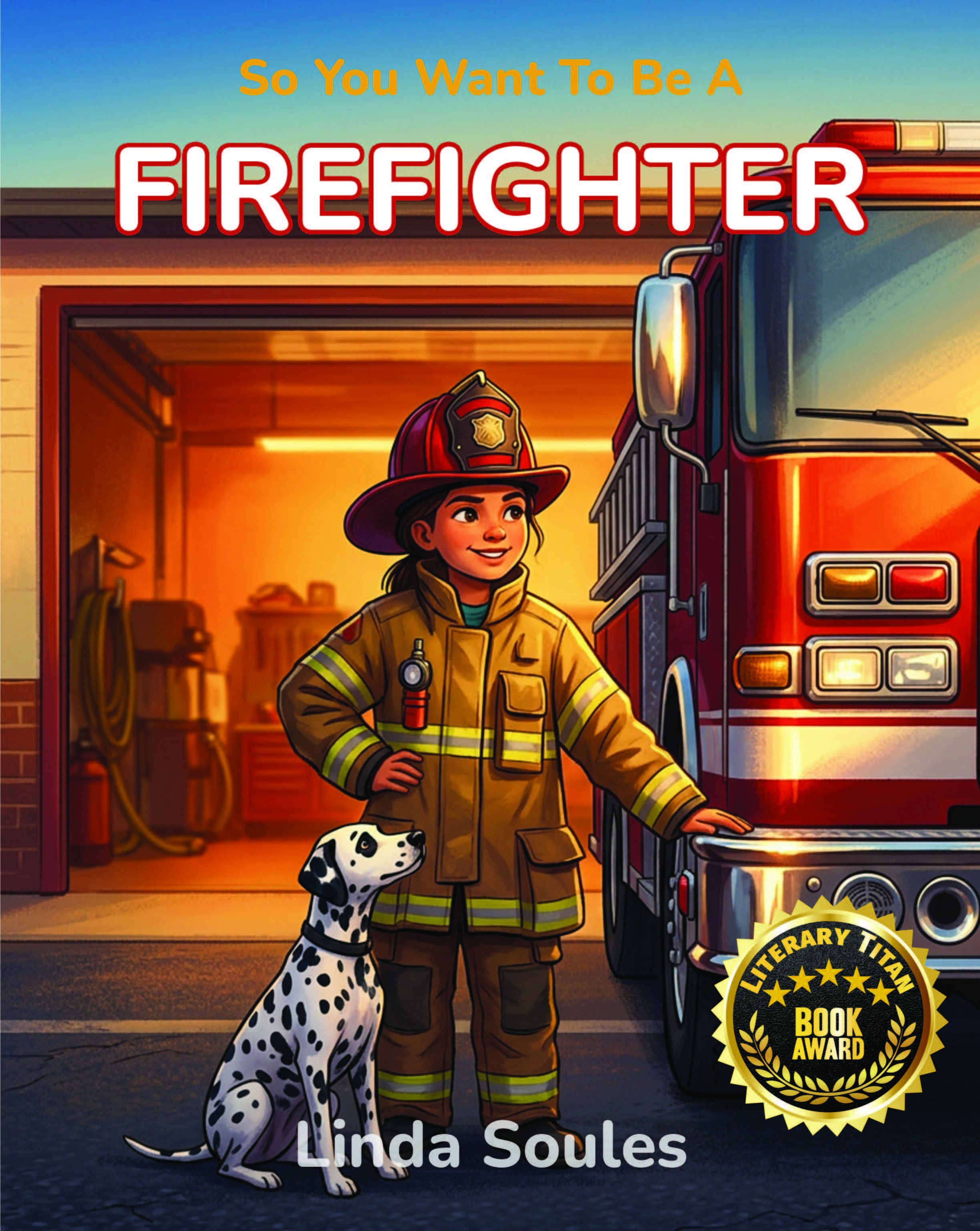
So You Want To Be A Firefighter cover
Documentary / Non-Fiction Documentary Series

So You Want To Be A Firefighter

by Linda Soules · 27 pages

Logline

Addressed directly to curious kids, this illustrated career guide follows a firefighter's real work, from the alarm bell to the station kitchen, showing that courage means acting while afraid and that the job is mostly about keeping a promi

Synopsis

The book opens in the second person, putting the young reader in the boots of a firefighter at the moment the alarm sounds. It describes the gear going on in under a minute, the engine rolling out, the crew planning en route, and the walk toward a smoking building. Its first lesson is that bravery is not the absence of fear. It is training that lets you keep moving anyway. The middle chapters correct the popular image of firefighting. Most of a firefighter's time goes to training, equipment checks, inspections, school visits, and cooking dinner with the crew. More than 75 percent of calls are medical or rescue calls, not fires. The book explains the stations, the fireground, and tools such as bunker gear, SCBA, thermal imaging cameras, and the Halligan bar. It also presents a counterintuitive fact: fires in modern homes built with engineered lumber can be more dangerous than fires in old solid-wood houses, because the structure can fail in four to seven minutes. The book then weighs the job's rewards against its costs. The rewards are adrenaline, the bond of the station, and the saves that firefighters remember for life. The costs are fire's unpredictability, the grief of losing crewmates, and the memorial traditions that honor them. A minute-by-minute day in the life runs from the 7 AM equipment check to a midnight structure fire. Chapters on teamwork and the qualities of a firefighter stress courage, coordination, technical knowledge, calm under pressure, and emotional intelligence. Historical profiles show what the job has meant. Red Adair blew out oil-well fires, still working in Kuwait at 75. Molly Williams, an enslaved woman, hauled a fire engine through the 1818 blizzard and is recognized as America's first known female firefighter. The 343 New York firefighters died on 9/11. Fun facts, a preparation checklist, and a glossary follow. The ending is the author's note. Firefighters do the job for a promise, not for money or fame: when something goes wrong, they will be there. The book tells readers who feel the call that they have already started, because the heart matters more than the gear. Resource lists point to books, websites, museums, and junior firefighter programs, closing on the line "The helmet comes later. The learning starts now."

AI Pitch Package

For producers, scouts & managers

Logline

Over one 24-hour shift, a real firefighter crew shows curious kids that courage means acting while afraid, and that a job people picture as fire is mostly medical calls, training, dinner and a promise to show up.

Short synopsis

So You Want To Be A Firefighter is a 27-page illustrated career guide that puts the young reader in a firefighter's boots the moment the alarm sounds. It follows the work from gear-up in under a minute to the walk toward a smoking building, then corrects the myths. More than 75 percent of calls are medical or rescue, and most of the job is training, inspections, school visits and cooking dinner for the crew. It weighs the rewards (adrenaline, station bonds, lifelong saves) against the costs (unpredictable fire, lost crewmates, memorial traditions). Profiles of Red Adair, Molly Williams and the 343 firefighters lost on 9/11 give the job a history. The book closes on a promise: when something goes wrong, they will be there.

Extended synopsis
The book opens in second person, so the reader is the firefighter when the alarm sounds. Turnout gear goes on in under a minute, the engine rolls, the crew plans on the way, and the walk toward a smoking building begins. Its first lesson sets the thesis: bravery is not the absence of fear. It is training that lets you keep moving anyway. The middle chapters take apart the Hollywood image. Most shifts are equipment checks, drills, inspections, school visits and cooking dinner together, and more than 75 percent of calls are medical or rescue. The book explains the station, the fireground and the tools: bunker gear, SCBA, thermal imaging cameras and the Halligan bar. It also offers a counterintuitive fact. Modern homes built with engineered lumber can fail in four to seven minutes, which makes them more dangerous than old solid-wood houses. The book is honest about the trade-offs. The rewards are adrenaline, the bond of the station and the saves a firefighter remembers for life. The costs are fire's unpredictability, the grief of losing crewmates and the memorial traditions that honor them. A minute-by-minute day runs from the 7 AM equipment check to a midnight structure fire. Chapters on teamwork and character name five qualities: courage, coordination, technical knowledge, calm under pressure and emotional intelligence. Historical profiles show what the job has meant. Red Adair blew out oil-well fires and was still working in Kuwait at 75. Molly Williams, an enslaved woman, hauled a fire engine through the 1818 blizzard and is recognized as America's first known female firefighter. The 343 New York firefighters who died on 9/11 anchor the book's weight. Fun facts, a preparation checklist, a glossary and resource lists (books, museums, junior firefighter programs) follow. The author's note carries the emotional payoff. Firefighters do this for a promise, not money or fame. Readers who feel the call have already started, because the heart matters more than the gear. The last line is "The helmet comes later. The learning starts now."
Why it adapts
The book's strongest cinematic asset is its contrast. Gear-up in under a minute, an engine rolling out, a walk toward smoke and a thermal-camera search sit against crew members cooking dinner and checking equipment. A docuseries can alternate high-adrenaline sequences with warm station-kitchen scenes. Distinct visual setpieces include a timed gear-up race, a Halligan bar and thermal camera demonstration, and a side-by-side burn comparing an engineered-lumber room with a solid-wood room. The four-to-seven-minute collapse fact gives the series a counterintuitive hook. The book also has a ready-made cast and episode spine. The minute-by-minute day, from the 7 AM equipment check to the midnight structure fire, suits a 24-hour-shift format. The historical profiles suit short animated or dramatized segments: Red Adair in Kuwait, Molly Williams hauling an engine through the 1818 blizzard, and the 343 firefighters lost on 9/11. Real crews and kid ride-alongs can supply the character-driven narration that a 27-page book cannot. Marketability is modest but dependable. Its theme, that courage means acting while afraid, appeals to parents, and the junior firefighter and school-visit connections suggest a real outreach and partnership channel. The main caveats are that the source is thin and the 9/11 content needs sensitive handling. A producer should treat the book as a proven framework and voice, not a finished story.
Format recommendation
Documentary Series

The book is a 27-page educational guide with no plot, so it cannot support a feature or scripted series. It works as a modular, topic-per-episode structure: the alarm, the gear, the station, the history, the cost. A kids-and-family docuseries with real crews and short historical segments fits that structure and the author's stated goal. Six to eight episodes of 22 to 30 minutes is the right size.

Comp titles
Cheer (Netflix)
It shows how a team's trust and daily unglamorous training produce high-stakes moments, the same bond-through-routine dynamic this book puts at the center of station life.
Mission Unstoppable (CBS)
It is a proven career-inspiration format for kids: real professionals, hands-on demonstrations, and role-model profiles that make a job feel reachable.
Operation Ouch! (BBC / Netflix)
It explains real emergency and medical work to young viewers with energy and clarity, a good model for the book's gear, tools and medical-call content.
Fire Country (CBS)
It proves the audience appetite for firefighter stories and crew dynamics. A documentary series can offer the real version that the scripted shows only imitate.
9/11: One Day in America (National Geographic)
It is a model for handling 9/11 with archival respect and a human scale, which the book's closing profile of the 343 requires.
Audience

Primary: kids 7 to 12 and the parents and teachers who co-view or assign educational content. Secondary: schools, libraries and fire-service outreach programs, plus adult fans of firefighter dramas such as Station 19 and Chicago Fire who would watch an authentic look at the real job. These viewers also watch Bluey-era family fare, Ada Twist, Scientist, Octonauts and Mission Unstoppable.

Tone
inspiring educational warm earnest kid-friendly heroic

Adaptation Readiness Score

66 / 100

Visual storytelling 78
Dialogue strength 42
Character distinctiveness 55
Hook strength 68
Format fit 62
Market timing 72
Strengths
  • The second-person opening, from alarm bell to gear-up in under a minute to the walk toward a smoking building, is a ready-made cold open with built-in tension and a clear visual grammar.
  • The myth-busting structure (75%+ of calls are medical or rescue; modern engineered-lumber homes can fail in 4-7 minutes) gives a documentary series a strong 'what you think you know is wrong' hook and episode-level reveals.
  • Historical profiles (Molly Williams in the 1818 blizzard, Red Adair in Kuwait, the 343 on 9/11) and the rewards-versus-costs emotional core offer human anchors and tonal range that fit an unscripted or hybrid format well.
Adaptation friction
  • As a 27-page illustrated kids' guide, the book has no named protagonists, interviews, or on-screen dialogue; a documentary series needs real, castable subjects with arcs, and the book supplies the topic rather than the people.
  • The material is broad and encyclopedic (gear, glossary, checklists, fun facts) with little narrative throughline, so it reads as episode topics rather than a season-long story engine.
  • The audience is young and educational; the tone may fit a kids' or family educational slot, which is a narrower and lower-budget lane than prestige documentary, and the book's text alone won't establish a distinctive point of view.

Listed on 2026-11-02
Back to directory