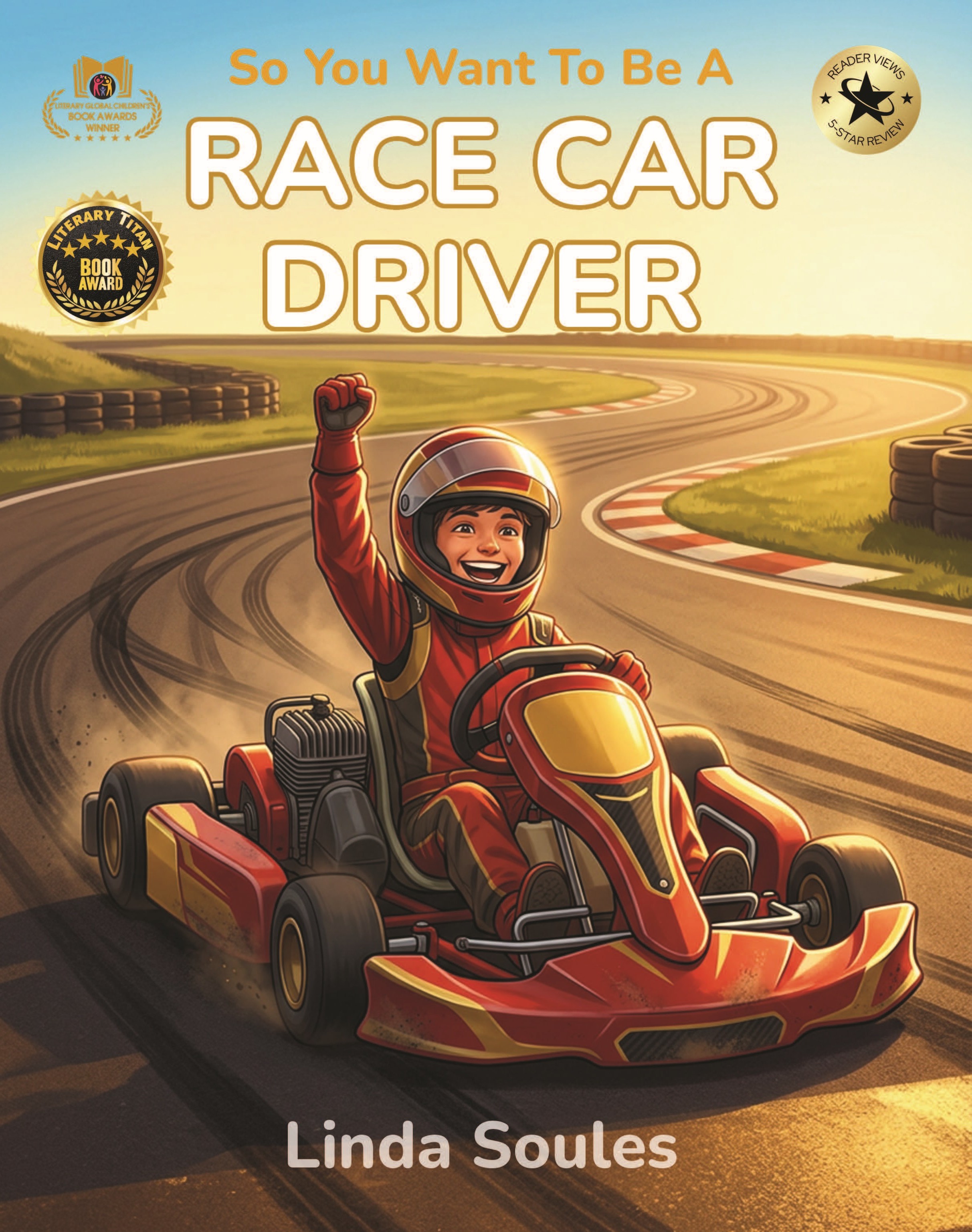
So You Want To Be A Race Car Driver cover
Children's Episodic Series

So You Want To Be A Race Car Driver

by Linda Soules · 27 pages

Logline

A curious young reader is invited to imagine life as a race car driver, learning that smooth beats aggressive, that 200 people stand behind every car, and that anyone can start training today with a bicycle and a notebook.

Synopsis

The book opens by challenging a common assumption: racing is not about going fast in a straight line but about going fast around corners. Drivers memorize every corner, brake within one meter at 200 miles per hour, and succeed by being smooth rather than aggressive. The central principle, "smooth is fast," recurs throughout the book. Next it explains what the job involves. The driver is the visible tip of an iceberg with more than 200 people beneath it, including engineers, mechanics, strategists, and a pit crew that changes four tires in under two seconds. The book surveys the different worlds of Formula One, NASCAR, and drag racing, and describes the tools of the trade: the lightweight car, the control-panel steering wheel, the fireproof suit, the helmet and HANS device, and the carbon-fiber survival cell. A sample race-weekend day shows simulator work, engineering briefings, practice sessions, and long debriefs. The middle sections cover the rewards and the difficulties. The joys are total focus, the puzzle of strategy, and the thrill of winning. The hardships are danger, fear management, crushing g-forces, brutal heat, drivers losing five to ten pounds per race, and heartbreaking mechanical failures that are not the driver's fault. The book also stresses the qualities that matter, including focus, calculated courage, stamina, technical curiosity, and adaptability, and it explains how racing innovations such as disc brakes and crumple zones made ordinary cars safer. The book then profiles Ayrton Senna, Danica Patrick, and Lewis Hamilton as examples of brilliance, barrier-breaking, and perseverance. It adds fun facts and a glossary of terms such as apex, downforce, telemetry, and understeer. A "Could This Be Your Job?" section asks four questions that make anyone faster: where am I losing time, what is the smoothest path, what does the data say, and what will I try differently? The ending is an invitation to act. Readers are encouraged to start this weekend by finding the racing line on a bicycle, practicing braking points, timing a friend's laps, trying go-karts or sim racing, and keeping a race notebook. A final resource list of books, websites, and organizations such as the SCCA, STEM Racing, and the Soap Box Derby closes on the line, "Smooth is fast... Go find your line."

AI Pitch Package

For producers, scouts & managers

Logline

Eager rookie go-kart racer Mia wants to win every race by driving flat-out, but her kid-sized pit crew teaches her that smooth is fast, and that no driver ever wins alone.

Short synopsis

Based on Linda Soules' nonfiction picture book, this animated series follows Mia, a speed-obsessed rookie at a junior karting club, and her team of young specialists: an engineer, a strategist, a mechanic, and a tire-change prodigy. Each episode takes one idea from the book (braking points, the racing line, telemetry, fear management, heat and fatigue, the pit stop) and turns it into a race-weekend problem Mia can't solve by going faster. She has to get smoother, read the data, and trust her crew. Real-world racing icons appear as inspirational touchstones. Every episode ends with a bike-and-notebook challenge viewers can try at home. The season builds to a championship finale where smooth beats aggressive.

Extended synopsis
Soules' book is a 27-page nonfiction career guide with no built-in characters or plot, so the adaptation needs an original framework. We invent one that stays faithful to the book's thesis. Mia is a fast, impatient 9-year-old who joins the Apex Karting Club believing racing means holding the throttle down. In the pilot, she loses to a quieter rival who brakes later and corners cleaner, which sets up the book's opening reversal: racing is about going fast around corners, not in straight lines. The core ensemble is Mia's crew, a kid-scale version of the book's "200 people beneath the iceberg." It includes a data-obsessed engineer, a calm strategist, a mechanic who treats the kart like a patient, and a pit-crew kid who counts everything in tenths of a second. Episodes follow the book's chapters. One covers memorizing every corner and braking within a meter. Another covers a race-weekend schedule of simulator, briefing, practice, and debrief. Others cover the gear (suit, helmet, HANS, survival cell), the heat-and-fatigue episode, and a mechanical-failure episode that is not Mia's fault. That last one is the emotional core of the season. The book's inspirational material becomes a recurring segment. Brief, respectful profiles of Ayrton Senna, Danica Patrick, and Lewis Hamilton cover brilliance, barrier-breaking, and perseverance. The "how racing made your family car safer" material (disc brakes, crumple zones) works as a short explainer interstitial. The glossary terms (apex, downforce, telemetry, understeer) become the vocabulary of each episode's problem and its solution. Every episode closes with the book's four questions: where am I losing time, what is the smoothest path, what does the data say, and what will I try differently. A live-action tag follows, with real kids finding a racing line on a bike, timing a friend's laps, or keeping a race notebook, which carries the book's "start this weekend" ending. The season finale is a championship race where Mia wins by being smooth and trusting her crew, closing on the book's line: "Smooth is fast... Go find your line."
Why it adapts
The book's visuals are strong. Car-racing setpieces are inherently cinematic: a kart braking within a meter at speed, a four-tire pit stop in under two seconds shown as a slow-motion team ballet, a view inside the carbon-fiber survival cell, and a split-screen of telemetry traces against the racing line. The 'iceberg' image of the visible driver and the 200 unseen people underneath is a ready-made title card and a poster-ready concept. Animation can show g-forces, heat, and fear management as visualized internal states, which live action can't do for this age group. The book gives us a thesis rather than characters, which is both the opportunity and the risk. 'Smooth is fast' is a counterintuitive, repeatable hook that gives every episode a built-in reversal: the impulsive instinct fails and the patient one wins. An ensemble crew of kid specialists turns the 'it takes a team' message into recurring, distinctive characters. Mia is original to the adaptation, so the rights picture is clean for the core cast. Marketability is strong. Racing has momentum with new family audiences, the 'Go find your line' tagline is merchandise-ready, and the live-action tag gives partners a natural tie-in (SCCA, STEM Racing, Soap Box Derby, go-kart venues, sim-racing hardware). Two caveats for producers: the Senna, Patrick, and Hamilton profiles involve real people and will need likeness clearances or a stylized, factual treatment (Senna's death needs especially careful handling for this age group), and F1 and NASCAR branding will need licensing or generic stand-ins.
Format recommendation
Episodic Series

The book is a modular, concept-per-chapter guide with no single narrative arc, which suits a repeatable 11-minute or 22-minute episode structure and not a feature. Each section (braking, pit crew, gear, fear, heat, strategy) is a self-contained lesson that can anchor an episode. A series also supports the at-home challenge tag and lets the 'smooth is fast' idea recur as a franchise hook.

Comp titles
Hot Wheels Let's Race (Netflix, 2024)
Proves current kid-audience appetite for racing-themed animated series and shows the genre's commercial reach, though it is pure spectacle where this project is skills-based.
Ada Twist, Scientist (Netflix, 2021)
A curious-kid-solves-a-problem structure with a STEM method built into every episode, which matches this project's four-question framework.
Bluey (2018–present)
Sets the bar for co-viewing, with emotional intelligence and real-world kid activities that parents enjoy as much as children.
Formula 1: Drive to Survive (Netflix, 2019–present)
Drove the recent surge of new, younger, and family F1 fans. This is the parent-facing comp and a source of the insider texture on strategy, pit crews, and data.
Cars on the Road (Disney+, 2022)
Shows that racing-adjacent animation keeps franchise value with young audiences. This project differs by being grounded in real driving skills and real careers.
Audience

Primary: kids 5–9 who like vehicles, building, and sports, plus their co-viewing parents. Secondary: parents and older siblings who follow F1 or NASCAR through Drive to Survive, and educators who look for STEM-linked content. These households watch Bluey, Ada Twist, Scientist, Hot Wheels Let's Race, Octonauts, and Cars-franchise content. The at-home activity tag also fits PBS Kids–style educational programming.

Tone
energetic curious empowering STEM-forward teamwork-driven warm

Adaptation Readiness Score

68 / 100

Visual storytelling 78
Dialogue strength 50
Character distinctiveness 58
Hook strength 72
Format fit 66
Market timing 78
Strengths
  • Motorsport is inherently cinematic, and the book is rich in concrete visual material: a two-second four-tire pit stop, braking within one meter at 200 mph, the carbon-fiber survival cell, and a driver's race-weekend day. All of it translates directly to screen.
  • The 'smooth is fast' mantra and the 'iceberg of 200 people' image give the book a clear, repeatable thematic spine. That works well as a series through-line and a segment tag, and it gives each episode a takeaway.
  • The Senna, Hamilton, and Patrick profiles and the 'start this weekend' call to action add real-world hooks and an interactive element. Together with the strong STEM angle, that fits the current appetite for educational kids' content that inspires kids to try things.
Adaptation friction
  • The book is nonfiction and explanatory, with no protagonist, no dialogue, and no plot arc. The 'curious young reader' is a second-person stand-in, so a series needs a character built from scratch.
  • As written, the content is a survey of topics (gear, jobs, series, glossary) rather than a story. Episodes would need an engine of want, obstacle, and payoff beyond 'here's how it works.'
  • The Formula One, NASCAR, and drag-racing material and the real-driver profiles raise rights, licensing, and likeness questions, and the facts may date quickly. These affect both budget and shelf life.

More books in the directory
Listed on 2026-11-02
Back to directory